

Your baby slept through the night for two glorious months. Then, at 4 months old, it all fell apart — waking every 90 minutes, fighting naps, inconsolable at 2 AM. You did nothing differently. Nothing is wrong with your baby. You have just met your first sleep regression.
Sleep regressions are predictable, developmental, and temporary. Knowing which one you're in, why it's happening, and what actually helps turns a bewildering ordeal into something you can navigate with a plan instead of panic.
This guide walks through every major sleep regression by age — 4 months, 8–10 months, 12 months, 18 months, and 2 years — what causes each, how long it lasts, and exactly what to do (and not do) to get through it without creating new problems.

What a Sleep Regression Actually Is
A sleep regression is a period when a child who was sleeping reasonably well suddenly starts waking frequently, fighting sleep, or napping poorly — without illness or an obvious external cause.
The key insight: regressions are almost always driven by developmental progress, not problems. A brain that is busy learning to crawl, walk, talk, or understand object permanence is a brain that is harder to switch off. The "regression" in sleep is the cost of a "progression" in development.
Two practical implications:
- You did not cause it, and you cannot fully prevent it. It is wired into how children develop.
- It will pass. The job is not to "fix" your child but to hold steady so a temporary disruption does not become a permanent habit.
The Sleep Regression Timeline
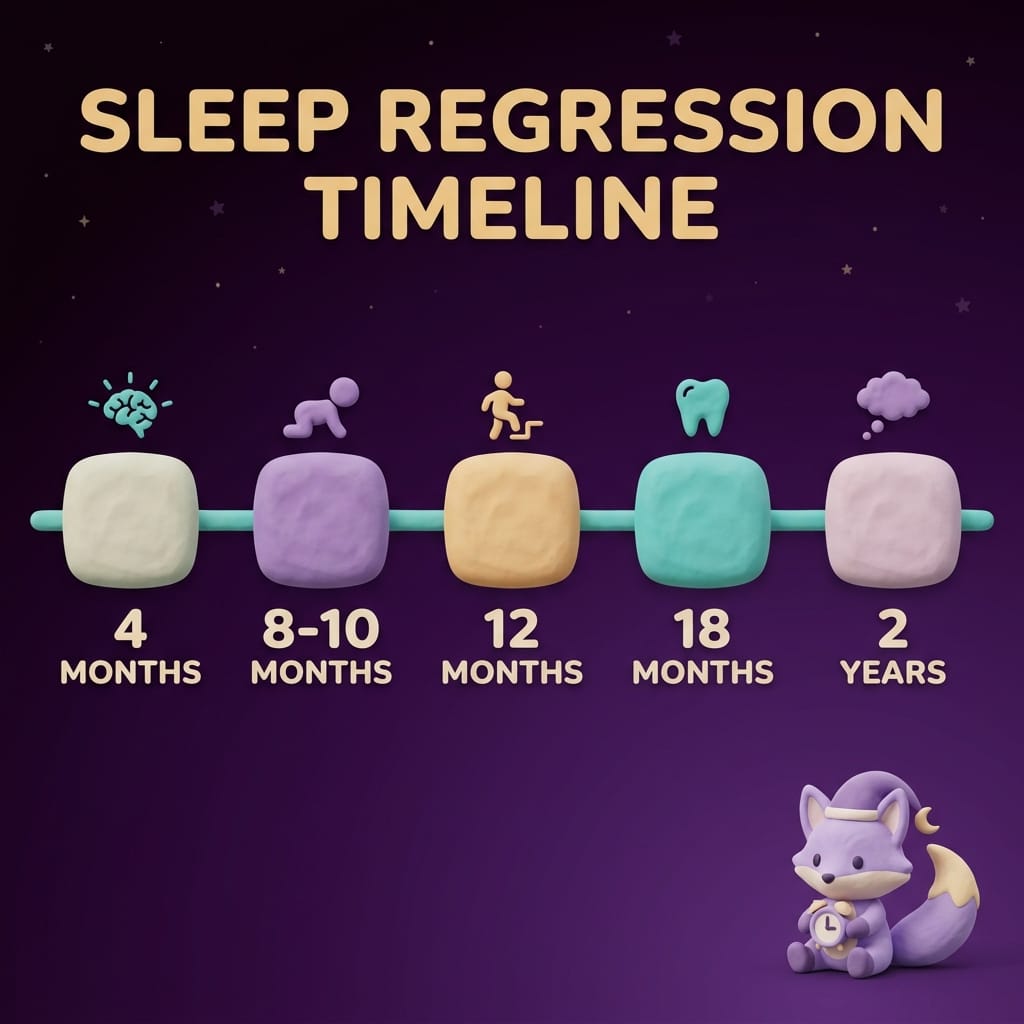
Five major regressions, by age. Timing varies by several weeks per child, and not every child gets every one.
The 4-Month Sleep Regression
What's happening: This is the only "regression" that's actually a permanent change. Around 4 months, your baby's sleep matures from newborn sleep (two simple stages) into a more adult-like architecture with distinct light, deep, and REM stages — and brief awakenings between cycles. Newborns drift back to sleep automatically; a 4-month-old briefly surfaces between cycles and has to learn to resettle.
Signs: Frequent night wakings (sometimes every 1–2 hours), short naps, fighting sleep that used to come easily, increased fussiness.
How long: The disruption typically lasts 2–6 weeks. The underlying change is permanent — this is better called a progression. Once the baby learns to link cycles, sleep improves and is more robust than newborn sleep was.
What helps most: Begin (gently) building the ability to fall asleep independently. Put the baby down drowsy but awake when you can. Keep a consistent wind-down. This is the foundational regression — how you handle it shapes the next year.
The 8–10-Month Sleep Regression
What's happening: A pile-up of development: crawling, pulling to stand, babbling, and — critically — object permanence and separation awareness. Your baby now understands that you still exist when you leave the room, which is exactly why they protest when you do.
Signs: Night wakings, standing up in the crib and not knowing how to lie back down, separation-anxiety crying at bedtime, nap resistance (often the start of the 3-to-2 nap transition).
How long: Usually 2–6 weeks.
What helps most: Lots of daytime practice of new physical skills (a baby who has practiced sitting back down all day is less stuck at 2 AM). Consistent, calm responses to separation protest. Brief, boring check-ins rather than big interventions.
The 12-Month Sleep Regression
What's happening: Often tied to walking and a surge in language, plus the 2-to-1 nap transition starting for some babies. This one is less universal — many babies skip it.
Signs: Nap refusal (especially the morning nap), bedtime resistance, shorter night sleep.
How long: Usually 2–4 weeks. Frequently it's actually a nap issue masquerading as a regression — the baby may be ready to drop from 2 naps to 1, or the schedule needs adjusting.
What helps most: Look at the nap schedule before assuming it's a pure regression. If the morning nap is pushing bedtime too late or the baby fights one nap consistently, the schedule — not the child — needs the change.
The 18-Month Sleep Regression
What's happening: The hardest one for many families. It combines a developmental leap (language explosion, growing autonomy and "no!"), separation anxiety peaking, molar teething, and the emergence of genuine bedtime opinions.
Signs: Strong bedtime resistance, new fears, repeated calling-out, early waking, tantrums at the start of the routine.
How long: Usually 2–6 weeks, sometimes longer because it overlaps with so much at once.
What helps most: Firm, kind consistency on boundaries (this is the age boundaries start mattering — see helping your child manage anger for the co-regulation framework). Rule out teething pain. Resist introducing new sleep crutches; an 18-month-old learns fast, and a "just for tonight" rescue becomes the expected default within days.
The 2-Year Sleep Regression
What's happening: Imagination comes online. A 2-year-old can now conjure a monster under the bed that did not exist in their mind six months ago. Add nap transitions (some drop the nap entirely between 2 and 4), potty training, a possible new sibling, and a move to a toddler bed, and you have a lot converging at once.
Signs: New nighttime fears, bedtime stalling, climbing out of bed, night wakings with genuine fear, early rising.
How long: Usually 3–6 weeks.
What helps most: Address the fears directly and gently (see child afraid of the dark and how to help a child with nightmares). A calm, predictable bedtime routine becomes more important than ever. This is the age where a soothing bedtime story does real work, because the disruption is partly imagination-driven and a story gives that imagination a safe place to go.
Why Regressions Cluster at These Ages
The pattern isn't random. Every major regression lines up with a developmental milestone:
- 4 months — sleep architecture matures.
- 8–10 months — object permanence + crawling/pulling up.
- 12 months — walking + language + nap transition.
- 18 months — language explosion + autonomy + molars + separation-anxiety peak.
- 2 years — imagination + fears + nap/bed transitions.
A brain in the middle of acquiring a major new skill processes that skill during sleep, which fragments it. Researchers studying infant motor development have documented that the onset of new motor skills (like crawling and walking) reliably coincides with temporary sleep disruption (Atun-Einy & Scher; Scher, 2005). The disruption is the brain consolidating the new ability. It is a feature, not a bug — which doesn't make 3 AM easier, but does make it temporary.
What to Do During Any Regression
The specifics differ by age, but the core playbook is the same for all of them.
1. Hold the routine steady
A predictable bedtime routine is the single biggest protective factor during a regression (Mindell & Williamson, 2018, Sleep Medicine Reviews). When everything else is in flux, the routine is the anchor. Same order, same time, same sequence. See bedtime routine for toddlers for a simple framework.
2. Resist new sleep crutches
This is the single most important rule. During a regression you will be desperate enough to try anything — rocking to sleep, feeding to sleep, bringing them into your bed, an extra hour of patting. Each "just for tonight" rescue teaches the child a new dependency in about 2–3 nights. Then you have two problems: the regression and a new habit that outlasts it. Comfort, yes. New permanent crutches, no.
3. Protect total sleep
An overtired child sleeps worse, not better. During a regression, move bedtime earlier (even 20–30 minutes) to offset the lost sleep. Check totals against the sleep-needs-by-age guidelines. Counterintuitive but reliable: earlier bedtime often reduces night wakings.
4. Maximize daytime skill practice
For motor-driven regressions (8–10 months, 12 months), give huge amounts of daytime floor practice for the new skill. A baby who has practiced standing up and sitting back down a hundred times during the day is far less likely to get stuck standing and screaming at 3 AM.
5. Respond calmly and boringly at night
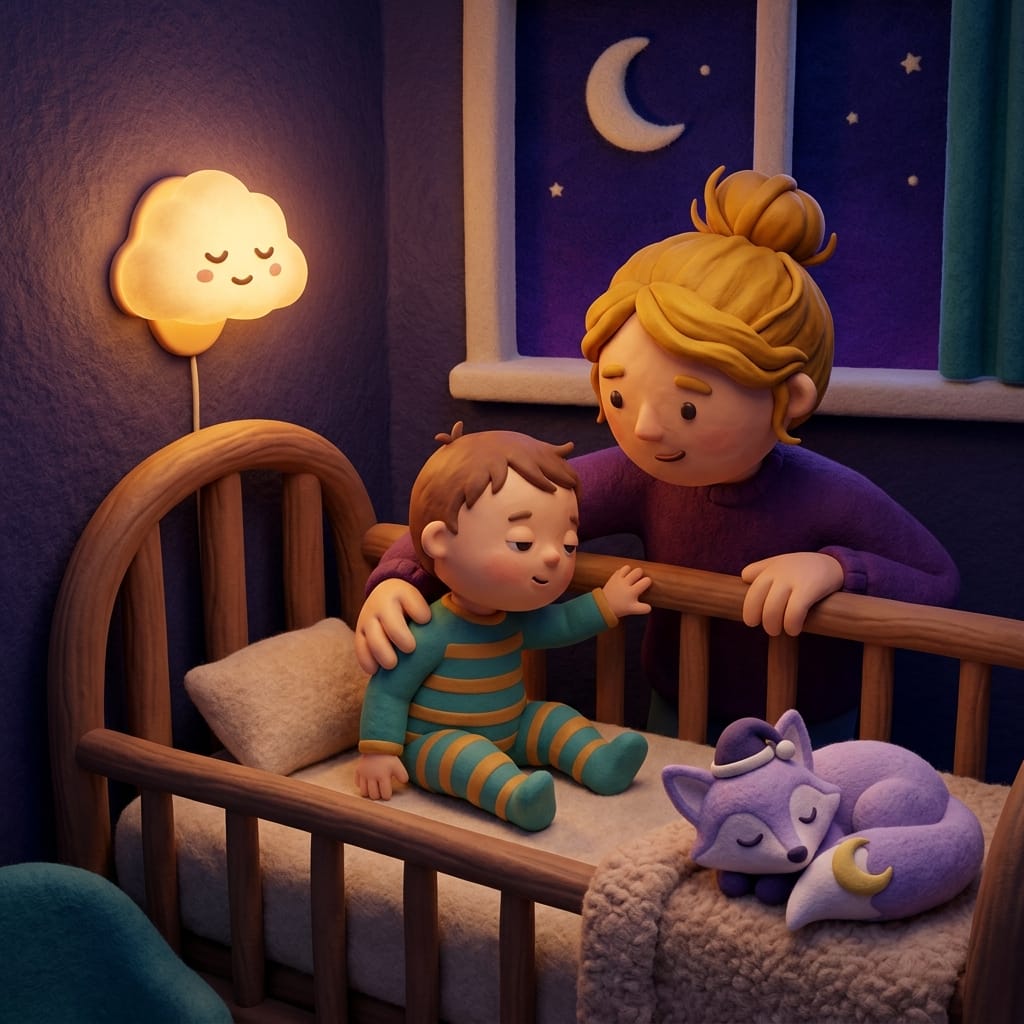
Night responses should be brief, low-stimulation, and undramatic. Dim light, quiet voice, minimal talking, a short reassurance, then back to sleep. The more exciting your night response, the more reason to wake.
6. Use a consistent sleep cue
A familiar, calm audio story or soft sound playing as you leave bridges the disruption — especially for the 18-month and 2-year regressions, which are partly anxiety- and imagination-driven. A predictable bedtime audio story gives a busy or anxious mind something steady to settle into. See bedtime stories for anxious kids for the structure that calms rather than stimulates.
What Not to Do
- Don't assume you broke something. You didn't. It's development.
- Don't overhaul everything. Changing the routine, the room, the method, and the schedule all at once makes it impossible to tell what helps.
- Don't start formal sleep training at the peak. Wait for the system to stabilize, then train if needed. Mid-regression is the worst time to add a new method.
- Don't compare to other babies. Regression intensity is enormously variable. Some babies barely notice the 4-month one; others are wrecked for a month.
- Don't abandon ship after 3 bad nights. Regressions are measured in weeks. Consistency only works if you give it long enough to work.
When It's Not a Regression
Sleep disruption isn't always developmental. Consider other causes — and a pediatrician call — if you see:
- Fever, ear-pulling, congestion, rash, or vomiting — points to illness, not a regression.
- Inconsolable crying that's different from normal protest — could be pain (ear infection, teething with fever, reflux).
- Disruption lasting more than 6 weeks with no developmental explanation.
- Snoring, gasping, or long breathing pauses during sleep — possible sleep-disordered breathing; needs evaluation.
- Loss of previously-gained skills alongside sleep changes — discuss with your pediatrician.
- Disruption with no plausible regression age and no milestone — worth a check-in.
Teething is often blamed for everything; in reality it usually causes only mild, brief disruption. A week of bad sleep "from teething" with no tooth in sight is more likely a regression or something else.

Common Questions from Parents
Does every baby go through every regression?
No. Regressions are common patterns, not universal laws. Some babies sail through the 4-month one and get hammered at 18 months; others are the reverse. A baby who skips a "scheduled" regression isn't behind or ahead — they're just an individual. Use the timeline as a map, not a prediction.
My baby is 5 months and still regressed. Did I miss the window?
No. The "4-month regression" is an average; it commonly appears anywhere from 3.5 to 5 months. The age labels on all regressions are approximate. What matters is the pattern (sudden disruption in a previously okay sleeper, lining up roughly with a developmental leap), not hitting an exact week.
Should I drop a nap during a regression?
Be careful here. A regression can look like a child is ready to drop a nap when they're not — they fight the nap because of the regression, you drop it, and now they're overtired, which makes the regression worse. As a rule, don't make permanent schedule changes during the peak of a regression. Wait until it stabilizes, then assess the nap schedule.
We sleep trained and now there's a regression. Did it not work?
Sleep training isn't permanent immunity from regressions — nothing is. A trained sleeper will still regress during developmental leaps. The difference: trained sleepers usually recover faster if you hold the method steady through the regression rather than abandoning it. Consistency is what protects the prior gains.
Is there anything that prevents regressions entirely?
No, and be skeptical of anything that promises this. Regressions are the sleep cost of brain development. What you can control is how long they last and whether they create lasting bad habits — and that comes down to consistency, protecting total sleep, and not introducing new crutches.