

If your evenings look anything like the toddler bedtime Olympics — one more cup of water, one more hug, one more trip to see if the cat is okay — you are absolutely not alone. Research shows that a third of toddlers and nearly half of preschoolers regularly stall at bedtime, and many flat-out fight it.
Here is the good news. A consistent bedtime routine is one of the most powerful and well-studied tools parents have to end bedtime battles — and it works faster than you might think. A landmark study from the Children's Hospital of Philadelphia found that families who started a simple nightly routine saw improvements in just three nights. Not three weeks. Three nights.
This guide walks you through exactly how to build a bedtime routine that works for your toddler, based on the latest sleep research and real-world advice from pediatric sleep specialists. No fluff, no gimmicks — just a clear plan you can start tonight.
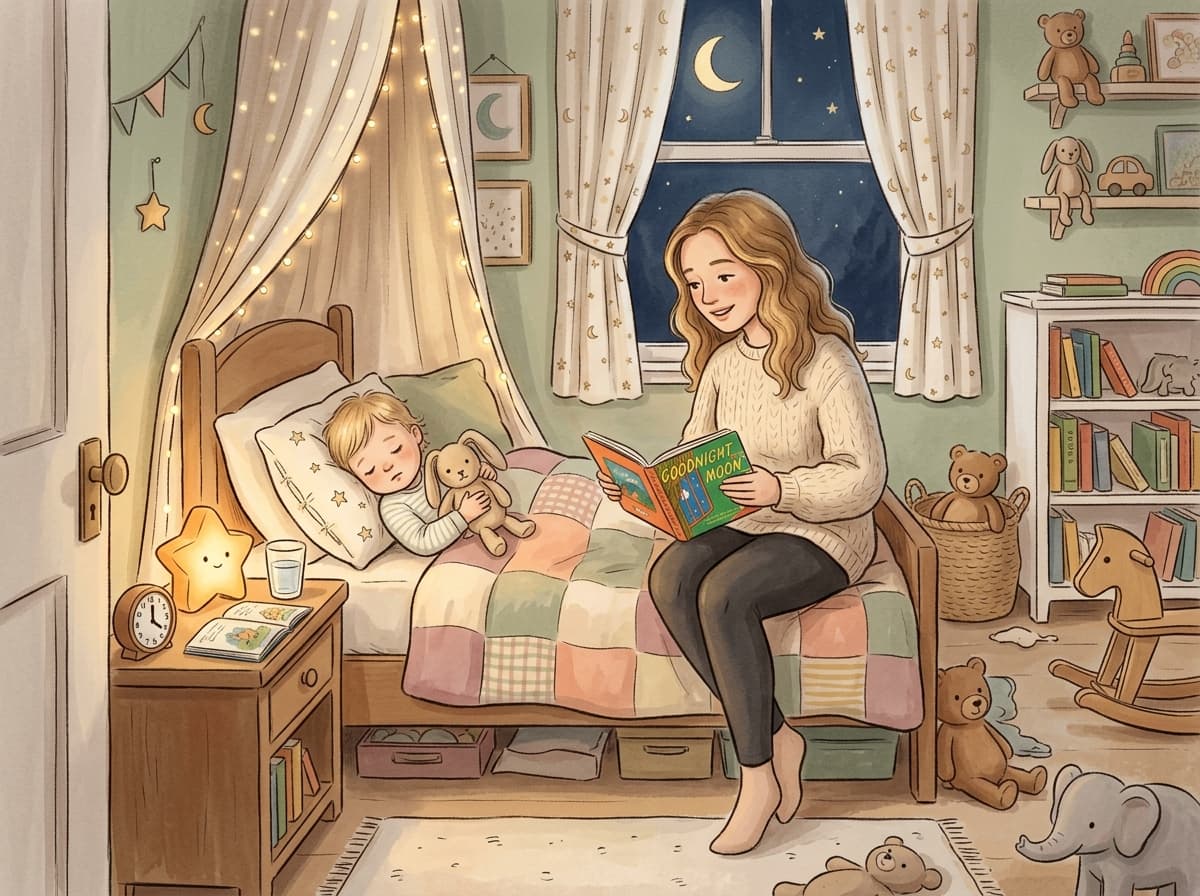
Why a Bedtime Routine Matters (More Than You Think)
A bedtime routine is not just about getting your kid to lie down. It is a signal — a series of predictable, calming steps that tell your child's brain and body: "The day is over. It is safe to let go and sleep."
A major study involving over 10,000 families across 14 countries (Mindell et al., published in the journal SLEEP, 2015) found a clear dose-dependent relationship between bedtime routines and sleep quality. In simple terms: the more consistently you do the routine, the better your child sleeps. Children who followed a bedtime routine every night slept over an hour longer than children who never had one.
That is not a typo. One hour more sleep, every single night, just from having a predictable routine.
But it goes beyond sleep. A 2018 review in Sleep Medicine Reviews found that bedtime routines are linked to:
- Better language development and literacy — children who are read to before bed at age 3 show stronger vocabulary and reading skills at age 5.
- Improved emotional regulation — the predictability of a routine helps toddlers process the feelings from their day.
- Stronger parent-child attachment — bedtime is often the only one-on-one time parents have with their child, and that focused connection matters.
- Reduced daytime behavior problems — well-rested children are calmer, more focused, and less prone to meltdowns.
Lead researcher Dr. Jodi Mindell put it simply: "Creating a bedtime routine for a child is a simple step that every family can do. It can pay off to not only make bedtime easier, but also that a child is likely to sleep better throughout the entire night."
Before the Routine: Setting Yourself Up for Success
A great bedtime routine does not start when you say "time for bed." It starts about an hour earlier, when you begin shifting the energy of your home from active to calm. Think of it as a slow dimmer switch, not a sudden off-button.
Dim the Lights
This is not optional — it is biology. Bright light suppresses melatonin, the hormone that makes your child feel sleepy. Research from the University of Colorado found that even typical room lighting can suppress melatonin production in preschoolers by up to 90%. Start dimming the lights in your home about 30-60 minutes before your child's bedtime.
Turn Off Screens
The American Academy of Pediatrics recommends no screen time for at least one hour before bed. Research published in JAMA Pediatrics (2024) confirmed that removing screens in the hour before bedtime improves sleep efficiency in toddlers. Interactive screen use — games, apps, swiping — is especially disruptive because it stimulates rather than calms the nervous system.
If your child is used to watching something before bed, the transition might take a few days. Replace screen time with quiet activities: drawing, blocks, puzzles, or simply playing on the floor together.
Watch the Clock
Timing matters. Most toddlers do best with a bedtime between 7:00 and 8:00 PM, but the right time for your child depends on their age, nap schedule, and how long they have been awake since their last nap. Here is a general guide:
| Age | Wake window before bed | Typical bedtime |
|---|---|---|
| 12-18 months | 4-5 hours | 6:30-7:30 PM |
| 18-24 months | 5-5.5 hours | 7:00-7:30 PM |
| 2-3 years | 5.5-6 hours | 7:00-8:00 PM |
| 3-5 years (no nap) | 6-7 hours | 7:00-7:30 PM |
| 3-5 years (with nap) | 5-6 hours | 7:30-8:00 PM |
If your child is consistently fighting bedtime, the first thing to check is whether bedtime is actually aligned with their body clock. A child who is not tired enough will resist sleep no matter how perfect your routine is.
Get tonight's bedtime in 10 seconds. The free bedtime calculator takes your child's age, wake time, and nap status and gives you a precise bedtime plus a short personalized story for tonight — starring your child, by name.
The 5-Step Bedtime Routine (That Actually Works)
After reviewing the research and the most successful approaches used by pediatric sleep consultants, here is a bedtime routine framework that works for most families. The whole routine should take about 20-30 minutes.
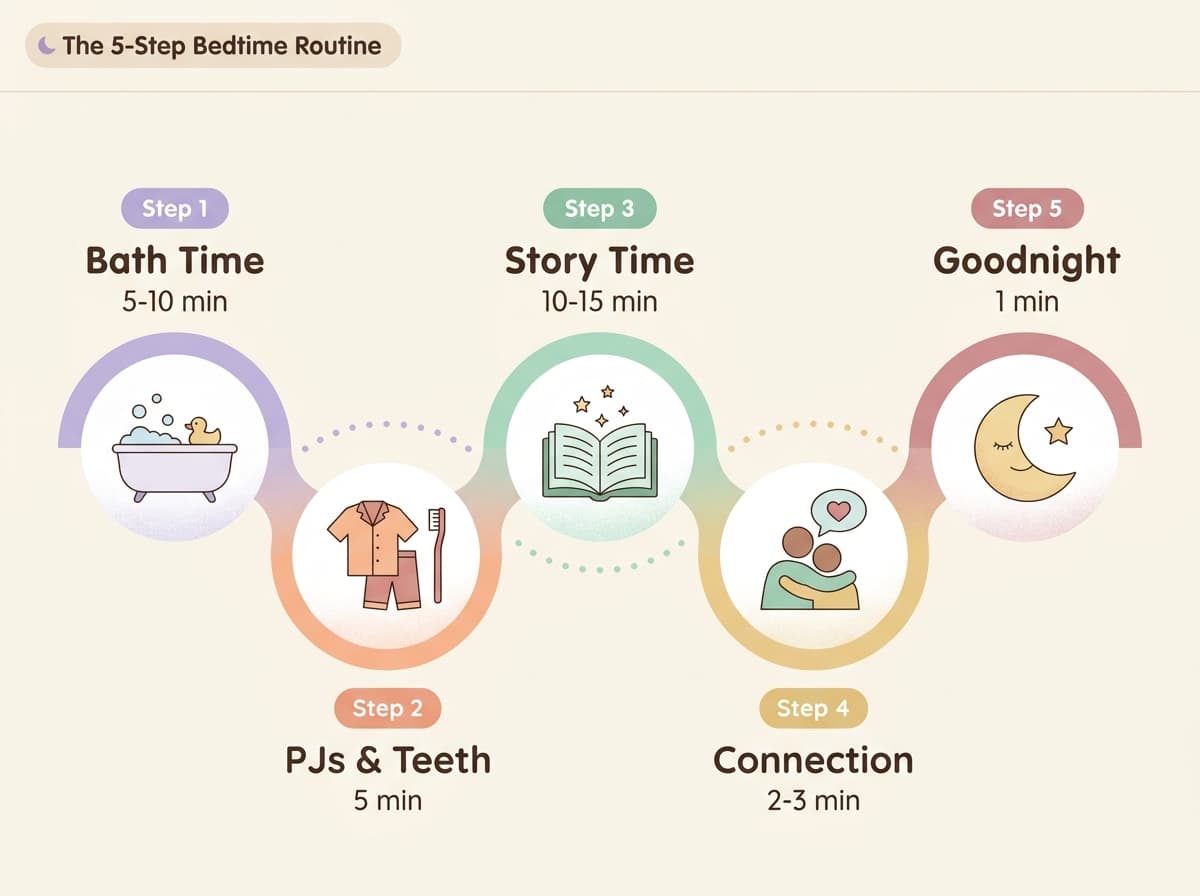
Step 1: Bath Time (5-10 minutes)
A warm bath is more than just hygiene — it is a physiological sleep trigger. When your child gets out of a warm bath, their body temperature drops slightly, which mimics the natural temperature drop that happens as we fall asleep. This signals to the brain that it is time to wind down.
You do not need a bath every single night. On skip nights, you can replace it with washing face and hands or a warm washcloth wipe-down. The point is the transition: we are leaving the active part of the day behind.
Tip: Keep bath time calm. This is not the time for splash wars or exciting bath toys. Think warm water, dim light, quiet voices.
Step 2: Pajamas and Teeth (5 minutes)
This is a great opportunity to give your toddler a sense of control — something that dramatically reduces bedtime resistance. Let them choose between two sets of pajamas. Let them squeeze their own toothpaste (with help). These small choices satisfy their need for independence without giving them power over whether bedtime happens.
For toddlers older than 2, a visual bedtime routine chart on the wall can work wonders. Each step has a picture, and your child gets to check them off or move a magnet as they complete each one. The chart becomes the "boss" — not you — which takes the pressure off both of you.
Step 3: Story Time — The Heart of the Routine (10-15 minutes)
If there is one part of the bedtime routine that research highlights as the most impactful, it is this one. Reading or listening to a story before bed is not just comforting — it is a conditioned sleep cue.
Dr. Janet Kennedy, a clinical psychologist and sleep specialist who developed the Sleep Disorders Treatment Program at the Manhattan Veterans Affairs Medical Center, explains it this way: because bedtime reading happens when a child is already tired and relaxed, the brain begins to associate the act of listening to a story with the feeling of sleepiness. Over time, this association strengthens. The story itself starts to trigger drowsiness — like a gentle, natural off-switch.
How to make story time work for sleep:
- Set a clear limit. "We are reading two books tonight" or "We are listening to one story." State it before you start, and hold the boundary gently but firmly.
- Choose calming content. Avoid stories with lots of action, suspense, or scary elements right before bed. Look for gentle narratives, repetitive language, and soothing themes.
- Keep your voice low and slow. The rhythm of your voice is part of the sleep cue. Let it get quieter as the story progresses.
- Consider audio stories. On nights when you are exhausted, or when your child is learning to fall asleep independently, audio stories with a calm narrator and gentle background music can be incredibly effective. They give your child something to focus on as they drift off — something that is not a screen. Explore free bedtime stories on DreamLoo — each one is narrated in a soothing voice designed specifically to help kids relax and fall asleep.
For a deeper dive into why this works, read our article on why bedtime stories help kids sleep better.
Step 4: Connection Time (2-3 minutes)
This is the step most bedtime advice skips, but many families say it made the biggest difference.
Before you say goodnight, spend a couple of minutes having a quiet, warm conversation. You can talk about the best part of the day, name three things you are grateful for together, or simply say something like: "I loved playing with you today. Tomorrow we are going to the park."
For younger toddlers, this might be as simple as naming the people who love them: "Mama loves you, Daddy loves you, Grandma loves you..." while cuddling or gently rubbing their back.
This connection time serves two purposes. First, it fills your child's emotional cup — a child who feels securely connected to you is far less likely to call you back for "one more hug." Second, it gives your child something warm to think about as they drift off, instead of worrying about the dark or being alone.
Step 5: Goodnight and Lights Out
Keep the goodbye short and consistent. Say the same thing every night — "Goodnight, I love you, see you in the morning" — and leave. Predictability is calming. Your child knows exactly what comes next (sleep) because the same words happen every time.
If your child uses a comfort object — a stuffed animal, a special blanket — make sure it is there. Comfort objects are not a crutch. They are a healthy self-soothing tool that helps your child manage the separation of sleep.
Leave while your child is drowsy but still awake. This is one of the most important principles in pediatric sleep science. A child who falls asleep independently (not while being held, rocked, or with you lying next to them) is far less likely to wake up and need you in the middle of the night. When they stir between sleep cycles — which every child does — they can resettle themselves because the conditions are the same as when they fell asleep.
Common Mistakes That Sabotage Bedtime
Even with a solid routine, a few common missteps can undermine your efforts.
Starting too late
By the time most parents start the bedtime routine, their child is already overtired. An overtired toddler becomes hyperactive, clingy, and emotionally volatile — which looks a lot like "not tired." Start the routine earlier than you think you need to, especially if your child has been struggling.
Inconsistency
The research is clear: the more nights you follow the routine, the better the results. A routine that happens three nights a week is good. Every night is significantly better. Try to follow the same sequence even on weekends, holidays, and when traveling. The more predictable it is, the more powerful the sleep cue becomes.
Giving in to "one more"
Toddlers are gifted negotiators. One more book, one more song, one more sip of water — each "one more" teaches your child that bedtime is negotiable. Set the expectations before the routine starts ("Tonight we have two books"), and then hold the line with warmth: "I know you want another one. We will read more tomorrow. It is time to sleep now."
Too much activity before bed
Roughhousing, tickle fights, and chase games are wonderful during the day — and terrible in the hour before bed. Active play raises cortisol and adrenaline, which directly work against melatonin and sleepiness. Save the active play for the afternoon.
Adjusting the Routine by Age
While the core structure stays the same, the details should evolve with your child.
12-18 months
At this age, the routine can be very simple: bath, pajamas, one short book (or a short audio story), cuddle, and bed. Keep it under 20 minutes. Toddlers in this age group cannot yet make many choices, so the routine is almost entirely parent-led.
18 months to 3 years
This is the peak of "NO!" and bedtime resistance. Give your child controlled choices (which pajamas, which book) to satisfy their need for autonomy. A visual routine chart is particularly powerful at this age because it shifts the authority from you to the chart. If your child stalls, you can point to the chart: "Look, what comes next? Teeth! Let us go brush teeth."
3-5 years
Older toddlers and preschoolers can be much more involved in the routine. They can brush their own teeth (with supervision), choose their own pajamas, and even "read" the pictures in a book back to you. This is also the age when children start having more complex fears — fear of the dark, fear of monsters, worry about being alone. The connection time (Step 4) becomes especially important here. A nightlight and a comfort object can help, and so can a brief, reassuring audio story that gives their imagination something gentle to focus on instead of fears.
When the Routine Is Not Working
You have been consistent for two weeks and nothing has changed. What now?
First, revisit the timing. The number one reason toddlers fight bedtime is that bedtime is not aligned with their body clock. If your 2-year-old is still napping until 4:00 PM and you are trying to get them down at 7:00, you are working against biology. Try adjusting the nap or pushing bedtime slightly later.
Second, evaluate the sleep environment. The room should be dark (blackout curtains make a real difference), cool (between 65-72°F / 18-22°C), and quiet (or with consistent white noise).
Third, consider whether something else is going on — teething, ear infections, a new sibling, starting daycare, a recent move. Life transitions often cause temporary sleep disruptions, and your child may need extra patience and connection during those periods.
If sleep problems persist beyond a few weeks, it is worth talking to your pediatrician. Chronic sleep issues can sometimes point to underlying conditions like sleep apnea, restless leg syndrome, or anxiety — all of which are treatable.
A Quick-Reference Routine Chart
Here is a simple version you can print or save:
30-60 minutes before bedtime: Dim lights. Turn off screens. Quiet play.
Bedtime routine (20-30 minutes):
- Bath — warm, calm, 5-10 minutes
- Pajamas + Teeth — let them choose, 5 minutes
- Story Time — 1-2 books or one audio story, 10-15 minutes
- Connection — talk about the day, say who loves them, 2-3 minutes
- Goodnight — same words every night, leave while drowsy
That is it. Five steps, every night, in the same order.