

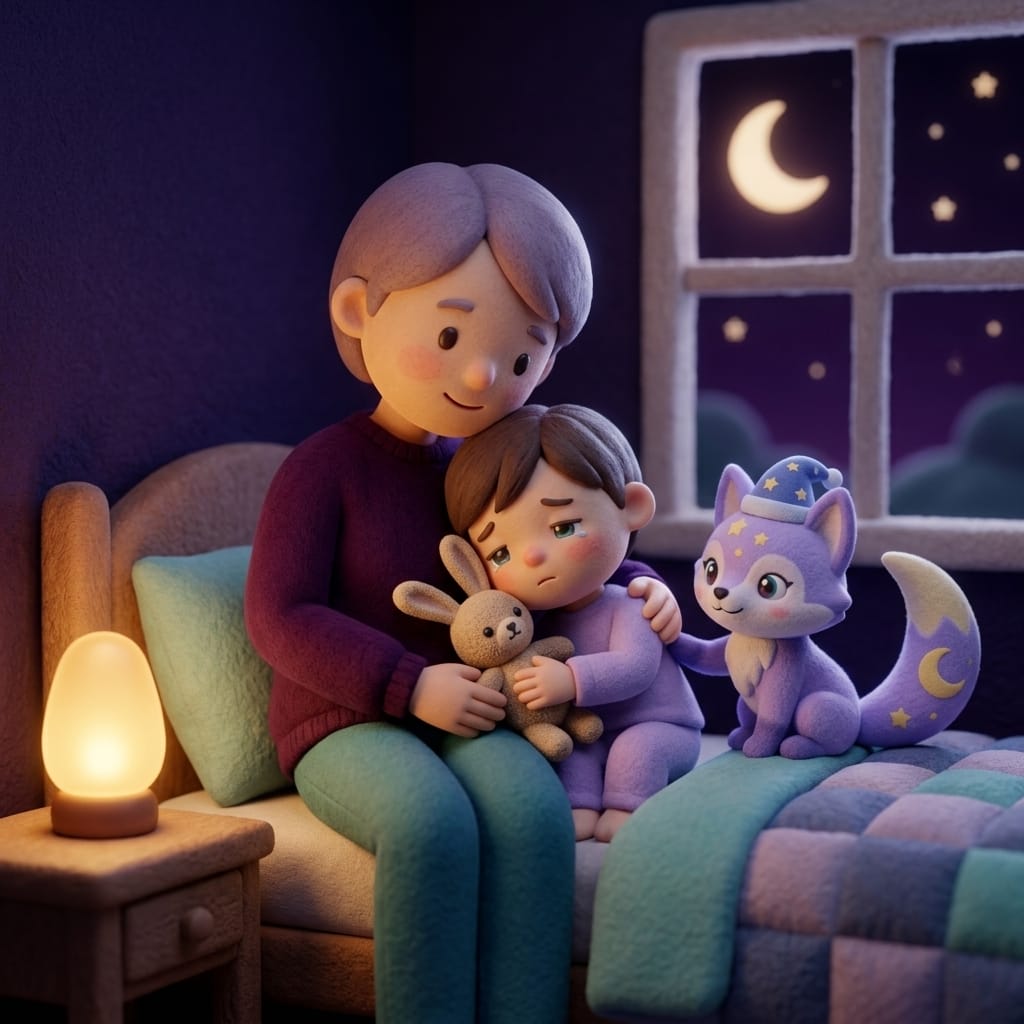
Your 5-year-old comes into your room at 3:47 AM crying. There was a wolf in their closet. They know it is gone now but they do not want to go back to their own bed. You are half-awake, they are fully awake, and in 90 minutes you will need to start the day. What do you do?
The answer to that question — and the deeper question of how to actually reduce how often this happens — has been studied more carefully than most parents realize. Nightmares affect somewhere between 10% and 50% of children aged 3 to 6 frequently enough for parents to notice (Schredl et al., 2009, Sleep and Hypnosis). They are a normal developmental phenomenon, but they are also genuinely distressing for kids and parents, and the way you respond tonight shapes how easily the pattern breaks.
This guide covers exactly what to do in the moment, how to respond during the day, what reduces nightmares over time, and the specific cases where a pediatrician should be involved. (If you're not sure whether what you witnessed was a nightmare or a night terror, start with our nightmares vs night terrors guide — the two require opposite responses.)
First, Make Sure It's a Nightmare
If your child:
- Woke up and remembers the dream — it's a nightmare.
- Appeared awake with open eyes but was unresponsive to you, and will remember nothing in the morning — it was a night terror. The response is very different; see the full comparison.
This guide covers nightmares — the kind where your child actually woke up, is aware, and needs your help resettling.
The In-the-Moment Response: What to Do at 3 AM
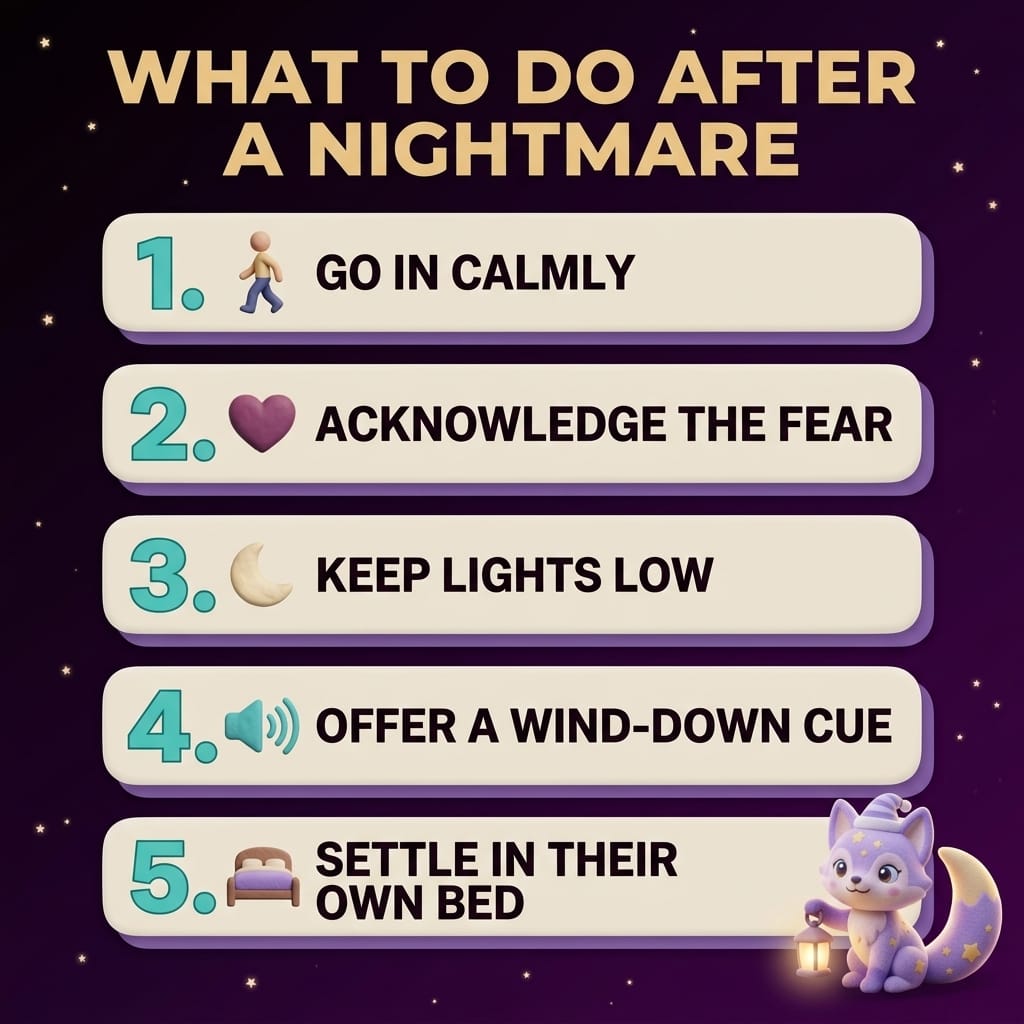
The structure of a good nightmare response is the same every time. Five steps, in order.
Step 1: Go in calmly
Your own nervous system sets the tone for your child's. A panicked parent produces a more anxious child. Before you speak, take one slow breath. Lower your shoulders. Soften your face. This is not an act — tired children read micro-tension in adults very quickly.
Step 2: Acknowledge the fear, don't dismiss it
Don't say: "It was just a dream. Go back to sleep." Dismissal makes the fear feel invisible, which makes it more likely to return.
Do say: "That sounds really scary. I'm here. You're safe." You can be honest that the dream isn't happening anymore without telling them their fear wasn't real.
This is called affect labeling in research — putting words to a feeling measurably reduces activity in the amygdala (the brain's alarm system) and increases activity in the prefrontal cortex (Lieberman et al., 2007, Psychological Science). Naming the fear helps the brain calm down.
Step 3: Keep lights low
Don't flip on a bright overhead light. A soft nightlight or lamp is plenty. Bright light resets the sleep system and makes it harder to settle again. If the room is too dark for your child's comfort after a nightmare, a small warm nightlight is worth having permanently.
Step 4: Offer a wind-down cue
Silence can feel too loud after a nightmare — the child's brain is still activated. A calming audio story, a gentle lullaby, or your soft voice narrating a simple, safe scene (a forest path, a sleepy kitten, a kind star watching over them) all work. A pre-recorded calm bedtime audio story is especially useful because it provides a consistent, familiar voice without you having to improvise at 3 AM.
Step 5: Settle them in their own bed
Whenever possible, help them resettle in their own room. Sit next to the bed for a few minutes. Lay a hand on their back. Stay until their breathing slows. Then quietly leave.
If they absolutely cannot resettle and it is 3 AM, one night in your bed is fine. But avoid making co-sleeping the default response — repeated every night, it can inadvertently train the brain to treat nightmares as a ticket into your bed, which often increases how often they happen.
What NOT to Do (Even Though It's Tempting)
A few instincts that feel right but often backfire.
- Don't interrogate the dream. Asking "what was the monster doing? what did it look like?" rehearses and reinforces the scary content. Let the child share a detail or two if they want, then gently move on.
- Don't promise it won't happen again. You can't keep that promise, and kids remember. Say "I'm here tonight" instead.
- Don't rely on "it's just a bad dream" dismissal. See above — this reads as invalidation.
- Don't check the closet or under the bed in a big, dramatic way. For some kids this is grounding. For many, it signals "yes, monsters are a real possibility worth inspecting for," which deepens the anxiety. Quiet, low-key reassurance is usually better.
- Don't bring it up repeatedly the next day. Acknowledging once is enough. Bringing it up over and over keeps the emotional charge alive.
The Daytime Work: How to Actually Reduce Nightmares
Responding well at 3 AM helps. But the real work of reducing how often nightmares happen is done during the day. Three levers matter most.
Lever 1: Sleep enough
Single biggest factor. Overtired children have more fragmented sleep cycles, which means more frequent partial arousals, which means more remembered dreams and more nightmares. Before trying anything fancy, check your child's total hours against the sleep-needs-by-age recommendations. If they are an hour short, closing that gap alone often drops nightmare frequency meaningfully.
Lever 2: Audit the pre-bed hour
Most nightmares trace back to something seen or experienced in the final waking hour. Strong candidates:
- Screens and content. Even a "kids" show with mild tension can seed nightmare content in a sensitive child. AAP recommends no screens for at least one hour before bed. See our full guide on screen time before bed.
- Loud or stressful environments. An argument, an unexpected scary sound, a heated conversation overheard.
- Exciting play too late. Tickle fights and wild games right before bed leave the brain too activated for smooth sleep.
- Scary content anywhere in the day, really — a shocking book, a scene from an adult's TV that wasn't meant for them, an overheard conversation.
The fix is simple in concept, harder in practice: protect the pre-bed hour. Calm play, a bath, a predictable bedtime routine. See bedtime routine for toddlers.
Lever 3: Process what's actually bothering them
Recurring nightmares are almost always about something. Not always literal — a 4-year-old who is anxious about a new sibling may dream about being chased by a whale, not about the baby. But there is usually a theme.
Ways to help them process daytime:
- One short, calm conversation during the day. "I remember you had a scary dream. Are there things that feel big to you right now?" Let them answer. Don't push.
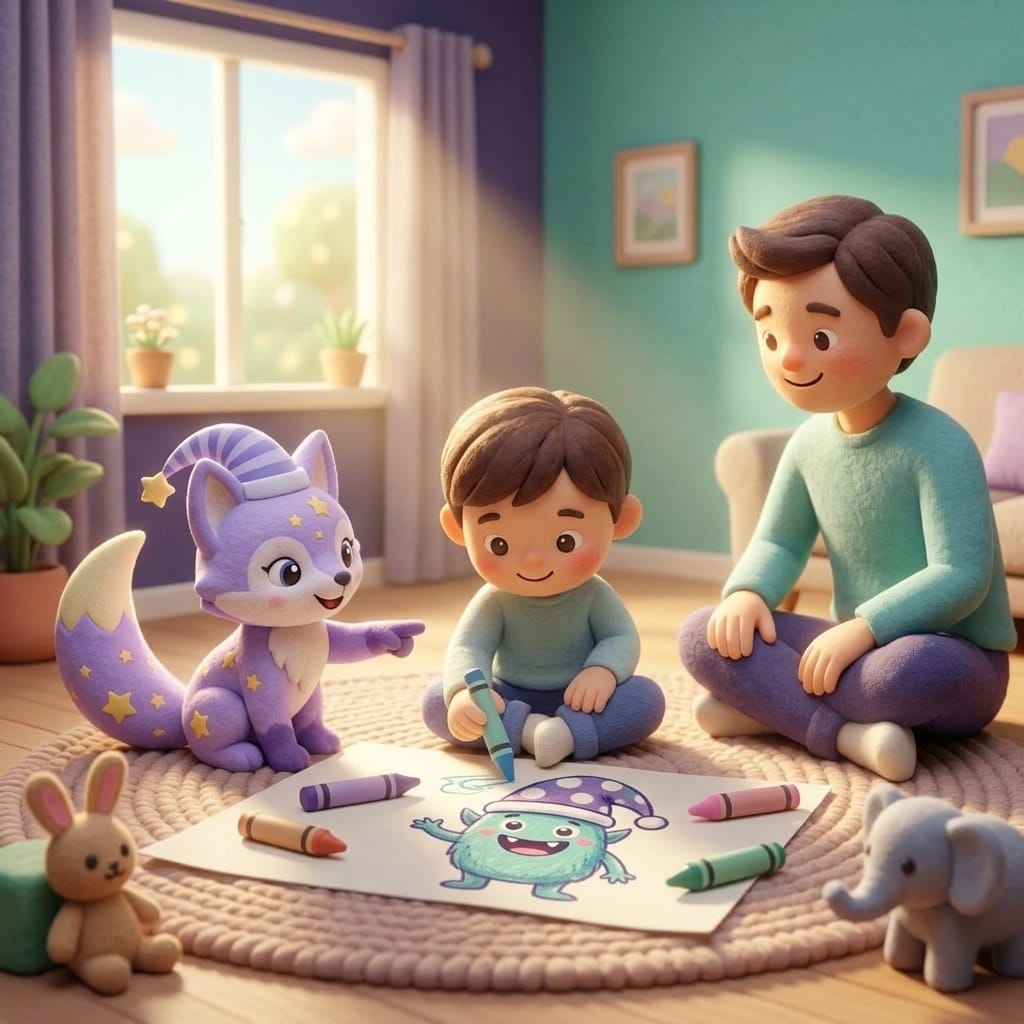
- Drawing the nightmare. Hand them paper and crayons, ask them to draw the scary thing from the dream. Then ask them to draw what would make it friendlier — a silly hat on the monster, a soft blanket around the wolf, a tiny rainbow above the scary cave. Redirection through drawing is surprisingly powerful for young kids.
- A bedtime story that addresses the theme. If your child is dealing with a specific fear, a gentle story where a character like them faces and resolves that fear helps the brain rehearse a different outcome. This concept — bibliotherapy — has real research support. Personalized stories do this especially well; see personalized bedtime stories for kids.
- Talking about big feelings more broadly. Many recurring nightmares trace back to emotions the child hasn't had space to name. Our guide on helping your child manage anger covers the general framework.
Imagery Rehearsal: The Research-Backed Technique for Recurring Nightmares
For children whose nightmares keep coming back — same monster, same chase, same scenario — there is a specific evidence-based technique worth knowing: Imagery Rehearsal Therapy (IRT).
Originally developed for adults with post-traumatic nightmares, IRT has been adapted for children in multiple clinical studies (Simard & Nielsen, 2009; Krakow, 2004) and works well. The idea is simple: during the day, when the child is calm, have them rewrite the nightmare's ending.
The process, roughly:
- During the day, ask your child to tell you about the recurring nightmare.
- Acknowledge the feeling. "That sounds really scary."
- Ask them to imagine a different ending. Not forcing it — offering the possibility. "What if instead of the wolf getting closer, a tiny lion showed up and told the wolf it was time to go home?" Let them generate the alternate ending themselves when they can. Younger kids may need you to offer options.
- Let them "practice" the new ending. Tell the new version once or twice. Some kids want to draw it. Some want to act it out with toys.
- Repeat over several days. The brain genuinely updates the mental script.
IRT typically reduces nightmare frequency within 1–4 weeks in children who have recurring themes. It does not work for every child or every nightmare, but the downside is essentially zero.
The Anxiety Connection
Occasional nightmares are a normal part of childhood. A cluster of nightmares — suddenly frequent, or consistently intense — often reflects something bigger going on during the day.
Common daytime drivers of increased nightmares:
- A big life change. New sibling, moving house, starting a new school, a parent traveling for work.
- Social stress. A friendship difficulty, a worry about fitting in, a conflict with a teacher.
- A loss. A grandparent, a pet, even a favorite object that went missing.
- An exposure to something scary. A news story overheard, a scary show, a real-world incident (a friend got hurt, a scary encounter with a dog).
- General anxiety rising for no single reason. Some kids are more prone to it, and stress accumulates quietly until it shows up at night.
If nightmares have ramped up over the past few weeks and you can't identify why, ask gently during a calm moment: "Is there something you've been thinking about a lot lately?" You may get a direct answer, or you may get a seemingly unrelated one that actually points to the source.
When to Call the Pediatrician
Most nightmares are developmentally normal and fade without intervention. Reach out to your pediatrician or a child therapist if any of the following apply:
- Frequency. Nightmares occur multiple times a week for more than a month.
- Intensity. Nightmares are severe enough that your child dreads bedtime, refuses to sleep alone, or cries for extended periods afterward.
- Daytime impact. Mood, behavior at school, appetite, or focus have meaningfully changed.
- Sleep refusal. Your child is trying to avoid sleep altogether because of fear.
- Post-traumatic pattern. Nightmares began or intensified after a known stressful event and include replay of that event.
- Other sleep symptoms. Loud snoring, breathing pauses, bedwetting that was previously resolved, excessive daytime sleepiness.
For children with trauma-linked nightmares, there are specialized treatment approaches (including trauma-focused CBT) that work well. Asking for help is a strength, not a failure.

Common Questions from Parents
My child wants to sleep with a light on after a nightmare. Should I allow it?
Yes, especially for a few weeks after a bad dream or during an anxious phase. Use a warm, dim nightlight (not a bright overhead or bright-white nightlight — these can interfere with melatonin). Over time, many children wean themselves off. If they don't, no harm done. A comfort tool for sleep is fine.
My child says they can still see the monster even when awake. Is that a problem?
Vivid post-nightmare imagery is common in young children, especially ages 3–6. Their ability to distinguish mental images from perceived reality is still developing. Reassurance ("I can see the room, and there is no wolf. Your brain is remembering the dream") plus a check-in flashlight tour of the room usually helps. If the imagery persists during the day or the child seems to genuinely believe the dream figure is still around, talk to your pediatrician.
How long should I wait before trying to resettle my child back in their own bed?
Usually 5–15 minutes of sitting with them is enough. Stay through the transition from alert to sleepy. Once their breathing slows and eyes are heavy, quietly step back. Many children do best when you sit near the door for another few minutes so they can feel you close as they drift off.
My older child (8+) is having nightmares. Is this normal?
Yes. Nightmares don't disappear at a specific age — they continue throughout childhood and adulthood for many people. The frequency usually drops after age 6, but older children can have nightmares especially during stress. The approach is largely the same: go in calmly, acknowledge, keep lights low, help resettle. Older kids often benefit more from talking about the dream the next day than younger children do.
Can storytelling before bed actually make nightmares worse?
Rarely, but yes — if the story itself has scary elements that get replayed in sleep. This is why a specifically calm, sleep-calibrated bedtime story works better than a random storybook. The pacing, tone, and resolution should all slow toward sleep. Our guide on why bedtime stories help kids sleep covers this in more detail.