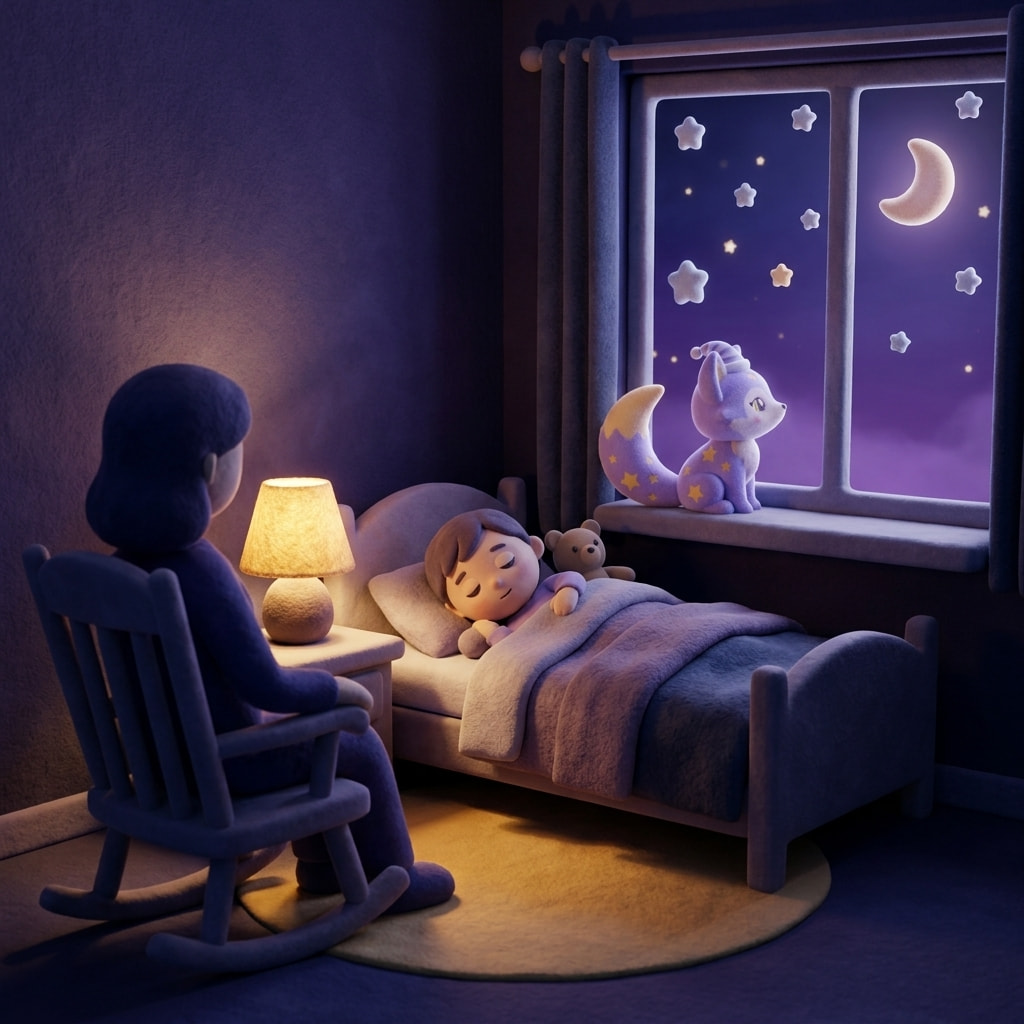

It is 8:47 PM. You have done the bath, the teeth, and the story. You are halfway down the hallway when you hear it: "I am scared." You go back. You check under the bed. You check the closet. You say goodnight again. Two minutes later: "There is something in my room." Sound familiar?
Nearly 73% of children between ages 4 and 12 report nighttime fears, according to research published in Behaviour Research and Therapy. Fear of the dark is consistently among the most common. And while it is a completely normal part of growing up, that does not make the nightly battles any less exhausting for you — or any less real for your child.
This guide covers why kids become afraid of the dark, when it typically passes, and 10 strategies that actually work — backed by child psychology research. You will also learn what not to do, because some well-meaning approaches can accidentally make the fear worse.
Why Are Kids Afraid of the Dark?
Fear of the dark is not random. It emerges from a very specific collision of developmental milestones, and understanding that can change how you respond.
Between ages 2 and 4, children develop the capacity for imaginative and symbolic thinking. This is wonderful for play, creativity, and language. It is less wonderful at bedtime. The same brain that invents elaborate imaginary worlds during the day can populate those worlds with threats at night.
Here is what makes darkness uniquely challenging for young children:
They cannot distinguish fantasy from reality. A 3-year-old genuinely does not know whether the dragon from the bedtime cartoon could appear in the closet. To them, the possibility feels absolutely real.
They have limited control over their environment. During the day, they can move, see, and interact with their surroundings. In a dark bedroom, those options disappear, and the feeling of helplessness is uncomfortable for anyone — let alone a child whose prefrontal cortex (the rational thinking center) is still years away from full development.
They absorb more than we realize. Research from Children's Hospital Colorado shows that when you ask kids what scares them about the dark, they frequently point to things they have seen on TV, in books, or overheard in conversation. Even seemingly harmless cartoons with villains or suspenseful music can plant seeds that grow at bedtime.
Separation amplifies everything. For many children, the fear is not actually about darkness — it is about being alone. Developmental psychologists note that separation anxiety is intertwined with nighttime fears, especially between ages 2 and 5. The dark simply makes the separation feel more intense.
What Age Does Fear of the Dark Start (and Stop)?
Fear of the dark follows a fairly predictable developmental pattern:
- Ages 2-3: First signs typically emerge as imagination develops. Children may resist bedtime or insist on a parent staying nearby.
- Ages 3-5: Peak intensity for most children. Imagination is vivid but the ability to reason through fears is still weak. Monsters, shadows, and "creatures" become common themes.
- Ages 5-7: Fear often begins to fade as children develop better understanding of what is real and what is not. They start to reason: "Monsters are not real."
- Ages 7-9: Most children have largely outgrown the fear. A preference for a night light might linger, and that is completely normal.
- After age 9: If the fear remains intense and interferes with daily life, it may have crossed into phobia territory (nyctophobia). About 2% of children experience a persistent darkness phobia that benefits from professional help.
The bottom line: if your 3 or 4-year-old is terrified of the dark, their brain is developing exactly on schedule. That does not mean you should ignore it — it means you can approach it with less worry and more strategy.
What NOT to Do (Common Mistakes That Make It Worse)
Before getting to what works, let us clear out what does not — because several popular approaches can backfire.
Do not dismiss the fear
Saying "there is nothing to be afraid of" or "don't be silly" might feel reassuring to you, but it tells your child that their feelings are wrong. Research from Children's National Hospital in Washington, D.C. emphasizes that dismissing fears makes children feel unheard and can actually intensify the anxiety.
Do not do "monster checks" or use "monster spray"
This is a controversial one, because it is wildly popular advice. But pediatric psychologists from Cleveland Clinic and Children's National both caution against it. When you check the closet for monsters or spray "anti-monster spray," you are implicitly confirming that the threat could be real. You are teaching your child that the closet needed checking.
Do not let your child sleep in your bed every night
An occasional exception during illness or extreme distress is fine. But routinely letting your child into your bed sends a message that their own room is not safe. It also delays the development of independent coping skills they will need long-term.
Do not flood them with reassurance on repeat
Going back five, ten, fifteen times to say "you are safe" teaches your child that calling out works — and that they need external validation to feel okay. The goal is to help them build internal confidence, not dependence on your presence.
10 Strategies That Actually Work
1. Validate first, then redirect
The single most important step is to take your child's fear seriously without reinforcing it. This sounds contradictory, but it is not.
What this looks like: "I can see you feel scared. It is okay to feel that way. And I know you are brave enough to handle it. Your room is safe, and I am right down the hall."
Acknowledge the emotion. Do not argue with it. Then point them toward their own ability to cope.
2. Find out what they are actually afraid of
Ask open-ended questions — but during the day, not at bedtime when emotions are high. "What do you think about when the lights go out?" or "Is there something specific that worries you at night?"
You might discover it is not darkness at all. It could be a shadow from the curtain, a sound from the heating system, or worry about a parent leaving. Each of these has a different solution.
3. Use a dim, warm night light
Night lights are not a crutch — they are a reasonable accommodation. The key is choosing the right one. A dim amber or red light does not interfere significantly with melatonin production, unlike blue or white lights that can suppress it and actually make falling asleep harder.
Avoid bright or blue-toned lights. Avoid projectors that create moving images (they are stimulating, not calming). A simple, warm, low-glow light is all you need.
4. Give them a "brave buddy"
Research from Tel Aviv University found that children who slept with a comfort object — a stuffed animal described as their protector — showed significant reductions in nighttime fear after just four weeks, regardless of what other interventions were used.
Let your child choose a specific stuffed animal or toy that "watches over them" at night. This gives them a sense of agency and a tangible source of comfort they can reach for without calling you.
5. Build the dark into daytime play
Help your child associate darkness with fun, not fear. Ideas that work:
- Make shadow puppets together on the wall.
- Have a flashlight scavenger hunt in a dim room.
- Do a "glow stick dance party" with the lights off.
- Read a book together by flashlight.
When darkness is paired with positive experiences during the day, the association carries over to bedtime.
6. Use calming audio as a transition tool
One of the most effective techniques for fearful children is giving them something to focus on as they drift off — something calming that replaces the anxious thoughts. This is where audio bedtime stories become genuinely useful.
A soothing voice telling a gentle story gives a child's mind something constructive to do instead of inventing threats in the shadows. Research in cognitive behavioral therapy for children supports the idea that replacing anxious thought patterns with calming content is one of the most effective approaches for mild to moderate nighttime fears.
Audio stories work especially well because they do not require a screen (no stimulating light) and they create a bridge between the parent saying goodnight and the child falling asleep. The child is not alone with their thoughts — they are listening to a story.
For children who are specifically afraid of the dark, stories where the main character faces and overcomes a similar fear can be powerful. These "bibliotherapy" stories help children see that fear is normal, that they are not the only ones who feel it, and that they can be brave. DreamLoo's bedtime stories are designed specifically for this — soothing audio narrated in a calm voice that gradually slows down to help children drift off.
7. Teach a simple breathing technique
Even children as young as 3 can learn basic breathing exercises. The simplest one: "Smell the flower, blow out the candle." Have your child pretend to smell a flower (breathe in through the nose slowly) and blow out a birthday candle (breathe out through the mouth slowly).
Practice this together during the day a few times, so it becomes automatic. Then at bedtime, when they start to feel scared, they already have a tool.
8. Create a predictable bedtime routine
Predictability reduces anxiety. When your child knows exactly what happens next — bath, pajamas, story, goodnight words — their brain has less room for uncertainty and fear. The routine itself becomes a safety signal.
A study involving over 10,000 families across 14 countries found that children with consistent bedtime routines had significantly better sleep outcomes. The routine is not just about sleep hygiene — it is a psychological anchor. Read our full guide on building a bedtime routine for toddlers that actually works.
9. Use gradual exposure (not all at once)
If your child currently sleeps with the hallway light blazing and the bedroom door wide open, you do not need to fix that in one night. Gradual change is more effective and less distressing.
Week by week, you might: dim the hallway light slightly, close the door an inch more, or switch from a bright night light to a dimmer one. Small, steady changes build confidence without overwhelming your child.
10. Praise courage, not fearlessness
When your child makes it through a night without calling out, or agrees to try a dimmer light, make a genuine big deal of it. "You were really brave last night. I am proud of you."
Focus on praising the effort to face the fear, not the absence of fear itself. You want your child to learn that bravery is not about never being scared — it is about doing the hard thing even when you are scared.
When to Talk to Your Pediatrician
Most children outgrow fear of the dark naturally with patience, consistency, and the strategies above. But in some cases, professional support helps.
Consider talking to your pediatrician if:
- The fear is so intense that your child has panic attacks or physical symptoms like nausea and stomachaches before bed.
- Sleep loss is significant and affecting daytime behavior, mood, or school performance.
- The fear has lasted more than six months with no improvement despite consistent strategies.
- Your child avoids dark spaces even during the day.
- The fear started suddenly after a traumatic experience.
The good news: childhood phobias are highly treatable. Cognitive Behavioral Therapy (CBT) has success rates above 80% for specific phobias in children, often within 8-12 sessions.
A Quick Recap: Your Nightly Toolkit
During the day: Talk about fears openly. Practice the "smell the flower, blow out the candle" breathing. Play games in the dark. Read stories about brave characters.
At bedtime: Follow a consistent routine. Validate the fear briefly. Turn on a dim amber night light. Hand them their brave buddy. Start a calming audio story. Say your goodnight words. Leave while they are drowsy.
Over time: Gradually reduce accommodations (brighter lights, open doors). Praise every small act of bravery. Be patient — this phase passes.
For tonight: our free bedtime calculator includes a "Brave in the dark" story theme — it generates a short, personalized bedtime story where a little braveness is exactly right. No account, ready in about 10 seconds.