

Your 5-year-old is in bed, tucked in, lights off — and their brain is lit up like a city. Did I do something wrong at school today? What if a storm comes tonight? What if you leave and don't come back? You have tried the soft voice, the hand on the back, the "it's okay." The worries keep coming.
What actually calms an anxious child at bedtime is not reassurance alone. It is redirection — giving the brain something steady, warm, and predictable to hold onto while the worry-loops quiet on their own. That is exactly what the right bedtime story does, and why it has been one of the most reliably helpful tools for anxious kids for as long as parents have been telling them.
This guide covers what actually works (and what doesn't), how to pick or tell a story that calms rather than activates, and when bedtime anxiety warrants something more than a good story.
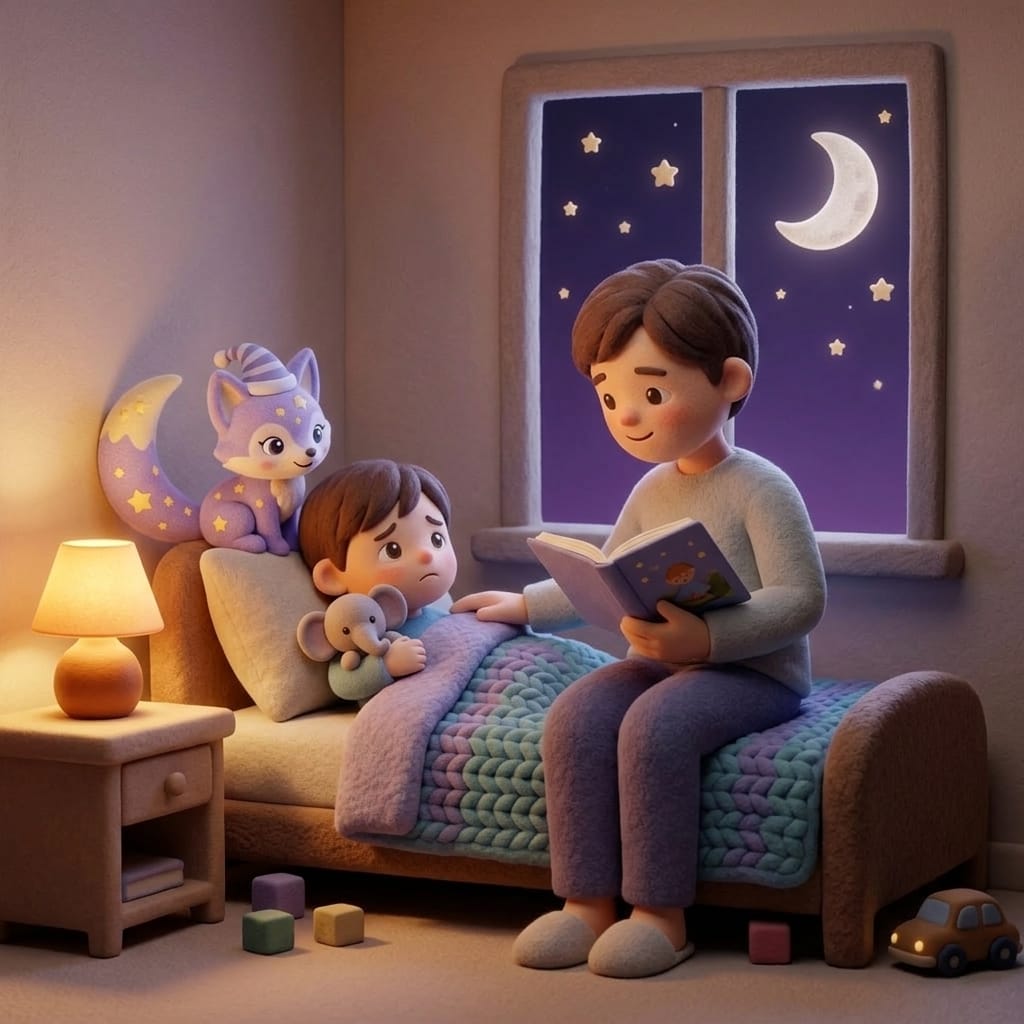
Why Bedtime Is the Hardest Time for Anxious Kids
Kids who seem fine during the day often fall apart at bedtime. It is not random — it is biology.
Three things happen at once when the lights go out:
- Distraction disappears. During the day, a worried child has school, play, screens, siblings, noise. At bedtime, all of that stops. Whatever has been quietly bothering them has the stage.
- The parasympathetic nervous system is trying to take over — the one that slows breathing and heart rate. But anxiety fights that shift. The body wants to sleep; the mind wants to check every possibility.
- Separation looms. For most young children, bedtime is the biggest daily separation from parents. That alone can activate a separation-anxiety response, even in kids who seem "too old" for it.
Add any additional stressor — a school problem, a new sibling, a life change, a scary thing overheard — and bedtime becomes the hardest part of the day. The American Academy of Pediatrics notes that up to 1 in 5 children experience some form of anxiety significant enough to affect daily life. For many of them, it shows up most at bedtime.
How a Calming Story Actually Helps
A good bedtime story is not just entertainment — it is a physiological intervention. Here is what measurably happens in a child's body when they listen to a well-paced calming story.
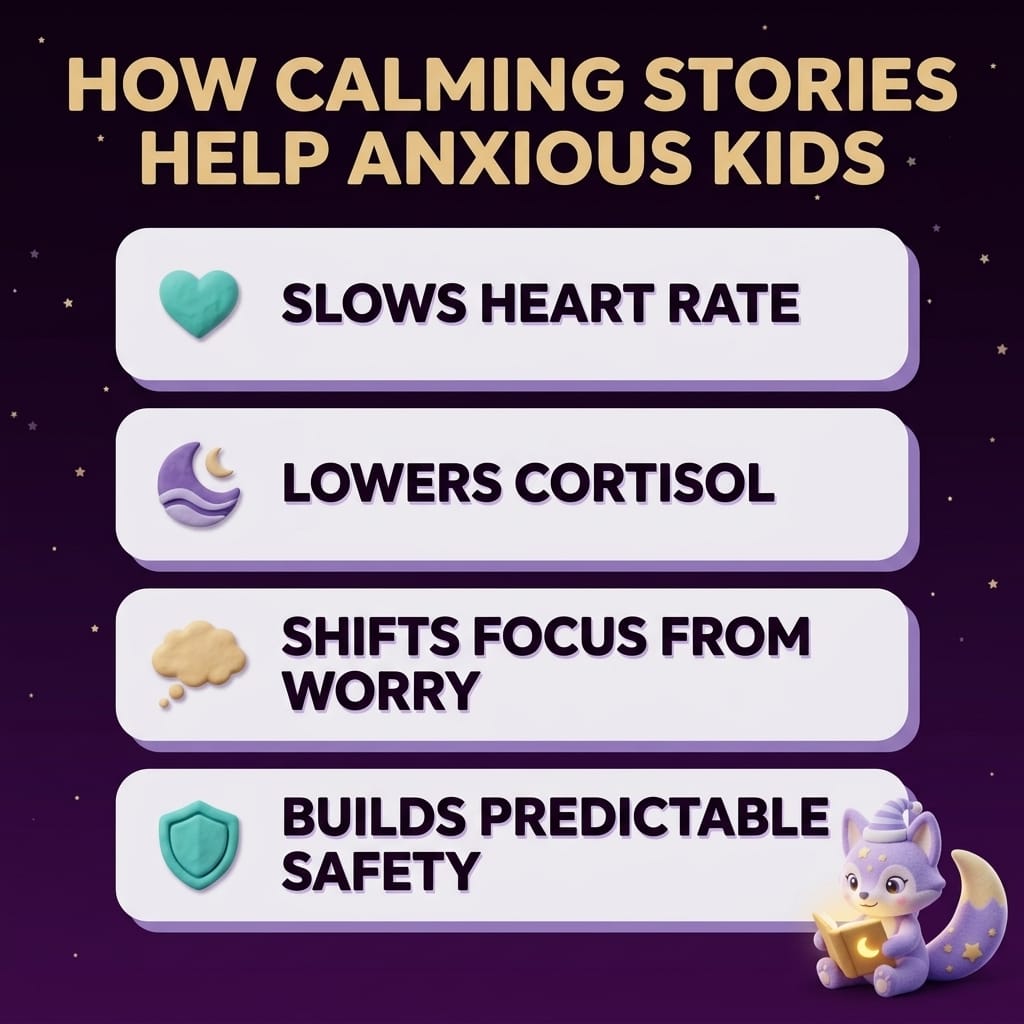
It slows the heart rate
Listening to a slow, calm voice synchronizes breathing and heart rate with the narrator's cadence — a phenomenon called respiratory sinus arrhythmia when it happens naturally with a parent's voice. A parent reading slowly, or a well-paced audio story, pulls the child's heart rate down within minutes.
It lowers cortisol
A landmark study by Brockington et al. (2021) in PNAS found that a 15-minute bedtime storytelling session in hospitalized children significantly reduced cortisol levels and pain perception compared to control activities. The effect is specific to storytelling, not just quiet time — the structure of narrative does something other activities don't.
It redirects attention away from worry loops
Anxiety is a brain looping on the same threat signals. A compelling but calm story gives the brain something else to process, which interrupts the loop. This is why silence and "just relax" don't work for anxious kids — silence is worse than sound for a looping mind. A steady voice gives the mind somewhere else to land.
It builds predictable safety
Repetition — the same voice, the same story structure, the same ending — creates a conditioned sleep cue. Over time, your child's brain starts linking the bedtime story with falling asleep safely. The story itself becomes a signal that nothing bad is coming.
The Anti-Pattern: Stories That Make Anxiety Worse
Not every "kids' bedtime book" calms an anxious child. Some make it worse. The stories to avoid at bedtime for an anxious child:
High-stakes adventure stories
If the character is in danger, chased, lost, or fighting a villain, an anxious child's brain treats it as a real threat to process. Save these stories for daytime reading.
Stories with unclear or cliffhanger endings
An anxious child cannot tolerate unresolved tension at bedtime. Every story read at bedtime should end softly and completely — no "to be continued," no "what happens next is your imagination."
Scary elements, even mild ones
Monsters under the bed, ghosts, witches, even intense weather events. A book that works fine for a neurotypical child can spike anxiety in a sensitive one. Know your kid.
Emotionally heavy themes
Books about loss, serious illness, or death can be beautiful — but at bedtime they deepen anxiety. Read them in the daytime if you want to address those topics.
Fast-paced, high-energy narration
Dramatic voices, sound effects, exciting rhythm. These are performance stories for daytime. Bedtime voice is slow, warm, and narrow in energy range.
Screens during the story
Even a gentle animated story on a tablet exposes your child to blue light, suppresses melatonin, and engages visual stimulation at exactly the wrong time. Audio stories or read-aloud books only. For more on this, see screen time before bed.
What a Story for an Anxious Child Should Look Like
The structural opposite of the anti-patterns above.
A gentle arc, not a rollercoaster
The story should open with warmth, introduce a small challenge (at most), resolve it kindly, and fade softly. Think: a small creature who can't find their cozy spot, tries a few places, finally settles into a warm burrow with a soft blanket, and drifts to sleep.
Familiar, warm sensory imagery
Soft, warm, quiet, sleepy, cozy, gentle, hush. These words are not decoration — research on embodied cognition suggests they activate associated calming states in the listener. Fill your story with them.
A calming, predictable setting
Forest paths, meadows, cozy cabins, quiet beaches, grandparent kitchens, little villages. Places that feel safe to your child. Avoid unfamiliar or chaotic locations.
A hero who feels like your child
The self-reference effect (Symons & Johnson, 1997) is well-documented: kids engage more deeply with stories featuring a hero who resembles them. Using your child's name, a similar age, a parallel interest helps anxious kids feel seen and accompanied in the story. Our full guide on personalized bedtime stories covers why this works.
A pace that slows as the story progresses
The first few minutes can have gentle energy. The last few should be almost a guided drift — shorter sentences, softer imagery, a fading scene. The story teaches the body what to do by demonstrating it.
A clear, complete ending
Everything resolves. The hero is safe. The world is quiet. The child can exhale.
Five Calming Stories and Story Ideas to Try Tonight
Specific ideas you can use tonight — mix published books with simple improvised narratives.
1. The Rabbit Who Wants to Fall Asleep — Carl-Johan Forssén Ehrlin
A polarizing book (some parents love it, some don't), built specifically around sleep-induction techniques. Repetitive, meditative, and explicitly designed to slow the reader. Ages 3+.
2. Llama Llama Red Pajama — Anna Dewdney
Names bedtime anxiety directly and resolves it with a parent's calm return. Rhythmic, rhyming, and reassuring. Ages 2–5.
3. When I'm Feeling Scared — Trace Moroney
Part of the "When I'm Feeling" series — gently normalizes anxiety and shows coping strategies. Short, calming, emotionally validating. Ages 3–6.
4. A soft made-up "safe place" story
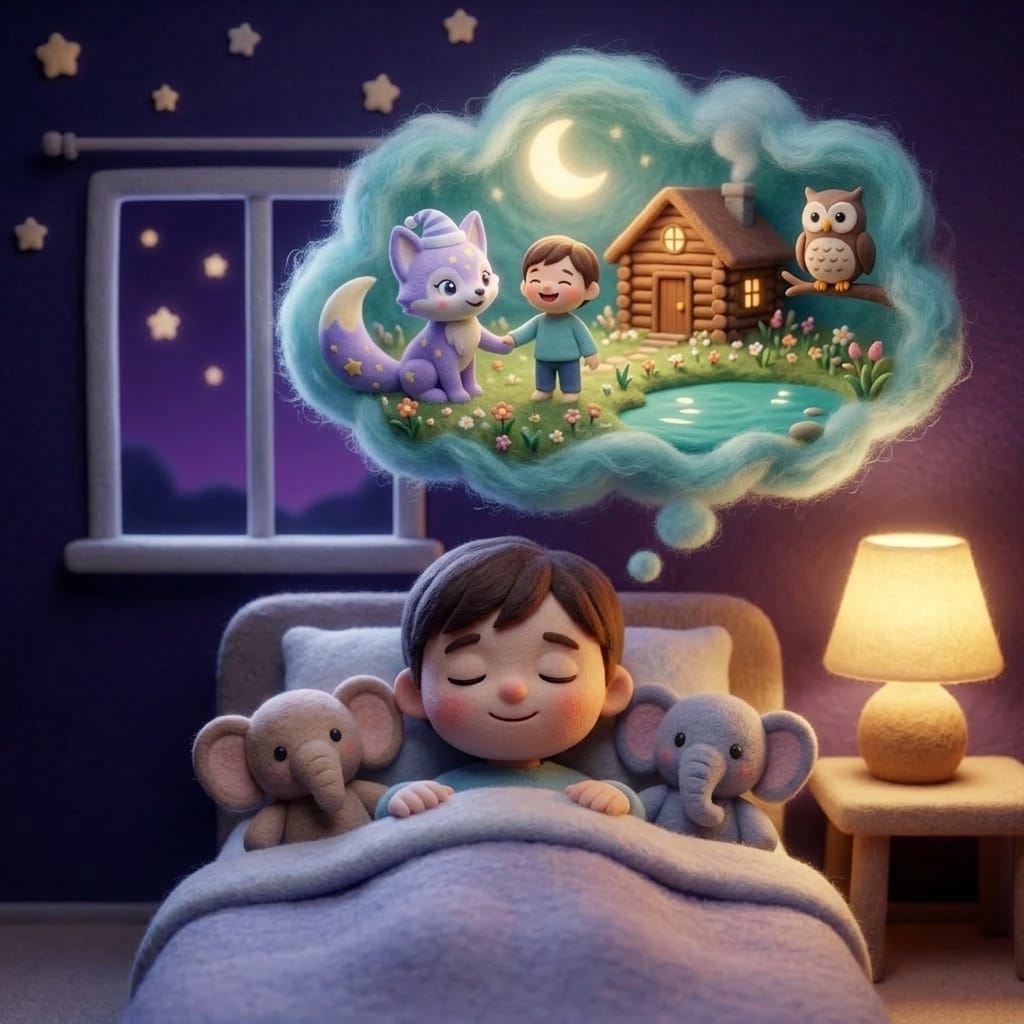
Open with: "Tonight, I'm going to tell you a story about a place where nothing scary lives. It's a small meadow, with tiny flowers, a little warm cabin, and a sleepy cat curled on a rug…" Just describe the place in slow, warm detail. Keep it uneventful. End with the cat falling asleep — or your child's own name falling asleep in the meadow. This works better than any book for many anxious kids.
5. A personalized story where your child is the quiet hero
"Once there was a child named [Name] who went on a gentle walk through a soft forest. They carried a small lantern. Everything they passed — the owl, the fox, the little stream — said goodnight to them, and they said goodnight back…" A narrative rhythm of small goodnights, one after another, is deeply soothing. It is essentially Goodnight Moon extended into a story.
For a wider range of picks, see our best bedtime stories for toddlers guide.
How to Tell a Story That Actually Calms
Delivery matters as much as the words.
Slow down more than feels natural
The instinct is to read at a natural pace. For anxious kids, that's too fast. Read about 30% slower than you would to yourself. Linger on the quiet phrases.
Lower your voice steadily through the story
Start at normal warm bedtime volume. By the last third of the story, you should be almost whispering. Your child's body reads this as the signal to rest.
Don't do big character voices
At bedtime, every voice should be within a narrow, low-energy range. Keep theatrics for daytime.
Breathe slowly yourself
Your child's nervous system mirrors yours. If you are relaxed, they will be. If you are rushing to get through the story so you can collapse on the couch, they will feel that.
Don't turn the story into a lesson
Resist the urge to end with a "moral" that ties back to your child's actual fear. Anxious kids often see through this and feel preached at. Let the story do its work implicitly.
Stay physically close — then slowly withdraw
Start the story sitting close. By the end, you can move to sitting at the edge of the bed, then to a chair nearby, then quietly out of the room as they drift off. Sudden withdrawal during a story can spike anxiety.
When a Story Isn't Enough: Signs to Call a Pediatrician
Most bedtime anxiety can be managed with calming stories, a consistent routine, and patient parenting. But some cases need additional support. Consider calling your pediatrician or a child therapist if:
- Bedtime anxiety is intense and nightly for more than a month and is not improving with calm routines.
- Your child is refusing to sleep or having panic-level responses at bedtime.
- Anxiety is showing up during the day too — school avoidance, stomachaches in the morning, withdrawal from friends.
- Physical symptoms accompany the anxiety — trouble breathing, racing heart, or persistent waking with distress.
- A specific triggering event (trauma, loss, a family change) is clearly driving the anxiety and it is not fading over weeks.
- Your gut says something more is going on. Parents are usually right about this.
Childhood anxiety is highly treatable. Short courses of cognitive-behavioral therapy, specialized child therapy, or parent-coaching sessions often produce significant improvements within weeks. Asking for help is a strength, not a failure.
Daytime Practices That Reduce Bedtime Anxiety
Bedtime is not the only place to address bedtime anxiety. The daytime work matters more than most parents realize.
Protect enough sleep
Overtired children have dramatically more anxiety. Check your child's total sleep against the sleep-by-age guidelines.
Name feelings during the day
Children cannot regulate emotions they cannot identify. Labeling feelings as they come up during the day — yours, theirs, characters' — builds the vocabulary that lets them process anxiety at night. Our guide on helping your child manage anger covers the general framework, which applies directly to anxiety.
Keep a calm and predictable routine
A predictable bedtime routine is one of the strongest protective factors against child anxiety. See bedtime routine for toddlers.
Read gentle stories about feelings during the day
Books that acknowledge worry, fear, or sadness — read in the daytime — build emotional literacy that shows up at night.
Cut pre-bed stimulation
Screens, exciting play, sugary snacks, and loud environments in the final waking hour all raise cortisol and make anxiety worse at lights-out.
How Dreamloo Fits In
A well-designed audio bedtime story is often the easiest way to deliver what anxious kids need: a warm, predictable, sleep-calibrated voice that is there every night, calmer than you when you're exhausted, and customizable to your child's worries.
DreamLoo was built specifically for this. Our stories are:
- Audio-first, no screens during the story. No blue light, no stimulation.
- Sleep-calibrated. Every story slows as it progresses and ends softly.
- Personalized. Your child's name, age, and a situation they're working through shape the narrative.
- Themed for emotional processing. Including anxiety, separation, starting school, a new sibling, and more.
- Free to try. Browse the free story library to hear the pacing and tone.
For anxious kids especially, the benefit of a good audio story isn't that it replaces you. It's that it covers the 20-minute gap between "goodnight" and falling asleep — the exact window where anxious minds spiral — with something calming, familiar, and consistent.
Common Questions from Parents
My child keeps asking "what if" questions at bedtime. What do I do?
Short, confident, concrete answers. "What if there's a storm?" → "We're inside, and we're safe. If one comes, I'll know." Avoid long reassurances that open into debate. After two or three questions, redirect into the story: "Let's hear what happens next in the story of the sleepy fox." Anxiety loves conversation; gently close the conversation and reopen the story.
My anxious child rejects every story I try. What now?
Try a made-up "safe place" story instead of a book. Let them name the place ("where is the coziest place you can imagine?") and you narrate it slowly. Because they helped create it, engagement is higher and resistance drops. This often works when published books don't.
Is it okay to let my anxious child listen to the same story every night?
More than okay — it's ideal. Repetition is calming. Familiarity is the point. Some anxious kids listen to the same audio story for months and their brain uses it as a sleep cue. Let them.
Should I stay in the room until my anxious child falls asleep?
Short-term, sometimes yes — especially during a hard period. Long-term, aim for a gradual fade: start close, slowly move to the edge of the bed, then to a chair, then to the doorway, then leaving quietly while they're still awake but sleepy. Abrupt "I'm leaving now" transitions often spike bedtime anxiety.
My child is anxious because of a real ongoing stressor (parents' divorce, a move). How do I use stories?
Stories can be part of the healing but are not a replacement for openly acknowledging the stressor during the day. During the day, name what's happening gently and age-appropriately. At bedtime, the story should be a warm, safe anchor — not a way of teaching a lesson about the hard thing. Keep bedtime a place of safety, not processing. If the stressor is significant, a child therapist can help the processing happen where it belongs.