
You are at a hotel in a different time zone. Your kid is in bed at home, and the call you promised to make in time for the bedtime story is going to land 20 minutes after lights-out. Your partner already read a book; the gap between goodnight and actually asleep is the moment your child usually wants you most.
This is the situation voice cloning for bedtime stories was built for. A short recording of your voice, made earlier, becomes the narrator of a calm bedtime story your child hears tonight — your tone, your warmth, your familiar inflection. Not a replacement for being there. A bridge to it.
But voice cloning is also the kind of technology that needs to be done carefully. Done well it is moving and useful; done badly it raises real privacy and safety concerns. This guide covers how it actually works, what to look for in a safe implementation, when it genuinely helps, and the honest tradeoffs.
What "Voice Cloning" Actually Means
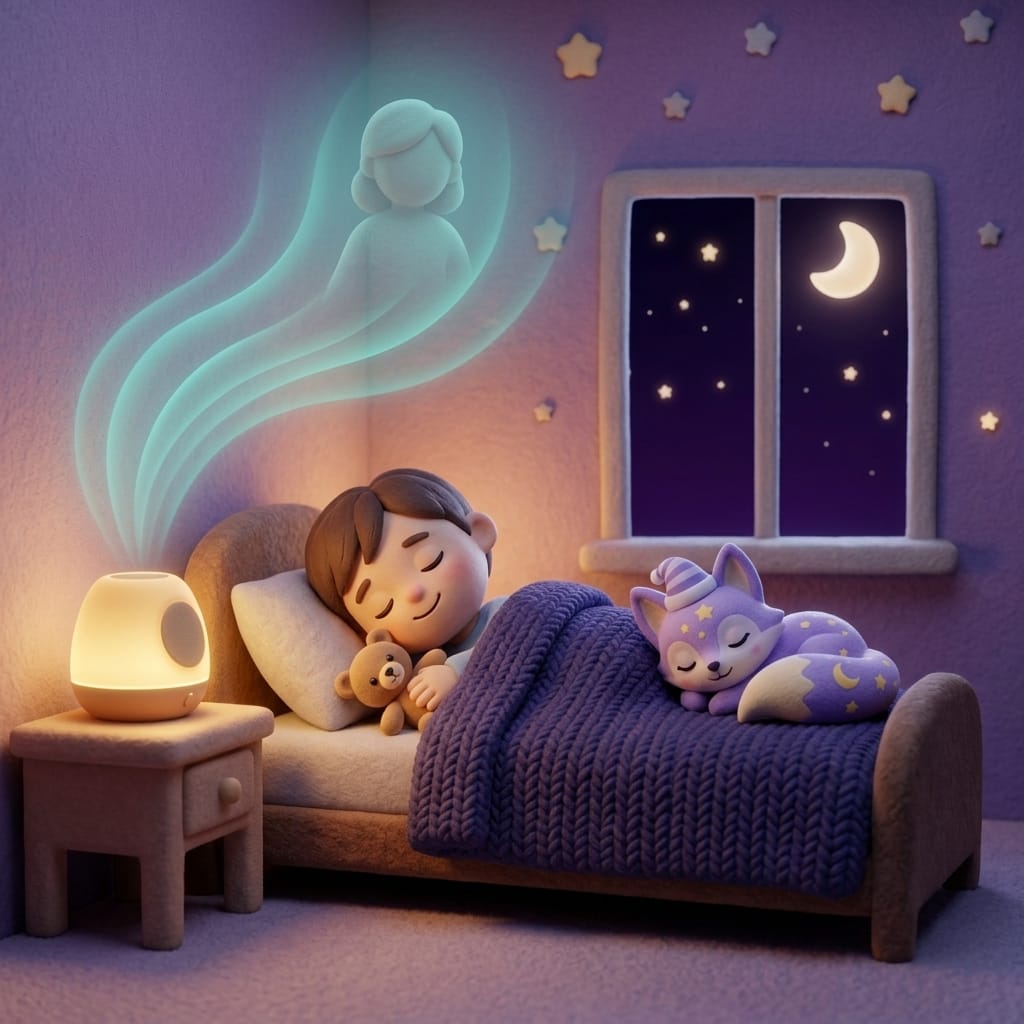
In the most general sense, voice cloning is using an AI model to synthesize new speech in a specific person's voice. Modern systems learn the acoustic and prosodic features of a voice from a sample, then can produce arbitrary new sentences in that voice.
For bedtime stories specifically, voice cloning is narrower than the general technology. A well-built kids' app constrains what the cloned voice can say (only the story content the app generates), how long the model is retained, and who can use it. That narrowness is the whole point — it makes the technology safe enough for a use case as personal as a child's bedside.
The two flavors
- General-purpose voice cloning — open tools (some commercial, some free) that let anyone record a sample and generate any speech. Useful for content creators, accessibility, dubbing. Not appropriate for kids' apps, because the same model can produce arbitrary content with no guardrails.
- Constrained kids' voice cloning — embedded into a bedtime story app, locked to the parent's account, only used to narrate pre-vetted story themes. This is the safe pattern.
The rest of this guide assumes the constrained kind.
How Voice Cloning Works — The Three-Minute Version
The non-technical mental model.
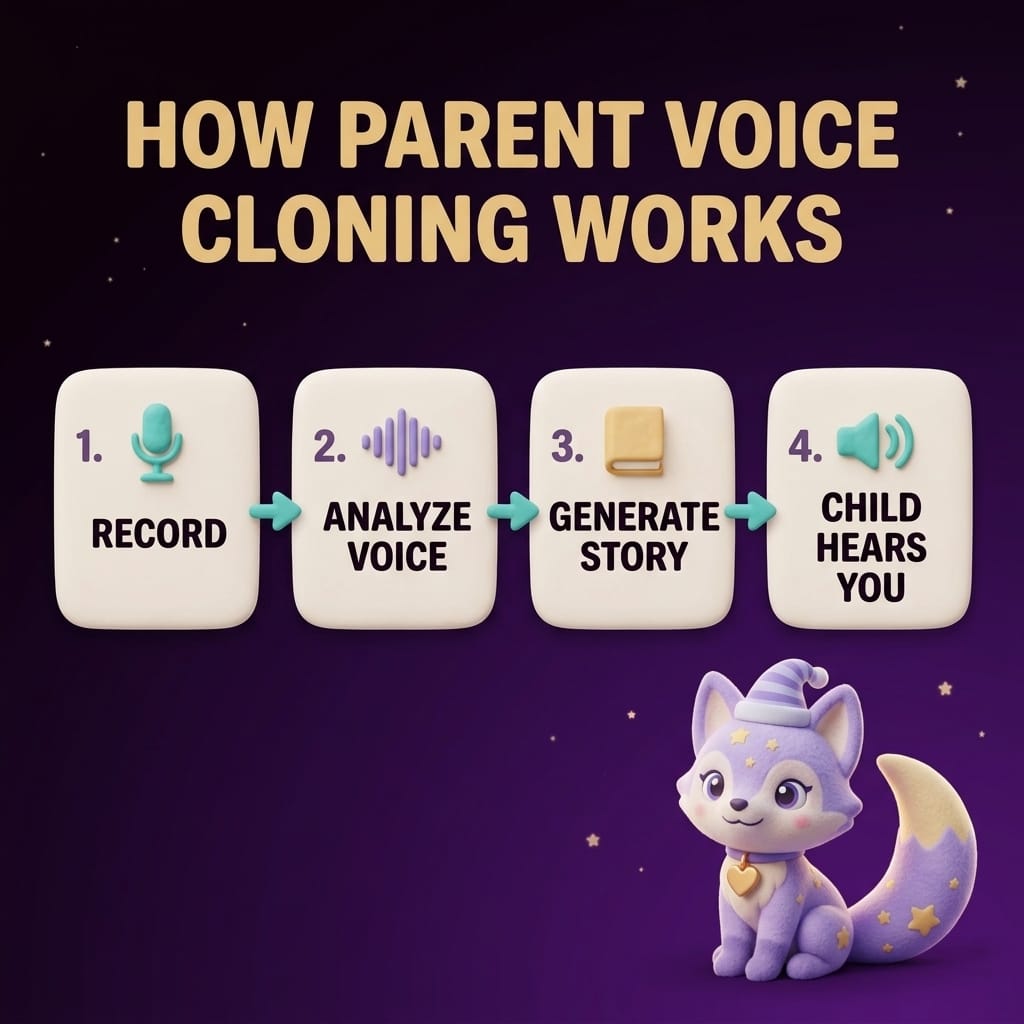
Step 1: You record a short sample
Most consumer apps ask for 2–5 minutes of clear speech. You read a short passage in a quiet room, varying your tone enough for the model to capture warmth, pace, and inflection. Some apps work with as little as 30–60 seconds.
Step 2: The model analyzes your voice
Behind the scenes, the system extracts acoustic features (pitch, timbre, breathing pattern) and prosodic features (rhythm, intonation, pauses). These become a mathematical representation of how your voice sounds — not a recording, but a model that can produce new speech that sounds like you.
Step 3: The story is generated
When you set up a bedtime story for your child, the app produces the narrative text (often using AI as well — covered in our AI bedtime stories guide), and then synthesizes the audio in your voice.
Step 4: Your child hears your voice
The completed audio plays at bedtime. To your child, the experience is just a story narrated by you — calm, familiar, theirs.
The whole pipeline runs in under a minute for most apps. Once your voice is set up, generating new stories is fast.
When Voice Cloning Genuinely Helps
The technology earns its place in specific situations. Less for novelty, more for connection.
Travel-heavy parents
Business trips, conferences, sales calls, military deployments. Voice cloning lets you maintain a nightly presence even when time zones make a real call impossible.
Shared custody arrangements
Children moving between two homes can experience disrupted bedtime routines. A cloned voice from each parent provides continuity at both houses without negotiation.
Hospital stays and medical separations
A parent who is unable to be with a hospitalized child overnight, or vice versa. The familiar voice is comfort that survives separation.
Long-distance grandparents
Grandparents who live far from grandchildren can record stories that get heard regularly, building a sense of presence across geographies.
After loss
Some families have used voice cloning to preserve a deceased parent's voice for storytelling. This use is emotionally complex and not for everyone — but for some grieving children, it has been deeply meaningful. It also raises ethical questions worth thinking through with a therapist before proceeding.
Day-to-day extra coverage
Even for parents who are present every night, voice cloning can fill the second story slot — your live reading first, then a calmer cloned-voice story while you handle a sibling, a chore, or simply rest.
When Voice Cloning Is the Wrong Tool
It is not always the right answer.
- For a child under age 2. The most valuable language input at this age is live human voice in real interaction. Save cloning for older.
- As a substitute for present-parent bedtime. If you are home and could read live, do that. The relationship value is in the live reading.
- When a child explicitly prefers another voice. Some kids find cloned voices uncanny or disorienting. Trust their reaction.
- From an unsafe app. If the app does not have strong consent flows, account-locked voice models, and content guardrails, do not use it. The technology is not worth the risk in a poorly designed product.
Safety: What to Check Before Recording
Voice cloning is one of the most consequential things a parent can hand to a tech product, because the resulting model can produce speech in your voice. The bar for the company holding it should be high.
Five questions to answer before using any voice cloning service
1. Can your voice sample or model be exported?
Look for an explicit "voice models cannot be downloaded or shared" guarantee. If the app allows voice export under any circumstance, do not use it for kids.
2. Who can use your cloned voice?
It should be locked to your authenticated account. No "share your voice with friends" features. No team accounts where another adult can generate stories in your voice.
3. What can the cloned voice be made to say?
A safe app constrains output to pre-vetted story themes. A cloned voice that can be prompted to say arbitrary things is not appropriate for a kids' product.
4. How is your voice data stored?
Encrypted at rest is the minimum. Look for retention limits, account deletion that actually deletes the voice model, and clear language about whether voice data is ever used to train other models.
5. What is the consent flow?
Recording your own voice should require a verified, in-app consent step. Recording someone else's voice — including a partner, a co-parent, or a deceased relative — should not be possible without their explicit verified consent.
If a service can't or won't answer all five clearly in plain language, that is a pass.
What about deepfakes and impersonation?
The deepfake concern is real for general-purpose voice cloning tools that allow voice export. A constrained kids' app where voice models are account-locked, non-exportable, and only used for pre-vetted story content does not create a meaningful deepfake risk. The risk lives in the export, not the technology itself.
That said: never record your voice through an app you don't trust, and never let a child record someone else's voice without that person's full understanding and consent.
How to Record a Good Voice Sample
If you decide to clone your voice for bedtime stories, the quality of the recording shapes everything that follows. A few practical tips.
Pick a quiet space, but not a recording studio
A bedroom or living room with carpet and soft furniture beats a tiled bathroom or echoey kitchen. You don't need a microphone setup — your phone's mic at conversational distance is fine.
Use your real bedtime voice
Many parents record in a "performance" voice that doesn't match how they actually sound at bedtime. Resist the urge. Read in your normal warm bedtime cadence — the slower, softer voice you use with your child at night. That is the voice your child knows. The model captures what you give it.
Vary your tone, gently
Read with mild emotional range — a sentence with warmth, one with a small smile, one slightly slower. The variety helps the model capture the quality of your voice, not just one note.
Say your child's name
Include your child's name a few times in the sample if the app allows custom passages. The model picks up the specific way you say it, which makes the cloned voice feel more like you in the actual stories.
Re-record if it doesn't feel right
If the playback sounds stilted or unfamiliar, re-record. The first try is rarely the best one. Ten extra minutes now saves disappointment later.
What It Sounds Like to a Child
A few honest observations from parents and clinicians:
- For the first 15–30 seconds, most cloned voices fool kids. The opening is when the warm familiarity lands.
- Subtle differences emerge in longer stretches. Specific consonant sounds, breathing patterns, the exact way you pause. Adults notice this faster than kids.
- Sleep-time matters most. Kids drifting toward sleep are cognitively softer; small acoustic differences fade. Voice cloning works particularly well in the settling window because the brain is no longer doing fine analysis.
- Repetition builds familiarity. A child who hears a cloned voice nightly comes to recognize it as a comfort cue, the same way they would a recorded lullaby — except this one sounds like you.
The benefit is not technical perfection. It is the warm, recognizable shape of your voice in the room when you can't be there.
Voice Cloning + Personalized Stories
Voice cloning composes especially well with two other features: personalized stories that use your child's name and interests, and sleep-calibrated narrative arcs that wind down toward sleep.
When all three line up, the experience is your voice telling a story uniquely about your child, structured for sleep. This is the use case our personalized bedtime stories guide describes from a different angle, and what DreamLoo is built around.
How Dreamloo Handles Voice Cloning
DreamLoo supports parent voice cloning as an opt-in feature, with the safeguards described above:
- Voice models are account-locked. No download, no export, no transfer.
- Constrained generation. Cloned voices can only narrate Dreamloo-generated bedtime stories within our pre-vetted theme library.
- Consent enforcement. Only the verified account owner can record the voice sample.
- Encrypted storage and clean deletion. Voice models are encrypted at rest. Deleting your account deletes the underlying model.
- No third-party model training. Your voice sample is not used to train any other model, ours or anyone else's.
For families that travel often, share custody, or have a parent in a long-distance situation, this is exactly what we built it for. For families where both parents are present every night, the live reading remains the gold standard — voice cloning is the bridge for nights that don't fit that pattern.
Common Questions from Parents
Will my child get attached to the cloned voice instead of my real one?
No. Children form attachment to the people who show up in their lives — not to audio. A cloned voice is, at most, a small comfort during specific separations. The relationship is built in waking hours, in eye contact, in shared meals, in the live moments. Your absence is what makes the cloned voice valuable; your presence is what makes the relationship.
What if my partner or co-parent doesn't want voice cloning used?
Don't do it. Voice cloning works best when both adults responsible for the child agree on its use. If one parent feels strongly that it conflicts with their vision of bedtime presence, respect that. The technology is optional.
Can I clone my deceased parent's voice for my child?
Technically yes — practically, only with great care. Some children find a deceased grandparent's preserved voice deeply comforting; others find it confusing or upsetting. This is a decision worth talking through with a child therapist, especially for kids old enough to understand who that voice belongs to. The technology is real; the emotional questions are bigger than the technology.
How does voice cloning compare to recording myself reading actual books?
Both are valuable. A pre-recorded book in your real voice is irreplaceable for the books your child loves. Voice cloning adds infinite variety — new stories every night in your voice, when recording every possible book yourself isn't feasible. Many families do both.
Is the audio quality of cloned voices good enough for bedtime?
Modern cloning has crossed the threshold from "uncanny" to "comfortable" for most listeners, especially in the calm low-energy register that bedtime stories require. The quality is best when the original sample was recorded in your natural bedtime voice and the app produces calm, slowly-paced narration.