
It is 7:55 PM. You said you would put your kid to bed half an hour ago. The kitchen is still a disaster. Your phone has 14 unread messages. Your child wants a story.
The temptation is to reach for the longest, most plot-rich book on the shelf because more story = better parenting, right? The science says the opposite. The bedtime stories that actually help kids sleep are usually short — 5 to 10 minutes — and the reasons go deeper than "you're tired and don't have time."
This guide covers why 5-minute bedtime stories are the sweet spot, how to pick or tell one, and includes three full short stories you can read or adapt tonight. No fluff. No setup overhead.
Why 5 Minutes Is the Sweet Spot
It is not just about your bandwidth. Short stories perform better at bedtime for measurable reasons.
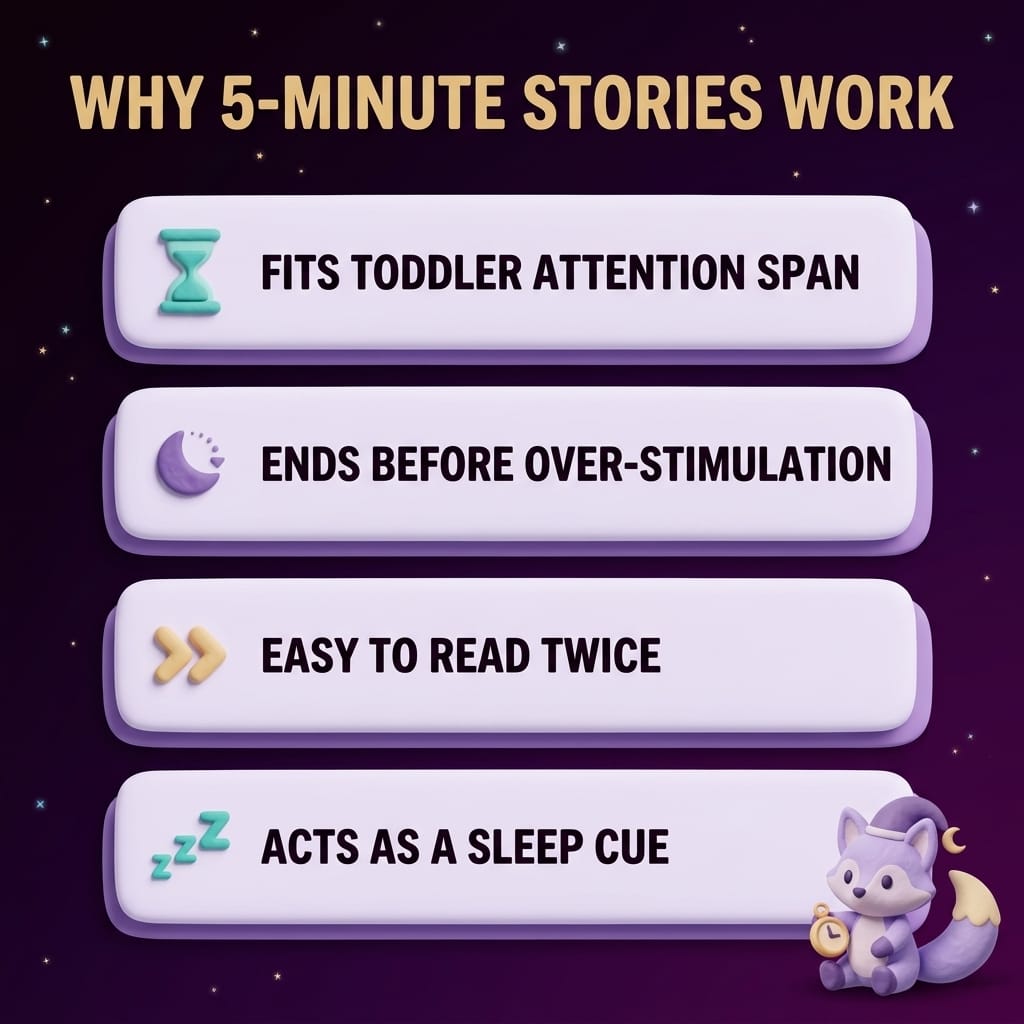
1. It matches a tired toddler's attention span
A 3-year-old's sustained attention for an entirely passive activity is roughly 5–10 minutes. By minute 12, you are competing with them, not soothing them. The story stops working as a wind-down and starts working as a stimulation source. Researchers studying joint reading have consistently found that short, repeated reading sessions outperform long ones for both engagement and language acquisition in kids under 6 (Hutton et al., 2015).
2. It ends before re-activation
A long story has more chances to introduce a high-stakes plot moment that re-activates a sleepy brain. Short stories with a gentle arc resolve before that risk arrives. The brain gets the calming benefit without the re-energizing.
3. It is easy to read twice — which is when the real magic happens
Repetition is the single most underrated tool in bedtime storytelling. A 2011 study at the University of Sussex found that toddlers who heard the same short story multiple times learned more new words than toddlers who heard different stories — because their brains stopped working on basic comprehension and started absorbing detail (Horst, Parsons, & Bryan, 2011).
For sleep, the second read of a 5-minute story is often when the child's body actually settles. Familiarity is calming. With a 20-minute story, you only get one pass; with a 5-minute story, you can read it twice and the repetition itself becomes the sleep cue.
4. It conditions sleep over time
A short, predictable story that ends the same way every night becomes a conditioned sleep cue — your child's brain begins associating those final soft phrases with falling asleep. After a few weeks the cue itself does part of the work. Long, varied stories rarely create this effect because the structure is too unpredictable.
Three 5-Minute Stories You Can Read Tonight
Three full short stories below. Each runs about 4–5 minutes read at a slow bedtime pace. Read each twice if your child wants more — that is a feature, not a problem.
You can use these as written, change the names, swap details for your child's interests, or use them as a template to improvise your own.
Story 1: "The Quietest Mouse in the Meadow"
Best for ages 2–5. Warm, predictable, deeply calming.
In a quiet little meadow, behind a small round hill, there lived a quiet little mouse named Pip.
Pip was the quietest mouse in the meadow. Quieter than the wind. Quieter than the soft brush of grass. Quieter, even, than the moon when it rose into the sky.
Every night, when the sun slipped down behind the hill, Pip would walk slowly through the meadow, looking for the very best place to sleep.
First, Pip walked past the tall flowers. They swayed gently. "Too breezy," whispered Pip.
Then Pip walked past the cool stream. It hummed softly. "Too splashy," whispered Pip.
Then Pip walked past the round pebbles by the rabbit's burrow. They were warm from the day's sun. "Almost," whispered Pip. "But not quite cozy."
At last, Pip came to a soft red leaf, just the right size, tucked under a small white flower. The leaf was warm. The flower was quiet. The moon was watching gently.
"This," whispered Pip, "is the cozy spot."
Pip curled up on the soft red leaf. The flower bent gently above. The moon shone gently down. The meadow grew quieter, and quieter, and quieter still.
And the quietest mouse in the meadow closed her quiet little eyes, and slept.
Goodnight, Pip. Goodnight, meadow. Goodnight, moon.
Story 2: "The Lantern That Found Its Way"
Best for ages 3–6. A gentle "small but brave" arc with a soft resolution.
In a tiny village at the edge of a soft, sleepy forest, there was a small lantern named Lumi.
Lumi had a job. Every night, Lumi would light the way for any small creature who might be walking home in the dark.
One night, the wind blew a little stronger than usual, and Lumi's small flame got very, very low. "Oh no," said Lumi. "How will I light the way home tonight?"
Lumi rolled gently down the path, looking for help.
First, Lumi met an owl on a high branch. "Excuse me, owl," said Lumi softly. "My flame is very small. Can you help?"
"I cannot make your flame bigger," said the owl, "but I can show you something. Look up." Lumi looked up. The sky was full of stars. "You are not the only light tonight," said the owl.
Lumi felt a little better, and rolled on.
Next, Lumi met a small fox curled on a soft moss patch. "Excuse me, fox," said Lumi. "My flame is very small. Can you help?"
"I cannot make your flame bigger," said the fox kindly, "but I can keep you company while you find your way home. We can walk together."
So they walked. Slowly. Quietly. The stars above were soft and silver. The forest was breathing gently around them. Lumi's small flame was small — but it was not alone, and so it was enough.
When Lumi reached home, the small flame flickered once and went peacefully out, knowing it had done its job.
The forest grew quieter. The owl closed her wide eyes. The fox curled up on the moss.
And the stars stayed lit, just as they always do, watching over a sleepy world.
Goodnight, Lumi. Goodnight, forest. Goodnight, you.
Story 3: "[Your Child's Name] and the Soft Cabin"
Best for ages 3–7. Personalized template — slot in your child's name and one favorite detail.
To use: replace
[Name]with your child's name and[favorite animal]with your child's favorite animal (a bunny, a kitten, a baby dragon — any small calm creature works).
Once, on a small hill at the edge of a quiet meadow, there was a soft cabin. The walls were the color of warm honey. The roof was the color of moss after rain. The door was just the right size for [Name] to walk through.
Tonight, [Name] walked up the small hill, holding a tiny lantern. The grass was soft under their feet. The sky was deep and gentle, full of slow stars.
When [Name] opened the door of the soft cabin, a [favorite animal] was already inside, waiting. "You came," said the [favorite animal] sleepily. "I saved you the cozy chair."
The cozy chair was the softest chair in the whole world. There was a thick warm blanket on the back of it. There was a small cup of warm milk on the table beside it. There was a tiny window with a view of the meadow below, where the grass was breathing slowly in the moonlight.
[Name] sat down. The blanket was just the right weight. The milk was just the right warm. The [favorite animal] curled up on the rug at [Name]'s feet, eyes half-closed.
Outside the window, the meadow grew quieter. A tiny owl flew slowly past. A small breeze brushed the tall grass. The moon watched gently, the way it always does.
Inside the soft cabin, the lantern dimmed itself. The [favorite animal] yawned. [Name] yawned, too.
"Goodnight, soft cabin," whispered [Name]. "Goodnight, [Name]," whispered the soft cabin.
And [Name] closed their eyes, and the meadow sang very softly, and everything was warm and safe and still.
The end.
These three stories together cover the most useful bedtime patterns: a quiet repetition story (Pip), a gentle small-but-brave story (Lumi), and a personalized safe-place story ([Your Child's Name] and the Soft Cabin). Most kids settle to at least one of them on the first try. For more curated picks across formats and ages, see our best bedtime stories for toddlers guide.
What Makes a 5-Minute Story Work
Use this checklist when picking or writing your own:
- Calm setting from the first sentence. Meadow, forest, cabin, beach, grandparent's kitchen. Avoid chaos.
- One small element of motion or change. A tiny mouse looking for a spot. A small lantern with a low flame. A gentle visit. Not a quest.
- Warm sensory language. Soft, warm, cozy, quiet, sleepy, gentle, hush. Use them often.
- Repetition. Phrases that come back. "The meadow grew quieter and quieter." Children's brains lock onto this.
- Slowing pace toward the end. The first paragraph can be slightly more energetic. The last paragraph should be almost a whisper.
- A clear ending. "And [character] closed their eyes, and slept." Or three soft "goodnights." Always wrapped, never cliffhanger.
How to Tell Your Own 5-Minute Story (Without a Book)
For nights when the books on the shelf feel stale, or when you forgot to grab one, or when your child specifically wants you — here is the simplest improv structure that works.
The 4-line story formula
- Line 1: A safe place. "Once there was a small bunny who lived in a cozy burrow under a quiet hill."
- Line 2–4: One tiny event. "Tonight the bunny was looking for the softest leaf in the meadow. They tried a wide green one. Too crinkly. They tried a small yellow one. Too rough. They tried a soft red one tucked under a flower. Just right."
- Line 5–7: Resolution and settle-in. "The bunny curled up on the soft red leaf. The flower bent gently above them. The moon watched. The meadow grew quieter and quieter."
- Line 8: The fade. "And the bunny closed their eyes. Goodnight, little bunny. Goodnight, soft red leaf. Goodnight, meadow."
That's it. If you want longer, add a second small character or a third "tried" iteration. If you want shorter, drop a try.
Tips that make improvised stories land
- Use your child's name once or twice. It deepens engagement (the self-reference effect — see personalized bedtime stories for kids).
- Slow your voice on purpose. Read about 30% slower than feels natural.
- Drop your volume in the second half. Almost a whisper by the end.
- End with a "goodnight" sequence. Three soft goodnights — to the character, the place, and your child — works almost every time.
When Two Short Stories Beat One Long One
A common parent question: "Should I read a long story, or two short ones?" For sleep, two shorts almost always wins. Here's why:
- The second story lands during the actual settling phase. By the time you start it, your child is already drifting. You're now layering calm sound onto a brain that's halfway to sleep, which is far more effective than the first half of the first story.
- Repetition is calming. Reading the same short story twice produces familiarity. Reading two different short stories also works because each is brief enough to feel containable.
- It locks in the routine boundary. "Two stories tonight" becomes a clear, repeatable rule. Open-ended single stories have nothing to hold a "one more" negotiation against.
When Not to Use a Short Story
A few cases where a short story isn't the right tool:
- Your child is already calm and just wants connected reading time. A longer book is great here, especially during a sibling-bonding moment or weekend night. You're not winding down; you're enjoying.
- Your child is having a full anxiety spiral. Comfort first. A short story can come later in the routine once the body is settled. See bedtime stories for anxious kids for the specific approach.
- Your child has just had a nightmare. Reassurance, soft physical comfort, and a calm voice come first. Story can follow if helpful — see how to help a child with nightmares.
Common Questions from Parents
My child always asks for "one more story." How do I hold the limit?
Decide the rule before you start: "Two stories tonight." Say it once at the beginning. After the second story, stay calm and close the book physically. "That's our two. Sleepy time now." The first few nights will feel like a battle. By night four or five, the rule sticks. A consistent rule, kindly held, beats a different bedtime length every night.
My toddler picks the same story for the 47th time. Should I refuse?
No. Let them. Repetition is exactly what young children need — for language, for emotional regulation, for sleep. Their preference for the same story is a feature of healthy development. Read it again. They will move on when they are ready.
Are picture books okay or should I read text-only?
Either works. Picture books for younger toddlers; text-only or chapter-style fine from age 4–5 onward. The structure of the story matters more than the format.
My older kid (7+) finds 5-minute stories babyish. What now?
For older kids, the "5-minute" guideline becomes more like 8–12 minutes. The principle holds: short, calm, gently-arced stories with a soft ending work better for sleep than long exciting ones. Frog and Toad-style episodes, calmer entries from the Mercy Watson series, or short audio stories work well.
Where can I find more 5-minute stories without buying ten books?
Audio bedtime story apps are designed for exactly this — endless short, sleep-calibrated stories without a screen. The DreamLoo bedtime story library generates short personalized stories for your child by default; we built it because we wanted infinite 5-minute stories without infinite shelf space. See our best bedtime story apps guide for what to look for.