
Here is something that roughly half of all parents believe: watching a show or playing a quiet game on a tablet helps their child wind down before bed. It makes sense intuitively. The child is still, the house is quiet, and it buys you twenty minutes to clean the kitchen.
But the science tells a very different story. And over the past few years, the research has become precise enough to explain not just that screens before bed are a problem — but exactly why, and what to do instead.
This is not an article that will shame you for handing your child an iPad. Every parent has done it. The goal here is to give you the facts so you can make informed choices — and to offer practical alternatives that are just as easy.
What Light Does to Your Child's Brain at Night
To understand why screens are a problem at bedtime, you need to understand one hormone: melatonin.
Melatonin is the signal that tells the brain it is nighttime. As the sun goes down and the environment gets darker, the pineal gland in the brain starts producing melatonin, and this rising level of melatonin makes your child feel sleepy. It is the body's natural preparation for sleep.
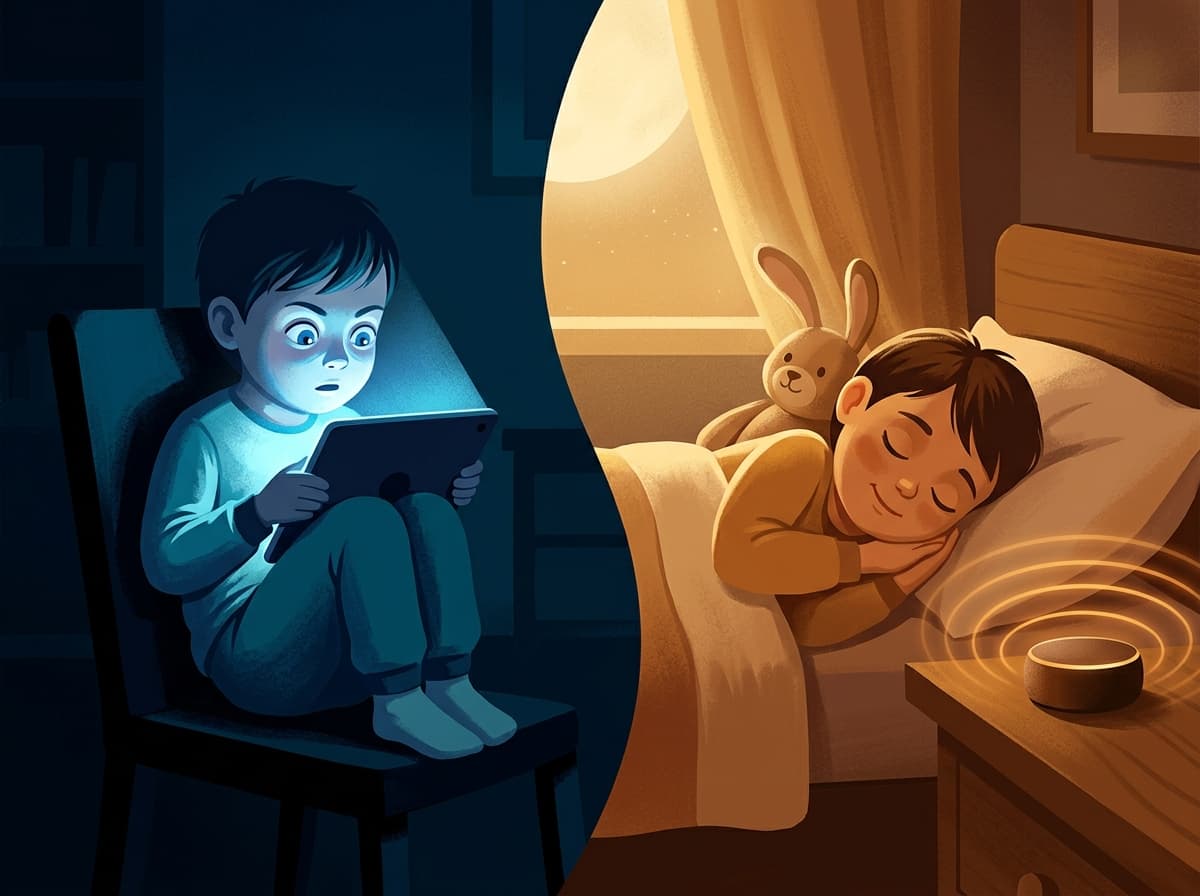
Light — any light — suppresses melatonin production. This is normal during the day. The problem starts when artificial light floods your child's eyes in the hour before bedtime, at exactly the moment melatonin should be rising.
And here is the part that surprises most parents: children are dramatically more sensitive to this effect than adults.
A research team at the University of Colorado Boulder has spent years studying this exact question, and their findings are striking. In one study, preschoolers exposed to bright light before bedtime experienced an 88% drop in melatonin levels. In a follow-up study with 36 children (Hartstein et al., 2022, Journal of Pineal Research), the researchers tested a wide range of light intensities — from 5 lux (dimmer than a single candle) to 5,000 lux (a brightly lit room). Melatonin was suppressed by 70-99% across all intensities.
That finding deserves repeating. Even very dim light — the glow of a nightlight, the ambient light from a hallway — suppressed melatonin by at least 70% in preschool-aged children.
And the effect did not end when the light was turned off. In more than half of the children tested, melatonin levels had still not recovered 50 minutes after the light exposure ended.
Why are children so much more affected than adults? The researchers explain that children's eyes are structurally different: their pupils are larger and their lenses are more transparent, allowing significantly more light to reach the retina. A comparable study in adults using 10 times the light intensity produced only a 39% melatonin reduction. Children's circadian systems are simply built differently — and far more sensitive.
The Three Ways Screens Disrupt Sleep
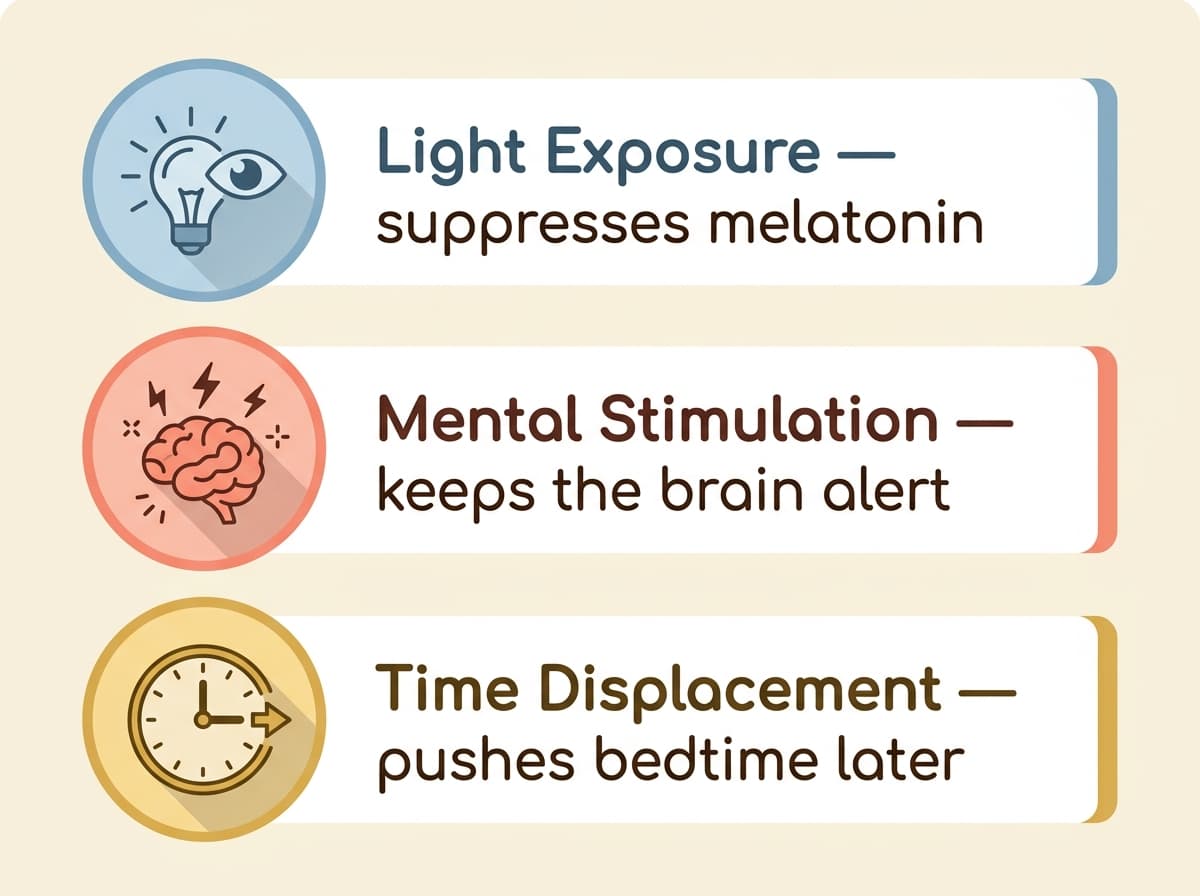
Light suppression of melatonin is the most well-studied mechanism, but it is not the only one. Researchers have identified three distinct pathways through which screens interfere with sleep.
1. Light Exposure
As described above, the light emitted by screens suppresses melatonin and delays the body's transition into biological nighttime. A tablet at full brightness held about one foot from a child's eyes in a dark room emits approximately 100 lux — far more than enough to trigger significant melatonin suppression in a preschooler.
This effect applies to all screens: phones, tablets, TVs, and laptops. The closer the screen is to the child's face and the brighter the environment, the stronger the effect.
2. Mental Stimulation
Not all screen content is equal. A large review of the research (published in Child and Adolescent Psychiatric Clinics of North America) found that interactive screen use — playing games, swiping through apps, watching fast-paced content — is significantly more disruptive to sleep than passive viewing.
Interactive screens keep the brain in an alert, problem-solving state. The brain gets a hit of dopamine from the engagement, which directly counteracts the drowsiness melatonin is trying to create. Even after the screen is off, the mental activation can linger, making it harder for a child to settle down.
A randomized clinical trial published in JAMA Pediatrics (2024) tested this directly. Researchers provided families with a "bedtime box" of non-screen activities and instructed one group to remove all screens in the hour before bed. The group that removed screens showed measurable improvements in sleep efficiency and fewer night wakings — suggesting that the content and the light both play a role.
3. Time Displacement
This one is simpler but often overlooked. Screen time before bed often pushes bedtime later. A child who starts watching a show at 7:30 is unlikely to be in bed at 7:45. The show runs long, the child begs for one more episode, or the parent loses track of time. Every minute of screen time at the end of the day is a minute taken from sleep.
A cross-sectional study of over 2,900 children in Hong Kong found that each additional hour of electronic device use was associated with a decrease of 6-11 minutes of sleep per night. A similar study of 736 children in Finland found a 10-minute reduction per additional hour of screen time. These might sound small, but over a week, that is an hour or more of lost sleep — and the effects accumulate.
What the Research Actually Shows (The Nuanced Version)
Here is where intellectual honesty matters, because the research is not as one-dimensional as most headlines suggest.
A 2024 study published in JAMA Pediatrics (Brosnan et al.) used an innovative approach: instead of relying on parent questionnaires, researchers attached wearable cameras to 79 adolescents to objectively measure exactly how much screen time they had before bed. Their finding: screen use in the two hours before bed, in general, had minimal association with most sleep outcomes. The exception was interactive screen use and multitasking, which were associated with delayed sleep onset.
What does this mean? It suggests that the problem is not as simple as "all screens are bad." The type of screen interaction matters. Watching a calm show while sitting on the couch is different from playing a fast-paced game on a tablet in bed. Passive use in a lit room is different from holding a bright screen close to your face in a dark bedroom.
For preschoolers, however, the bar is lower because of their extreme sensitivity to light. Even calm, passive screen use exposes their eyes to enough light to significantly suppress melatonin. For this age group, the AAP's recommendation of no screens for at least one hour before bed remains well-supported.
The Realistic Approach: What to Do Instead
Telling a parent to "just stop using screens before bed" without offering alternatives is unhelpful. The reality is that screens serve a function — they keep children occupied while exhausted parents handle the end-of-day chaos. The key is finding replacements that are equally easy but do not sabotage sleep.
Here are seven screen-free alternatives that work for the hour before bed, ranked from easiest to most involved:
1. Audio Stories
This is the single best screen-time replacement for bedtime. An audio story gives your child a narrative to follow — keeping them engaged and still — without any light exposure. It works whether you are in the room or not, and it doubles as a powerful sleep cue when used consistently.
DreamLoo's free audio stories are narrated in a calm, soothing voice with gentle background music, designed specifically for the transition to sleep. Unlike a screen, your child can lie in bed with their eyes closed and simply listen.
For the science behind why this works, see our article on why bedtime stories help kids sleep.
2. Reading Together
If you have the energy, nothing beats reading a physical book together. The research is clear that shared reading activates brain regions associated with empathy and emotional understanding in ways that screens do not. It also builds vocabulary, strengthens your bond, and serves as a natural sleep cue. Even 10 minutes is enough.
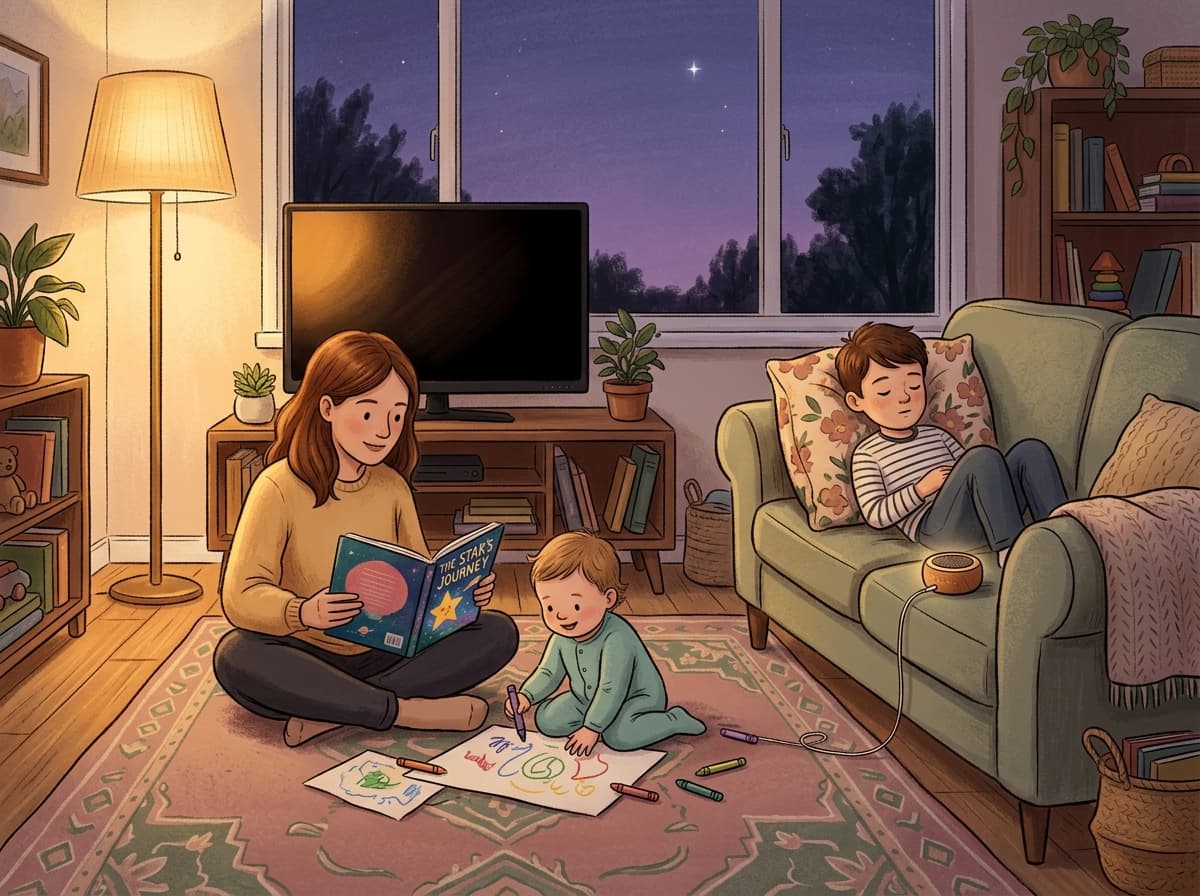
3. Drawing or Coloring
Give your child a few crayons and a blank piece of paper — under a dim, warm light. Drawing is calming, requires no setup, and keeps small hands busy without stimulating the brain the way a screen does. Many parents find this works well during the wind-down period before the actual bedtime routine begins.
4. A Warm Bath
A warm bath is a physiological sleep trigger. When your child's body temperature drops slightly after leaving the warm water, it mimics the natural temperature decline that occurs as we fall asleep. This signals the brain to start the sleep process. You can combine this with dim lighting and quiet conversation for maximum effect.
5. Gentle Yoga or Stretching
Even very young children can do simple stretches: reaching up high like a tree, curling into a ball like a hedgehog, breathing slowly like a sleeping bear. This is calming, physically satisfying, and teaches your child a skill they can use to self-regulate for the rest of their life.
6. Breathing Exercises
This works surprisingly well with toddlers. Place a small stuffed animal on your child's tummy and ask them to make it "ride the wave" by breathing in slowly and out slowly. Even 18-month-olds can do a simplified version. It calms the nervous system and gives the child a sense of mastery over their own body.
7. Gratitude or "Best Part" Conversation
Ask your child: "What was the best part of your day?" This simple question does three things. It shifts their attention away from the stimulation of the day. It creates a moment of connection between you and your child. And it gives them something warm and positive to hold in their mind as they fall asleep.
For more detailed ideas, see our full guide to calming bedtime activities for kids.
How to Make the Transition (Without a Meltdown)
If your child currently watches a show or plays on a tablet before bed every night, going cold turkey will likely result in protest. Here is a gentler approach:
Week 1: Move screens to 30 minutes earlier. If your child usually watches until 7:30, cut it off at 7:00 and fill the gap with one of the activities above.
Week 2: Replace the last 15 minutes of screen time with a new wind-down activity. Audio stories work particularly well because they still feel like "entertainment" — your child gets a story, just without the screen.
Week 3: Shift to fully screen-free for the final hour before bed. By now, your child has a new routine, and the transition will be much smoother.
Be consistent. The research shows that it takes only a few nights for new routines to take hold. You are not fighting your child — you are helping their body do what it naturally wants to do: sleep.
Lead by example. If your child sees you scrolling your phone during the bedtime routine, your words lose power. Try putting your own phone in another room during the last hour of the evening. You might be surprised how much better you sleep too.