

You read The Boy Who Cried Wolf to your six-year-old, who finds it more interesting than instructive and asks why nobody just came to help. Two days later, the same child invents an elaborate story about not eating dinner. You are left wondering: do moral bedtime stories actually do anything?
The honest answer from the research is: yes — but not the ones most parents reach for first.
In a striking 2014 study, psychologists Lee and colleagues tested classic moral stories on children. They read kids one of three tales — Pinocchio, The Boy Who Cried Wolf, or a story about young George Washington choosing to tell the truth about chopping down a cherry tree — and then gave them an opportunity to lie. The cautionary tales did nothing. Children who heard about Pinocchio or the boy lying about wolves lied at the same rate as the control group. The children who heard about Washington — a story where honesty is positively rewarded — lied significantly less (Lee et al., 2014).
This single study reshapes how we should think about bedtime stories with moral lessons. The lesson does not come from a punishment plot. It comes from a hero a child wants to be like. This article unpacks why that is, what makes a moral story land, the six lessons worth telling, and the kinds of "moral" stories that backfire.
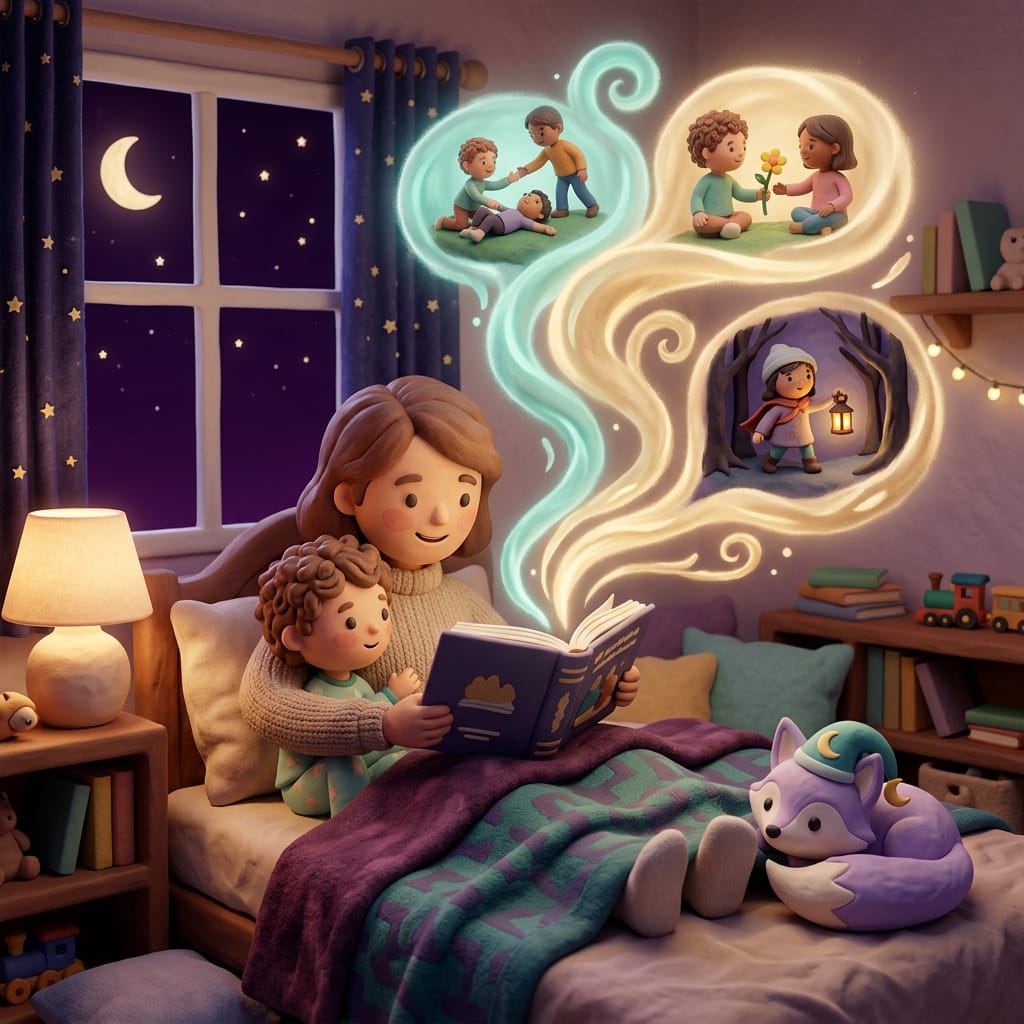
Why moral stories work at all
Stories are how humans have always passed down what matters. The neuroscience is now catching up with what every culture has practiced. When a child listens to a story, their brain runs a simulation of being inside it — the same regions that handle real social experience light up for imagined ones (Mar, 2011). A story is, in Mar and Oatley's phrase, "the simulation of social experience" — and simulating the experience of being honest, brave, or kind is practice.
Children also learn powerfully through observation. Bandura's classic work on social learning showed that kids absorb behaviors and consequences by watching models, real or fictional. A character a child likes and identifies with becomes, briefly, a template — that is the kind of person I could be. This is why moral identity matters more than moral rules in long-term character: kids do not become honest because they remember the rule against lying; they become honest because somewhere along the way they came to think of themselves as an honest person (Hardy & Carlo, 2011).
Bedtime stories with moral lessons, told well, do two things at once. They give a child a simulation of the right choice — what does it feel like to share? — and they offer them a model of who they could be — that helper, that brave one, that kind one. That is real developmental work, not just nice ambient values.
The Lee 2014 surprise: which moral stories actually change behavior
The mainstream picture of "moral story" in many parents' minds — a cautionary tale where bad behavior gets punished — is exactly the kind the Lee study found did not work.
Why?
Punishment-framed stories trigger fear, not identification. A child can absorb that a character was punished without translating it into "I shouldn't do that," especially because their developing brain is more drawn to the action than the consequence. The Pinocchio reader can finish the story with the takeaway "noses are funny," not "honesty matters."
Positive-framed stories invite the child in. When the hero is rewarded for being honest — admired, trusted, embraced — the child's mind models them. The simulation is I could be that kid, and that identification carries into behavior.
This connects to a separate landmark finding: telling young children "be a helper" is more effective than telling them "to help" (Bryan, Master & Walton, 2014). The first invokes identity (the kind of person I am); the second is just a verb. Stories that show characters being honest or brave invoke identity. Stories that show characters being punished for failing to be honest or brave invoke fear and avoidance — a much weaker behavioral lever.
The implication for bedtime: pick stories where the right choice is shown being made, valued, and rewarded. Skip stories whose engine is punishment.
What makes a moral lesson land
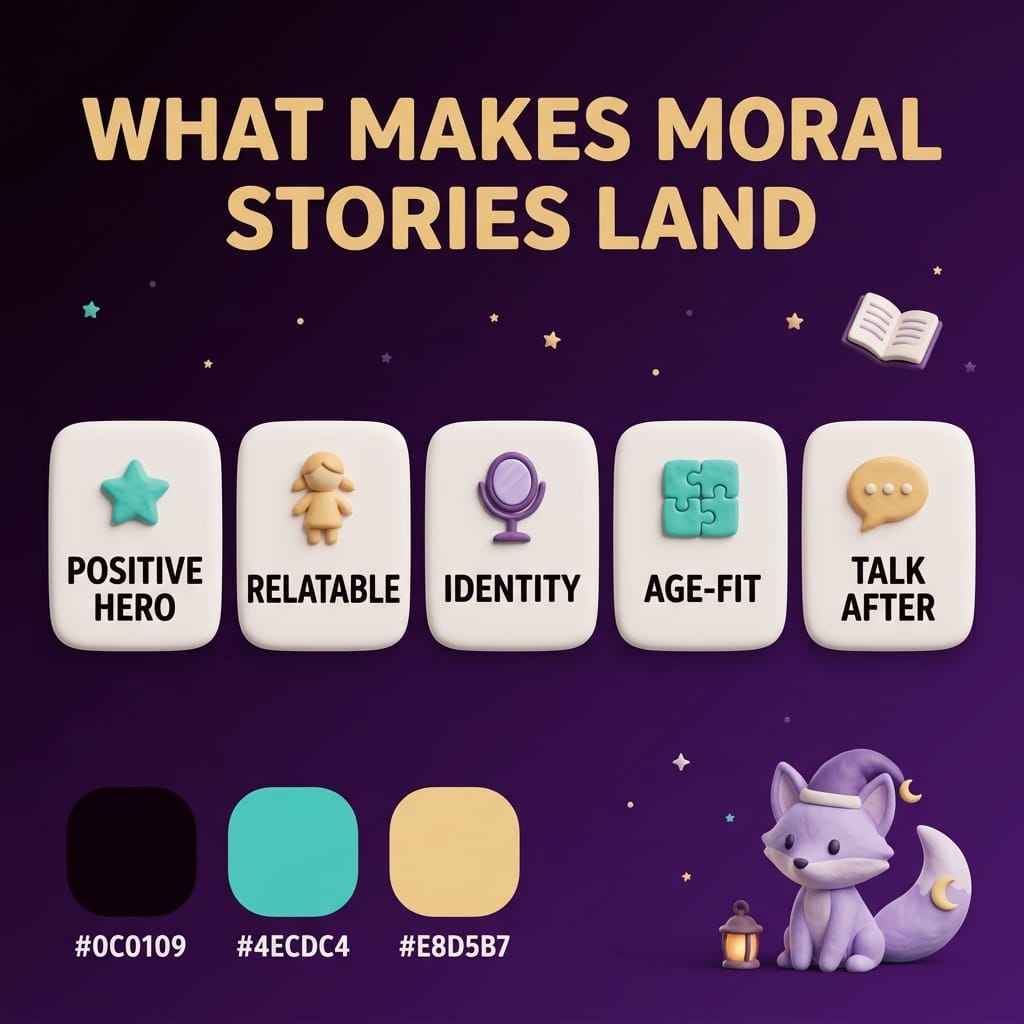
Five features show up again and again in research and practice:
- A positive hero who chooses the virtue. Not a villain who fails it. The model is the lever, not the consequence.
- Relatability. A child-aged or kid-coded protagonist beats an adult or an abstract animal in a generic landscape. The closer the hero is to the listener, the stronger the identification.
- Identity framing. "She is a helper." "He is brave." Naming the character with the trait shifts the simulation from action to identity, which is what carries forward (Bryan et al., 2014).
- Age-appropriate emotion. Strong enough that the child feels something; gentle enough that they are not overwhelmed. Bedtime is not the place for harrowing.
- Room to reflect, not a moral lecture. End on the action and the warm consequence; let the child do the thinking. A brief open question is better than a verdict.
Match those five and a bedtime story does real character work. Miss them — especially the first two — and you have a tale, not a lesson.
Six moral lessons worth telling
A short, opinionated list of foundational themes that work at every age. For each, the test is whether your version has a positive, relatable hero choosing the virtue and being honored for it.
Kindness. A small character notices someone struggling and helps, quietly. The reward is the warmth of the moment and the gratitude of the helped. This is the easiest theme to find well, and the one that lays the foundation for every other.
Honesty. A character chooses to tell a hard truth and is trusted, embraced, or freed by it. The Washington story Lee tested is the archetype. Avoid stories where the lesson is fear of being caught.
Courage. A small character is afraid of something — the dark, a new place, a hard thing — and does it anyway, gently. (For nighttime, this overlaps with our guide on a child afraid of the dark.) Bravery is best shown as small and choosing, not big and dramatic.
Perseverance. A character tries, fails, rests, tries differently, succeeds. Quietly powerful for any child working at something hard. Avoid versions that mock the failures.
Sharing and empathy. A character recognizes that someone else feels something — and acts on it. Fiction is one of the best tools for theory of mind (Mar, 2011), and sharing stories give the simulation a concrete shape.
Responsibility. A character cares for something — a pet, a plant, a sibling — and the care matters. Best as a steady, ordinary plot rather than a crisis.
Stories chosen for your child. Dreamloo's personalized audio bedtime stories put your child by name into gentle, brave, kind narratives — with the positive-hero framing the research says actually works, told in the calm wind-down voice bedtime needs.
Moral stories by age
Toddlers (1–3 years). Keep it concrete and single-action. Bunny shared. The other bunny smiled. Toddlers absorb moral patterns through what they see characters do, not through reasoning. Repetition matters: the same simple kindness story across many nights does real work.
Preschoolers (3–6 years). The character-building sweet spot. Preschoolers are actively constructing their sense of fairness, right and wrong, and "what kind of kid am I?" Stories with a small, relatable hero making a kind, honest, or brave choice are deeply absorbed at this age. This is also where heavy moralizing starts to backfire — preschoolers can sniff a lecture.
School-age (6–10 years). Now nuance lands. The hero can face a real dilemma, where doing the right thing costs something. Chapter stories with morally interesting characters — friendships, fairness, courage in social situations — work better than simple parables now. A school-age child can also handle a less-than-perfect hero who grows, which is closer to real life.
What to skip
Some popular "moral" story types quietly do little or nothing — and a few do harm.
Punishment-as-lesson tales. As Lee 2014 found, cautionary tales where the wrongdoer is punished tend not to change behavior. The child remembers the spectacle, not the principle.
Fear-as-lesson stories. A scary creature that eats children who lie, or a witch who steals naughty kids — these stick because they frighten, but the lasting takeaway is fear of consequences, not internalized values. Bedtime amplifies that fear effect, which is the opposite of what you want at lights-out.
Heavy-handed didactic stories. Stories that end with "And the moral of this story is…" stated explicitly tend to read as lectures and weaken identification with the character. Show the act, show the warm outcome, let the lesson live in the child's mind.
"Lessons" that target the kid's specific behavior too obviously. A story written by a parent to punish a real lie or a real tantrum is usually transparent to the child and damages the safe-ground feeling of story time. Use stories for general character, not for trial proceedings.
Stories where adults always solve everything. A child who never sees a kid-protagonist resolve something on their own gets a weaker identity-with-the-virtue signal. Let small heroes do their small heroic things themselves.
How to talk after the story
The lighter the touch, the better. One open question — What would you have done? Why do you think she shared? How do you think he felt right after? — beats any verdict. If the child does not want to discuss it, that is fine; the simulation already happened.
Two things to avoid: quizzing the child to check they "got it," and connecting it too pointedly to their own behavior at the dinner table. Both turn a story into a stealth-lesson and tax the trust of bedtime. Stories live in the child longer when adults handle them lightly.
For more on how stories also build empathy and emotional understanding, see how stories develop children's imagination and why bedtime stories help kids sleep.
Common Questions from Parents
Do I need to read "moral" stories every night, or just sometimes?
Just sometimes. The character work is cumulative — a kindness story once or twice a week, woven in naturally with picture books and adventures, is plenty. Every-night moralizing turns story time into instruction time and the child senses it. The bigger lever is the consistency of any nightly story routine, not the proportion that carries an explicit lesson. Strong characters who happen to be kind, brave, and honest in adventure stories do most of the moral work invisibly.
My child laughed at the punishment in a moral story — should I be worried?
No. Young children often respond to the dramatic part of a story without registering the intended consequence — which is exactly the Lee 2014 finding. The laugh tells you the punishment was vivid; it does not tell you anything about your child's empathy or future behavior. If the response feels off, that's a signal that the story missed, not the child. Try one with a positive hero instead; you will likely get a different reaction.
Can audio bedtime stories carry moral lessons as well as read-aloud books?
Yes, and sometimes better. A calmly narrated audio story can deliver the same positive-hero, identity-framed model without requiring a tired parent to perform. The child still simulates the experience, still identifies with the protagonist, still absorbs the values shown — the language and the model do the work either way. The trade-off is the lost cuddle of being read to, so the ideal is both: live reading when you can, audio when you can't.
What if my values are different from those in a traditional story?
Use the story as a starting point. Briefly name the difference — "In our family we think about this a little differently…" — and then let the question hang for the child to think about. Mismatched values are a feature, not a bug; they are exactly the kind of thinking a story is meant to provoke. The goal is not for every story to perfectly mirror your household, but for stories to expand the moral imagination your child can draw from.