

Your five-year-old watches a friend fall on the playground and freezes. Not unkind — just unsure what to do. You wonder, gently and not for the first time: can you actually teach a child to feel with other people, or does that just unfold on its own?
The answer from a couple of decades of research is encouraging: empathy develops, on its own timetable, but the inputs a child gets — especially the stories they grow up with — measurably shape how strongly and how early. In a 2010 study by Mar and colleagues, the number of children's storybooks a preschooler had been exposed to significantly predicted their theory of mind — the ability to understand that other people have thoughts and feelings different from their own (Mar, Tackett, & Moore, 2010). A landmark adult study found that even short bouts of reading literary fiction temporarily improved scores on theory-of-mind tests (Kidd & Castano, 2013).
Stories work because they are, in cognitive scientist Raymond Mar's phrase, "the simulation of social experience." Every time a child enters a story, their brain runs a small version of feeling what someone else feels. Done well, often, over years, that becomes empathy. This article covers exactly how to do it well — what empathy is, how stories grow it, which kinds work best, how to read them, and a simple plan to start tonight.
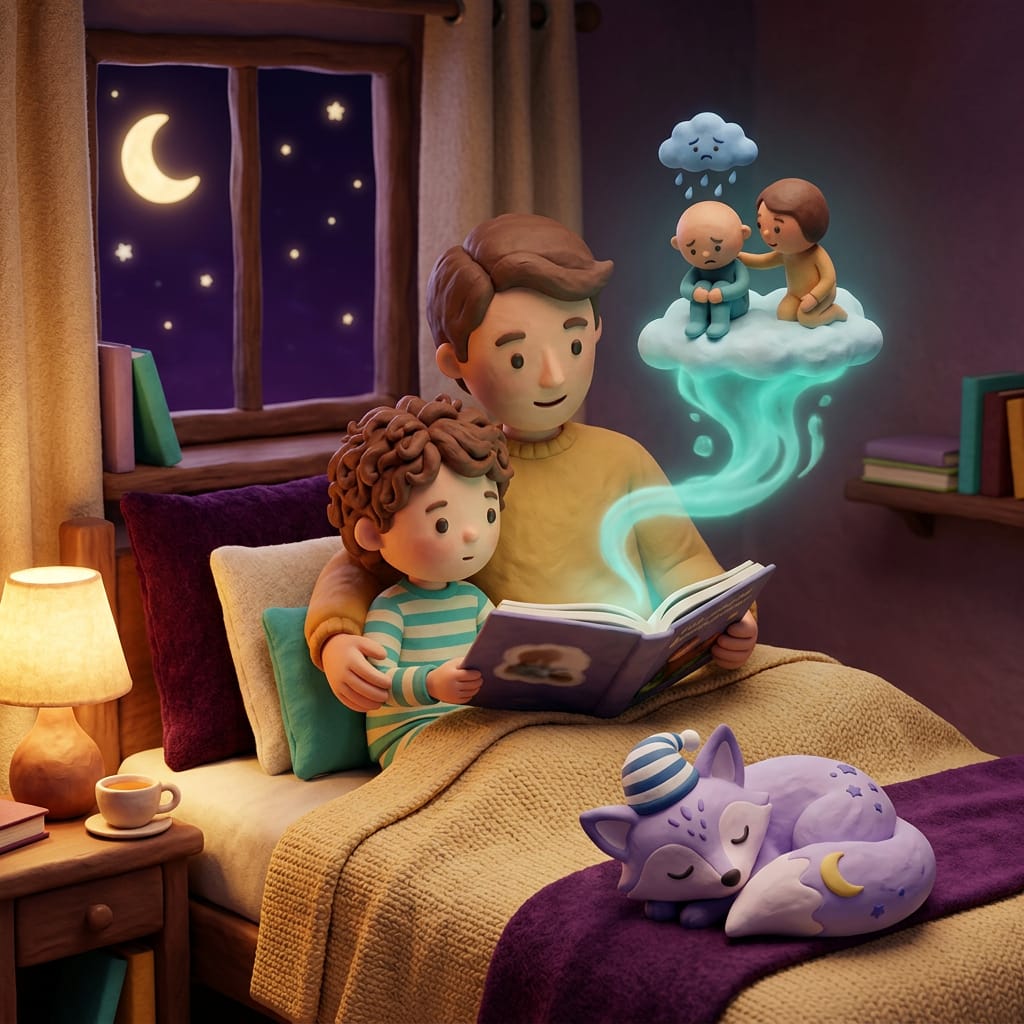
What empathy actually is
The word covers two related but distinct skills.
Cognitive empathy — also called theory of mind — is the ability to understand that another person has thoughts, beliefs, and feelings that may be different from one's own, and to roughly figure out what they are. ("She thinks the box has crayons in it, but it actually has rocks.")
Affective empathy is the ability to feel an emotional response to another's feelings — sympathy, distress at their distress, joy at their joy.
A whole, kind person uses both. Stories happen to be unusually good at building both at once: they show inner lives explicitly (cognitive) and they evoke emotional response (affective). This is part of why stories are the empathy lever they are — there is no other everyday activity that exercises both halves so reliably.
The science: how stories build empathy
The mechanism is not metaphorical. fMRI work shows that comprehending a story activates the same brain networks used to understand real social situations and other people's minds (Mar, 2011). Reading or listening to a story is, neurologically, social practice.
The behavioral evidence stacks up across ages:
- Preschoolers: Mar, Tackett, and Moore (2010) found that the more children's storybooks a child had been read, the stronger their theory of mind, even after controlling for age, vocabulary, and parent income. Television exposure did not show the same effect — the gain was specific to storybooks.
- School-age and adult: Mar and colleagues' earlier work found that lifetime fiction reading predicted higher social ability, while non-fiction reading did not (Mar et al., 2006). The 2013 Kidd and Castano paper in Science showed that even brief exposure to literary fiction lifted theory-of-mind performance in adults.
- The interaction matters. Adrián and colleagues (2007) followed mothers and their preschoolers and found that mothers who used more mental-state language during reading — "thinking," "feeling," "wondering," "remembering" — had children with stronger theory of mind a year later. It is not only the story; it is how a parent reads it.
The headline: empathy can be cultivated, stories are one of the most evidence-backed tools, and the way a story is told and discussed amplifies the effect.
What kinds of stories build empathy best
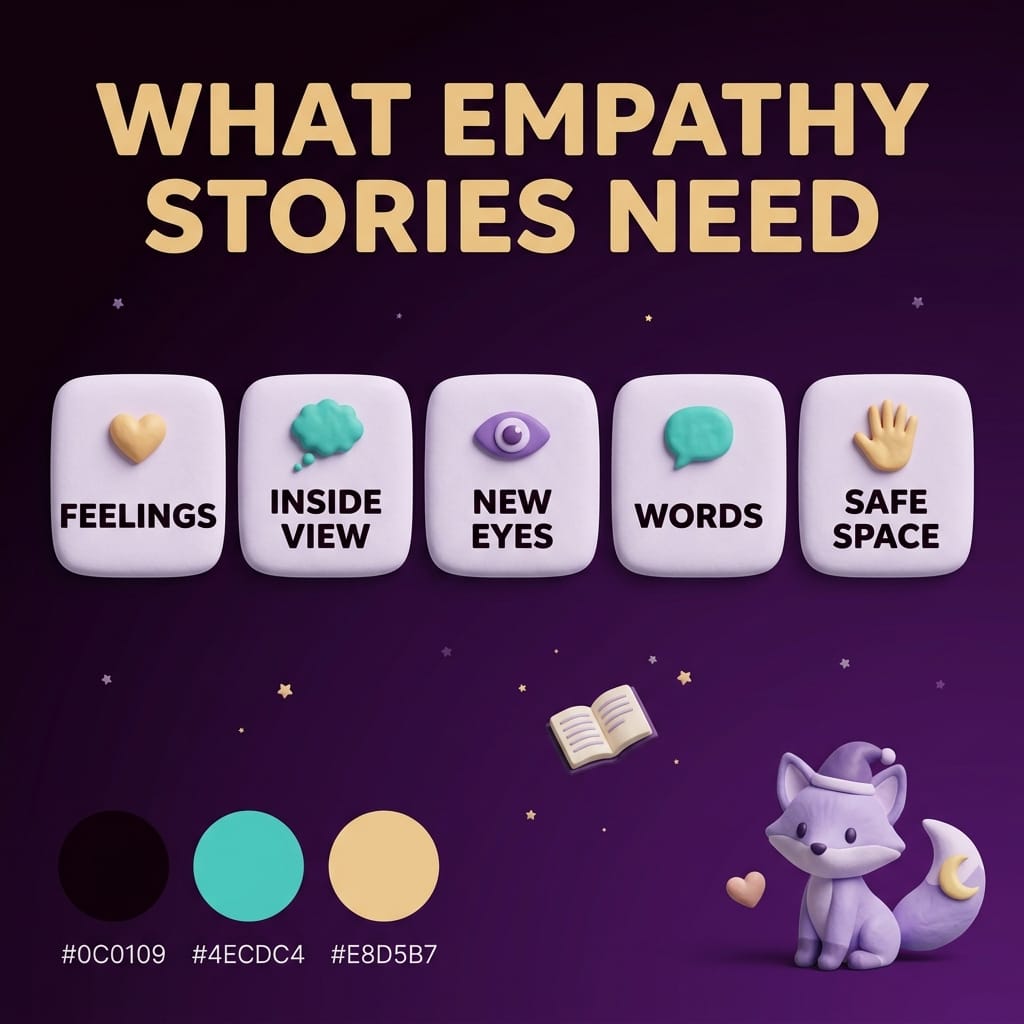
Five features show up in the empathy-building stories that work:
- Real feelings. Characters experience genuine emotional states — sadness, fear, frustration, longing — rendered with enough specificity that the child can feel them. Books that flatten feelings to labels do less work than books that show them in motion.
- Inside view. The story gives the child access to the character's thoughts, not just their actions. He felt his stomach tighten. She thought maybe nobody would come. This inner narration is exactly what builds theory of mind.
- A different perspective. The story shows a character whose situation, background, or response is different from the child's own. Perspective-taking is exercised by encountering perspectives to take.
- Emotional vocabulary. Words for feelings, used naturally — disappointed, embarrassed, relieved, jealous. Stories that name emotions give a child the toolkit to name their own and others'.
- A safe, age-appropriate tone. Especially at bedtime: depth without distress. The story can show hard feelings; it should not overwhelm.
When choosing or telling an empathy story, run it against these five. If three or more are clearly present, you have a story worth a place in the rotation.
Empathy by age
The shape of empathy work changes as a child grows.
Toddlers (1–3 years). Foundation: naming feelings and noticing them in others. Simple picture books that label emotions — he is sad, she is happy — give the toddler an emotional vocabulary to start mapping onto themselves and the people around them. Toddlers already show pro-empathic responses around 18 months (Vaish, Carpenter, & Tomasello, 2009); stories help label what they are already sensing.
Preschoolers (3–6 years). The window where theory of mind comes online. This is the prime age for stories with characters who think and want and feel — and where the difference between what a character knows and what the reader knows can be played with. Picture books about misunderstandings, friendship hiccups, or a character whose situation is gently different from the child's own are gold here.
School-age (6–10 years). Now nuance lands. Characters can be morally mixed, situations ambiguous, and stories can sit with discomfort. Chapter books with friendships, fairness, exclusion, and growth become deeply formative. This is also the age where stories about people very different from the child — different family shapes, abilities, neighborhoods, histories — expand the empathy radius further.
Stories built for the empathy window. Dreamloo's personalized audio bedtime stories feature relatable child-aged characters with real feelings, inner thoughts, and gentle perspective shifts — the exact ingredients the research connects to empathy growth, told in the calm voice bedtime needs.
How to read empathy stories well
The Adrián finding deserves a practice. Try these as you read:
- Use mental-state words. "I wonder what she is thinking right now." "He must be feeling worried." Lightly seeded across a story, this single habit reliably grows a child's theory of mind.
- Pause to wonder. Brief, open: Why do you think she did that? How might he be feeling? What would you have done? Wonder, not quiz.
- Name the emotion when the child reaches for it. "Yeah, that sounds like he was embarrassed." You are handing them vocabulary.
- Sit with the hard parts briefly. A character feeling left out is uncomfortable, and that discomfort is the empathy work. Resist the urge to rush past it or fix it.
- Reread favorites. Repeated readings let the child notice the inner-life details they missed first time. Empathy deepens with familiarity.
- Connect lightly to life, occasionally. "Have you ever felt that way?" Once in a while; not as a homework assignment.
For more on talking with children during reading without turning it into a lecture, see the benefits of reading to kids every night.
What to skip
A few story patterns do less empathy work — or undo some.
Pure-villain stories. A character who is simply bad, with no inside view, gives the child nothing to step into. Conflict needs complexity to build empathy.
Lectures dressed as stories. "And the moral of this story is to be kind." We covered this in depth in moral lessons in bedtime stories: heavy-handed framing weakens identification. Show; don't preach.
Books that flatten feelings. "He felt sad. Then he felt happy." Without specificity or inner thought, these do little. Look for stories that render emotion in motion.
Tear-jerkers at bedtime. Empathy does not require devastation. At bedtime especially, gentle depth beats heart-wrenching. Save the heaviest stories for daytime.
A 7-day empathy story plan
A small, runnable rotation to start this week. Use what you already own; the principle is the mix, not the titles.
- Day 1 — Feelings book. A simple picture book that names emotions. Foundation.
- Day 2 — Friendship hiccup. A story where two characters misunderstand each other and repair. Perspective-taking in action.
- Day 3 — Different family / different life. A character whose situation is gently different from your child's. Expands the empathy radius.
- Day 4 — Helper hero. A story where a small character chooses kindness when it costs something. Pairs with the positive-hero framing from moral lessons in bedtime stories.
- Day 5 — Inside-the-head story. A book heavy on a character's thoughts and inner world. Builds theory of mind directly.
- Day 6 — Audio empathy story. A calm narrated story your child listens to with eyes closed. Imagination supplies the rest.
- Day 7 — Their favorite. Reread anything the child asks for. Empathy work consolidates with familiarity.
Run this for a few weeks. You will start noticing the child reaching for emotion words, pausing at moments in real life that mirror moments from stories, sometimes offering small unprompted comfort to a sibling or a friend. That is the work, doing what it does.
Common Questions from Parents
My child seems to relish "mean" characters and roots for the wrong side — is that a problem?
Almost never. Children can find villains, mischief, and rule-breakers fascinating without that meaning anything worrying about their empathy. The fascination is often with power, danger, or transgression — all normal things to explore safely inside a story. What matters more is whether your child can also engage with characters who feel things deeply, take perspectives, and choose kindness in other stories. A balanced reading diet handles the villain-rooting phase on its own.
Does watching shows about feelings count, or only books?
Mar's preschool research found the empathy effect specifically for storybooks, not television (Mar et al., 2010). That doesn't mean shows do nothing, but the story-listening or reading mode seems to engage the simulation more fully — because the child is constructing more of the inner life themselves, rather than receiving it ready-made. Books and audio stories are the strongest tools for this; thoughtful video can be a useful add-on, not a substitute.
Can stories help a child who is on the autism spectrum or has trouble with perspective-taking?
Stories can be a useful, non-pressured tool for many neurodivergent children, especially picture books that explicitly label feelings and thoughts. But individual needs vary widely, and serious or sustained difficulty with perspective-taking warrants a conversation with a pediatrician or developmental specialist, not just a reading list. Treat empathy stories as one supportive tool alongside whatever professional support is appropriate.
How long does it take to see empathy grow from stories?
There is no fixed timeline, but the effect is cumulative and often becomes noticeable over weeks and months of consistent story exposure, not days. The clearest early signs: your child reaching for an emotion word they hadn't before, asking why a character did something, or unprompted offering a kind gesture that mirrors a story moment. Don't watch for it intently — that pressure backfires. Read consistently, read with mental-state language, and the work happens quietly underneath.