

Your four-year-old is narrating again. The couch cushions are a boat, the dog is the captain, the carpet is "lava but the friendly kind," and there is an elaborate rule about which pillow is safe. You half-listen while making dinner. It is adorable, a little exhausting — and easy to file under "just playing."
It is not just playing. That running narration is a brain building one of its most important tools. To imagine is to construct something that is not in front of you — a skill that turns out to sit at the center of problem-solving, planning, empathy, and creativity. And the single best fuel for it, decades of research suggests, is stories.
A 2015 study at Cincinnati Children's scanned preschoolers' brains as they listened to stories and found that children who heard more stories at home showed greater activation in the regions responsible for language and mental imagery — the brain literally building pictures from words (Hutton et al., 2015). This article explains what imagination actually is, how stories develop it, why that matters far beyond childhood, and how to feed it at home — including the one thing screens cannot do.

What imagination actually is
Strip away the whimsy and imagination is a specific cognitive act: simulating something not physically present. When a child pictures a dragon, plans how to build a fort, or wonders how a friend feels, they are running the same core operation — constructing a scene in the mind.
Neuroscience calls this self-projection or mental simulation, and it draws on a network of brain regions also used for remembering the past and imagining the future (Buckner & Carroll, 2007). The striking finding is that imagining a future event and remembering a past one rely on overlapping machinery. The brain that imagines well is the brain that plans well, remembers richly, and understands others — because under the hood, these are versions of the same skill.
This reframes the couch-boat game entirely. The child is not escaping reality. They are practicing the foundational act of building a reality in the mind — the cognitive muscle behind nearly everything we call thinking.
How stories build the imagination muscle
Here is the mechanism, and it is simple. A story made of words gives a child raw material but not the finished image. "The old house creaked at the top of the stairs." To follow that sentence, the child has to build the house, the stairs, the creak, the dark — none of it supplied, all of it generated.
That generation is the workout. Every story a child hears or reads is a set of reps for the imagination: take these words, build this world. Mar's review of the neuroscience of story comprehension shows that understanding narrative recruits exactly the brain systems used for imagining scenes and simulating other minds (Mar, 2011). Stories are not a passive pastime that happens to be wholesome; they are active mental construction, disguised as fun.
This is also why the same story reread builds imagination rather than dulling it. Each pass, the child fills in more — finer detail, richer voices, deeper sense of the characters. The world gets more vivid because the child is doing more of the building.
Why imagination is not frivolous
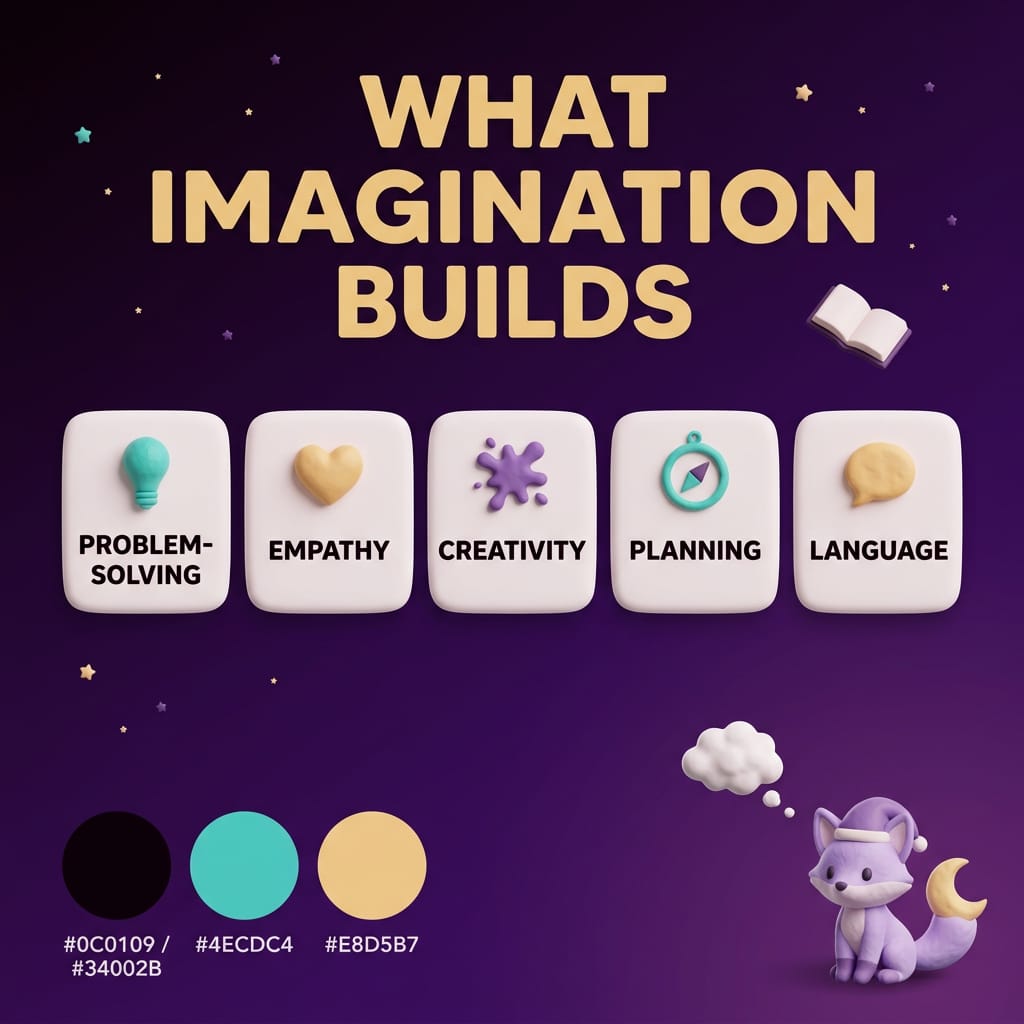
Imagination powers a surprising amount of serious cognition. Five payoffs, each with real support:
Problem-solving. To solve a problem you have not seen before, you must imagine possible solutions and mentally test them. That is simulation — the same skill stories exercise. A child who can build worlds in their head can build candidate answers in their head.
Empathy and social understanding. Fiction is, in Mar and Oatley's phrase, "the simulation of social experience" (Mar & Oatley, 2008). Every story asks the child to inhabit someone else's situation and feelings — direct practice for theory of mind, the understanding that other people have inner lives. Children with vivid imaginative play, including imaginary companions, tend to show stronger social understanding (Taylor & Carlson, 1997).
Creativity. Creativity is recombination — putting known things together in new ways. Imagination is the workspace where that happens. Stories stock the shelves with characters, places, and possibilities to recombine.
Planning and future thinking. Imagining the future uses the same brain network as imagining a story (Buckner & Carroll, 2007). A child who practices "what happens next?" in a story is practicing the mental time-travel behind planning.
Language. Building a world from words deepens vocabulary and comprehension at the same time — imagination and language grow together, each pulling the other forward.
The American Academy of Pediatrics took this seriously enough to issue a clinical report, The Power of Play, urging doctors to actively promote imaginative play as core to healthy development (Yogman et al., 2018). This is mainstream pediatric science, not a nice idea.
Stories vs screens for imagination
This is the distinction that matters most for modern parents, and it is not anti-screen scolding — it is mechanics.
A screen supplies the imagination's output pre-made: the dragon's exact shape, color, voice, and movement, all delivered. There is nothing left for the child to construct. A told or read or audio story supplies only the input — words — and leaves the entire construction job to the child. The dragon's color is whatever the child decides. The castle's size is theirs. The voice is theirs.
That gap between the words and the picture is precisely where imagination develops. Screens close the gap; stories open it. This is why audio and read-aloud stories are uniquely good imagination fuel — more so, in this specific respect, than even illustrated video. A child listening to a story in the dark is building an entire world from nothing but a voice. (For the broader trade-off, see audio stories vs reading for kids.)
The dark is the imagination's best canvas. A calm audio bedtime story at lights-out gives a child words and lets their own mind build the pictures — the exact mental workout that grows imagination, right as the day winds down. No screen to do the imagining for them.
Imagination at every age
What a child can build changes as they grow — and so should the stories.
Toddlers (1–3 years). Pretend begins around 18 months: feeding a doll, "talking" on a banana. Imagination here is concrete and tied to objects. Simple stories with clear characters and repeated phrases give toddlers patterns to imitate in their own play.
Preschoolers (3–6 years). The peak of make-believe. Elaborate pretend, imaginary companions, fantasy worlds, and the famous "why?" of a mind testing how everything works. Singer and Singer's classic research documented just how central this make-believe season is to development (Singer & Singer, 1990). Stories with adventure, gentle problems, and feelings give a preschooler rich worlds to enter and extend.
School-age (6–10 years). Imagination turns narrative and abstract: inventing stories, building rule-based games, reasoning about hypotheticals. Longer chapter stories, with plots that unfold over many nights, feed this stage — the child holds an entire imagined world in mind across days.
How to feed imagination at home
Practical, low-effort, tonight-ish:
- Tell and read stories daily. The single biggest lever. See the benefits of reading every night for the full case.
- Ask "what happens next?" Pause before a page turn and let the child invent. You are handing them the pen.
- Leave gaps; don't over-explain. Resist describing every detail. The unsaid is where the child's imagination goes to work.
- Use wordless or sparse picture books. They force the child to narrate, which is pure imaginative output.
- Let stories spill into play. When a story becomes a couch-boat game the next day, that is the imagination consolidating. Don't redirect it; join it.
- Protect unstructured, screen-light time. Boredom is often the doorway to imagination. A child with nothing to watch will eventually build something.
- Try "story-building" together. Take turns adding one sentence to an invented tale. Silly is fine; silly is the point.
Common worries, briefly
"My child tells tall tales — is that lying?" Usually not, especially under age 5 or 6. Young children blur the line between imagined and real as a normal part of development. Distinguish a fanciful story (imagination) from a deliberate cover-up (a different conversation). The first is healthy.
"The imaginary friend won't go away." Common and benign. Imaginary companions are linked to better social skills, not worse, and typically fade by school age (Taylor & Carlson, 1997). Worry only if the imaginary world causes real distress or crowds out all real connection.
"Their imagination scares them at night." A vivid imagination can conjure monsters as easily as castles. That is the same powerful tool pointed at fear. The fix is to channel it — gentle, brave stories that give the imagination somewhere reassuring to go. Our guide on a child afraid of the dark covers this in depth.
Common Questions from Parents
Can too much pretend play be a problem?
Almost never for young children — elaborate pretend is a sign of healthy development, not a warning. The "high season" of make-believe between ages three and six is supposed to be intense. Concern is only reasonable if a child seems unable to engage with reality at all, shows real distress inside the imaginary world, or avoids all real-world interaction. For the everyday child narrating epic sagas to the houseplants, more pretend is more development, not less.
My child only wants the same story over and over — does that limit imagination?
The opposite. Rereading the same story lets a child build the world more deeply each time, adding detail, anticipating events, and noticing layers they missed before. Repetition is how young children master narrative and language. The fortieth reading is doing real imaginative work, even if it tests your patience. You can gently introduce new stories alongside the favorite, but there is no need to ration the beloved one.
How do I rebuild imagination if my child is very used to screens?
Start small and expect a lag. A child accustomed to having images supplied may find story-listening "boring" at first, because the mental construction muscle is underused. Begin with short, vivid, engaging stories, dim the lights to remove visual competition, and be patient through the initial restlessness. Within a couple of weeks of regular story time, most children's capacity to build and enjoy their own mental images noticeably returns. The muscle rebuilds with use.
Does imagination matter for academic success?
Yes, though indirectly and powerfully. The skills imagination underpins — mental simulation, planning, comprehension, perspective-taking, creative problem-solving — are exactly the ones school and later life reward. A strong imagination is not opposed to "serious" learning; it is part of the cognitive foundation that makes serious learning possible. The child building couch-cushion boats is laying that foundation in plain sight.