

Your newborn falls asleep instantly in a noisy coffee shop. At home, in a quiet nursery, every floorboard creak jolts them awake. That is not bad luck — it is biology. Babies spend nine months inside a womb that measures roughly 80 decibels of constant, rumbling noise. Sudden silence is the strange part. Which is why white noise works so well, and why picking the right machine and setting it up correctly matters more than most new parents realize.
But there's nuance. White noise that's too loud, too close, or played for too long can cause harm. Different "colors" of noise work differently. And toddlers have different needs from newborns. This guide walks through what the research actually says, how to use white noise safely, how it compares to pink and brown noise, and the specific rules for babies versus toddlers.
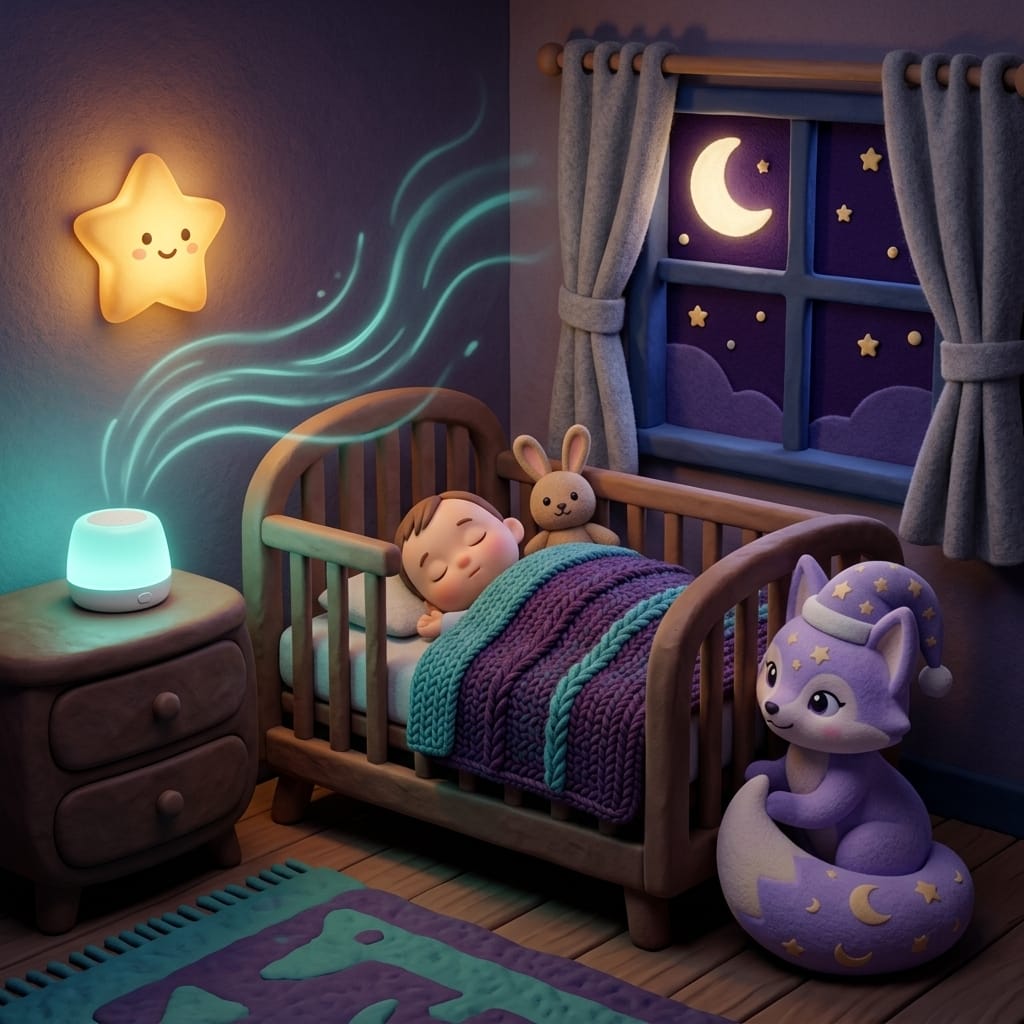
Does White Noise Actually Help Babies Sleep?
Yes — the evidence is consistent and goes back decades.
A landmark 1990 study published in Archives of Disease in Childhood by Spencer, Moran, Lee, and Talbert tested white noise on 40 newborns. Within five minutes, 80% of the babies exposed to white noise fell asleep, compared to only 25% of the babies in the control group. That is not a marginal effect — it is a three-fold increase.
More recent research has confirmed and expanded those findings. Work by Karakoç and Türker (2014) in the Turkish Archives of Pediatrics found that newborns exposed to consistent white noise during painful procedures like heel-prick tests cried less and returned to a calm state faster. A 2020 review in the Cochrane Database concluded that continuous background sound appears to help babies transition into and maintain sleep, particularly during the first three months.
Why does it work? Two main mechanisms:
It mimics the womb. In utero, babies hear a constant, low-level rush of sound — blood flow, the mother's heartbeat, muffled voices. Most measurements place the average womb sound level around 80–90 decibels of low-frequency rumble. When newborns enter the world, that sonic backdrop disappears. White noise provides something closer to what they are used to — a steady, predictable sound that signals everything is okay.
It masks disruptive stimuli. A quiet room is not actually quiet — it has a baseline of micro-noises (a sibling opening a door, a dog barking outside, your partner flushing the toilet) that can jolt a sleeping baby awake. White noise raises the ambient "floor," so those small spikes do not stand out as much. For toddlers and older kids, this is often the most useful effect.
The Safety Rules (These Are Not Optional)
White noise is only beneficial when used correctly. Get these wrong and you can do real harm, mostly to hearing.
A 2014 study by Hugh, Wolter, Propst, and colleagues, published in Pediatrics, tested 14 commercially available infant sleep machines. They found that all 14 machines could exceed 50 dB, the recommended maximum for infants, when played at full volume close to the crib. Three of them exceeded 85 dB — a level known to cause hearing damage with sustained exposure. This does not mean white noise machines are dangerous; it means parents need to use them correctly.
Rule 1: Volume ≤ 50 decibels
The American Academy of Pediatrics and audiology researchers consistently recommend staying at or below 50 dB for infant sleep environments. That is roughly the level of a quiet conversation or a soft dishwasher running in the next room. To measure: download a free decibel-meter app, open it, and hold the phone at your baby's ear height while the machine plays. Adjust the volume until the reading settles around 45–50 dB.
Rule of thumb without a meter: if you cannot hold a normal conversation from next to the crib without raising your voice, it's too loud.
Rule 2: Distance — at least 2 meters (about 7 feet) from the crib
Sound intensity drops quickly with distance — roughly 6 dB for every doubling of distance. Placing the machine on a dresser across the room instead of on the crib rail can cut the effective volume in half. Never put a white noise machine inside the crib, on the mattress, or attached to the crib rails.
Rule 3: Time-limit long sessions if possible
Continuous loud noise over many hours has been associated with auditory processing concerns in very young children (Chang & Merzenich, 2003, Science). Most research on this was done at higher-than-recommended volumes, so if you follow rules 1 and 2, overnight use is generally considered safe. If you want extra caution, use machines with a 1–2 hour timer that auto-fades, especially for daytime naps.
Rule 4: No white noise for babies with diagnosed hearing issues without an audiologist's input
If your baby has failed a newborn hearing screening or has known middle-ear issues, skip white noise until you have talked to your pediatrician or an audiologist. Sound masking can complicate diagnostic evaluation.
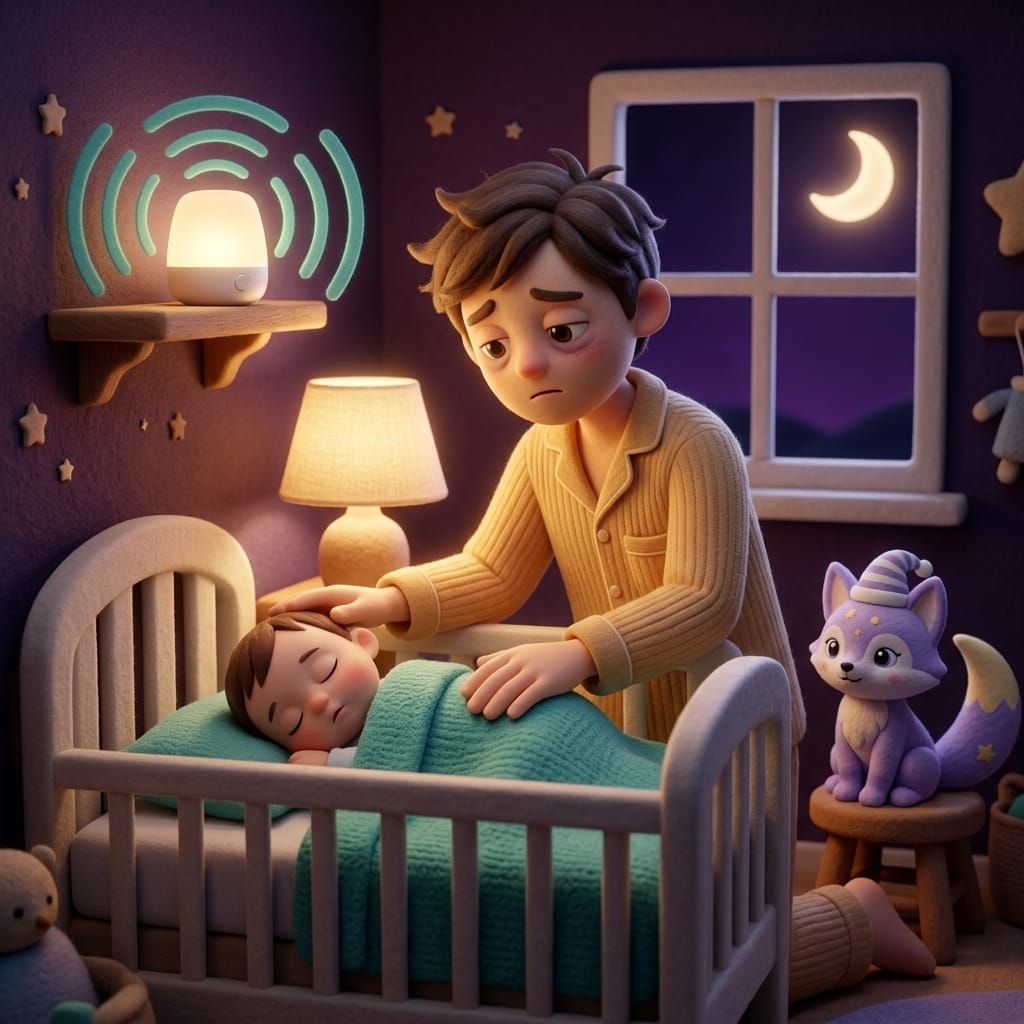
White Noise vs. Pink Noise vs. Brown Noise
Not all "noise" is the same. The "color" refers to how sound energy is distributed across frequencies.
White noise — bright, balanced, universal
White noise contains equal energy at every frequency the human ear can hear. It sounds hissy and bright, like untuned TV static or air conditioning. This is the most-studied sleep sound and the one in most research on infants.
Best for: newborns, masking sudden environmental sounds, loud neighborhoods.
Pink noise — softer, rainfall-like
Pink noise has more energy in the lower frequencies, so it sounds deeper and more natural than white noise — most people describe it as "steady rain" or "wind in trees." It is gentler on adult ears and, according to a small but interesting study by Zhou et al. (2012) in the Journal of Theoretical Biology, may help stabilize brain activity during deep sleep.
Best for: toddlers, older children, light sleepers, and parents who find white noise harsh.
Brown noise — deepest, waterfall-like
Brown noise emphasizes low frequencies even more heavily. It sounds like a distant waterfall or a deep rumble. Less studied for infants, but many adults and older kids find it the most soothing option.
Best for: toddlers and older children who need a deeper, less "hissy" sound to fall asleep.
Which should I use?
Start with white noise for newborns — the research base is strongest and its masking effect is more effective against sudden sharp sounds. When your child gets older (roughly 12 months and up), you can experiment with pink or brown noise to find what your specific child responds to best. Many machines let you switch between options.
Using White Noise with Toddlers
Toddlers are a different category from newborns. The womb-mimicking effect no longer applies, but the masking effect is often more useful — a toddler who has mastered walking, talking, and curiosity is easily woken by the same household noises they used to sleep through.
When white noise helps most for toddlers
- Shared bedrooms or walls — a sibling climbing into bed, a parent closing a door, traffic sounds.
- Light-sleeping toddlers who wake at 4–5 AM — white noise can bridge the sound-sensitive final sleep cycle.
- Travel and disruption — the sound becomes a portable routine cue that says "this is sleep time," whether you are in a hotel, grandparents' house, or at a cousin's sleepover.
- During the nap transition or other disrupted sleep stages — see our full guide to helping your child get enough sleep by age.
Toddler-specific volume guidance
Toddlers can tolerate slightly louder levels than newborns (50–55 dB at the ear), but the same principles apply: distance matters, and a conversation-level volume is always enough. Louder is not better.
Combining white noise with a bedtime routine
White noise is a sleep cue, not a sleep strategy. It works best as part of a consistent routine — bath, books, lights out, white noise on. For a full walkthrough of how to build one, see our bedtime routine guide.
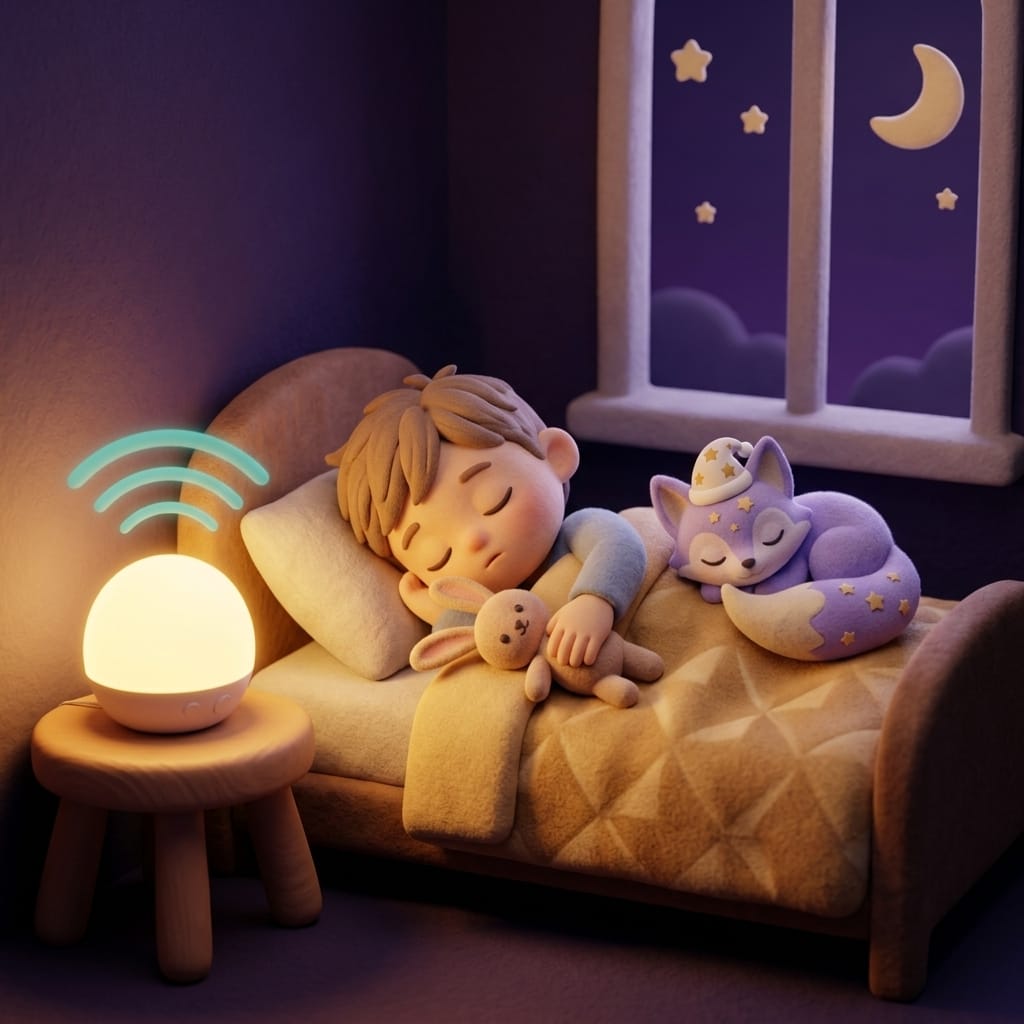
How to Pick a White Noise Machine
Here's what actually matters, stripped of marketing noise.
1. A real continuous loop — not a short repeating clip
Cheap machines loop a 2- or 3-second clip that sounds identical every cycle. Sensitive sleepers detect the loop and wake. Look for machines that generate actual continuous noise or use long, seamless loops.
2. A volume control with real low-end range
Some budget machines start at 65 dB even at their lowest setting — too loud for a newborn from across the room. Test the lowest volume with a decibel meter app before committing. If you cannot get it down to around 45–50 dB at crib distance, return it.
3. No auto-shutoff for overnight use
Many machines auto-shut-off after 30 or 60 minutes. If your baby relies on white noise to stay asleep, a sudden silence partway through the night will wake them. Look for a machine with either no timer or a "continuous" option.
4. Multiple sound options (nice to have)
White, pink, brown, or some variation of each lets you experiment as your child ages. Not essential for newborns; useful for toddlers.
5. Portable + plug-in options
A battery-powered compact model for travel, a plug-in model with a bigger speaker for the nursery. Most families end up with both.
6. Avoid: machines that also emit light, lullabies, or heartbeat sounds
These are heavily marketed, but the extra features are often unhelpful at bedtime. Blue light suppresses melatonin; varying lullabies break the masking effect; recorded heartbeat sounds are too short and loop obviously. A simple, single-purpose machine is almost always the right choice.
Free alternatives
You do not need to buy anything. A standing fan across the room is one of the most reliable white noise sources in the world. A dedicated app (played through a phone with airplane mode on, placed at least 2 meters away) works just as well for most families.
When White Noise Is Not the Answer
White noise is a tool. Like any tool, it solves some problems and not others. If your child is not sleeping and you've added white noise but nothing has improved, look elsewhere:
- Overtired baby/toddler. An overtired child often cannot fall asleep no matter how soothing the environment. Move bedtime earlier.
- Too much light. White noise helps with sound but does nothing for a room that is too bright. Blackout curtains often make a bigger difference.
- Sleep association stall, not noise sensitivity. If your baby falls asleep at the breast or bottle and can only re-settle that way, the issue is the association pattern, not the environment.
- Screen use before bed. Blue light and stimulation override any masking effect. See screen time before bed and kids' sleep.
- A medical sleep issue. Chronic snoring, breathing pauses, or frequent night waking with distress warrants a pediatrician visit — do not rely on white noise to cover symptoms.
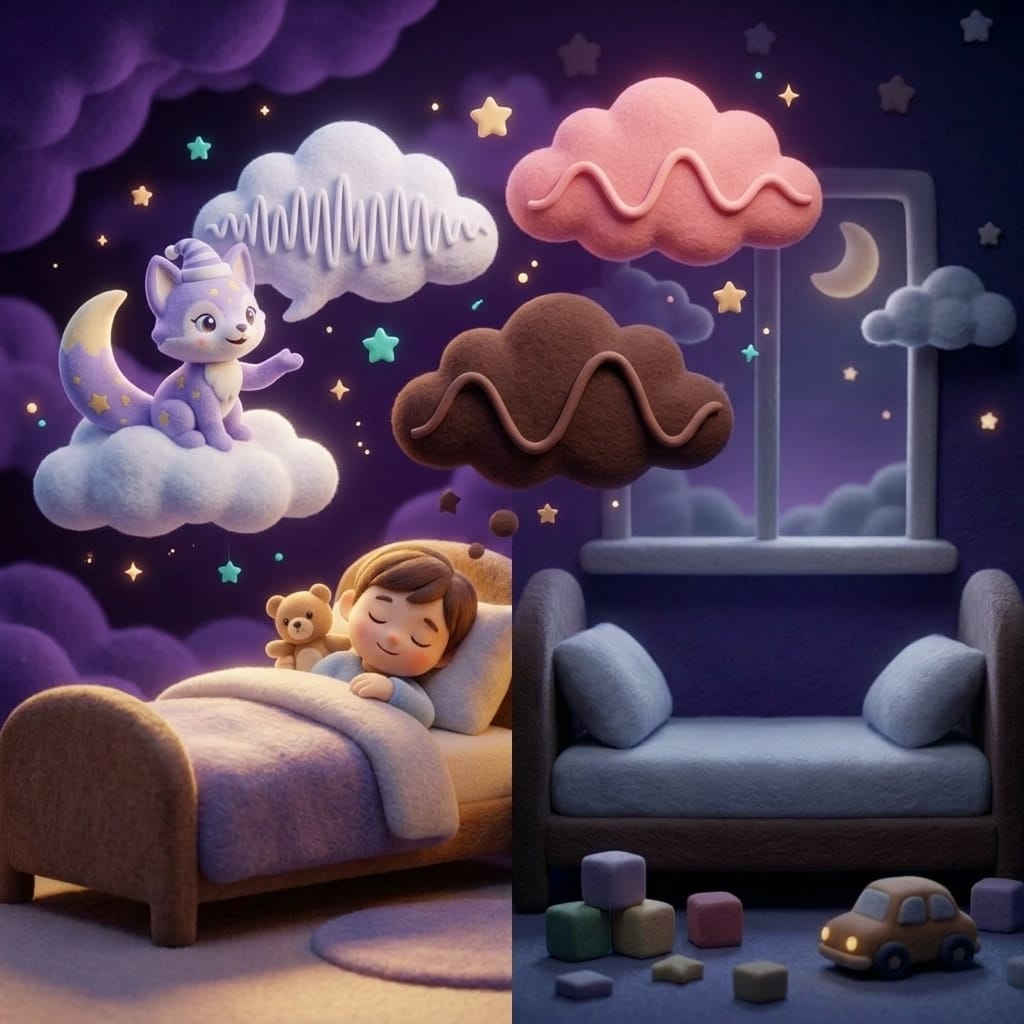
White Noise and Audio Bedtime Stories
A common question: should you use white noise or a bedtime story as your sleep soundtrack? For most families, the answer is: different tools for different moments.
- White noise is for the whole sleep session — continuous, non-narrative background that masks disruptions and signals "sleep mode." It plays from the moment the light goes off until morning.
- Audio bedtime stories are for the transition window — that 10–20 minutes after "goodnight" when many toddlers are not yet asleep and would otherwise call out, stall, or get anxious. A calming story engages the mind gently and eases it toward sleep, then fades naturally.
Many parents stack them: a soothing audio story for the first 15–20 minutes, then white noise holds the space for the rest of the night. If you want calming stories designed specifically for this wind-down moment — with voices that gradually slow and soften — DreamLoo's bedtime story library was built for exactly this.
Common Questions from Parents
My baby only sleeps in the car. Does that mean white noise will work?
Usually, yes. The steady engine/road hum at roughly 65–75 dB is a form of broadband noise, and babies who fall asleep in the car are typically responding to it. A properly set-up white noise machine can reproduce the effect at home at a safer volume.
Can I play white noise from my phone?
Yes, with caveats. Use airplane mode to prevent notifications, place the phone at least 2 meters from the crib (not on the mattress), and use a free decibel-meter app to verify the volume is at or below 50 dB. A dedicated machine is more convenient for nightly use, but a phone is fine as a starting point.
What if my partner sleeps in the same room and cannot stand the noise?
Try pink or brown noise instead — most adults find them less harsh than white noise. Or use a machine with focused speakers that sits between you and the crib rather than between you and your partner. Some couples use a small machine for the crib zone plus earplugs on the other side.
My baby sleeps fine without white noise. Should I still use it?
If it is not broken, do not fix it. White noise is a useful tool when sleep is fragmented or the environment is noisy; it is not required. Some babies sleep deeply in quiet and wake up at the hum of a white noise machine — trust what you see.
Does white noise interfere with language development?
This concern comes from older studies on very loud, constant noise exposure in animal models. At the safe volumes recommended here (50 dB, 2+ meters, used only during sleep), there is no credible evidence of language-development harm in humans. Plenty of language exposure during waking hours is what matters.