

You hand your toddler the tablet so you can make dinner without a meltdown, and somewhere underneath the relief is a small persistent guilt. You have heard "screen time is bad" so many times that the number on the screen-time report feels like a report card you are failing.
Here is what rarely makes it into the headlines: the research is far more nuanced — and far more forgiving — than the scary version. What a child watches, whether anyone watches with them, and what the screen replaces matter more than the raw number of minutes. The official guidelines exist, they are useful, and they are also widely misunderstood.
This article lays out exactly what the American Academy of Pediatrics and the World Health Organization recommend at each age, explains the three things that matter more than the clock, and gives you a practical, guilt-free way to make screens work in a real household. The goal is not zero screens. The goal is screens in their place.
The official guidelines, plainly
Two major bodies issue screen-time guidance: the AAP (US) and the WHO (global). They largely agree.
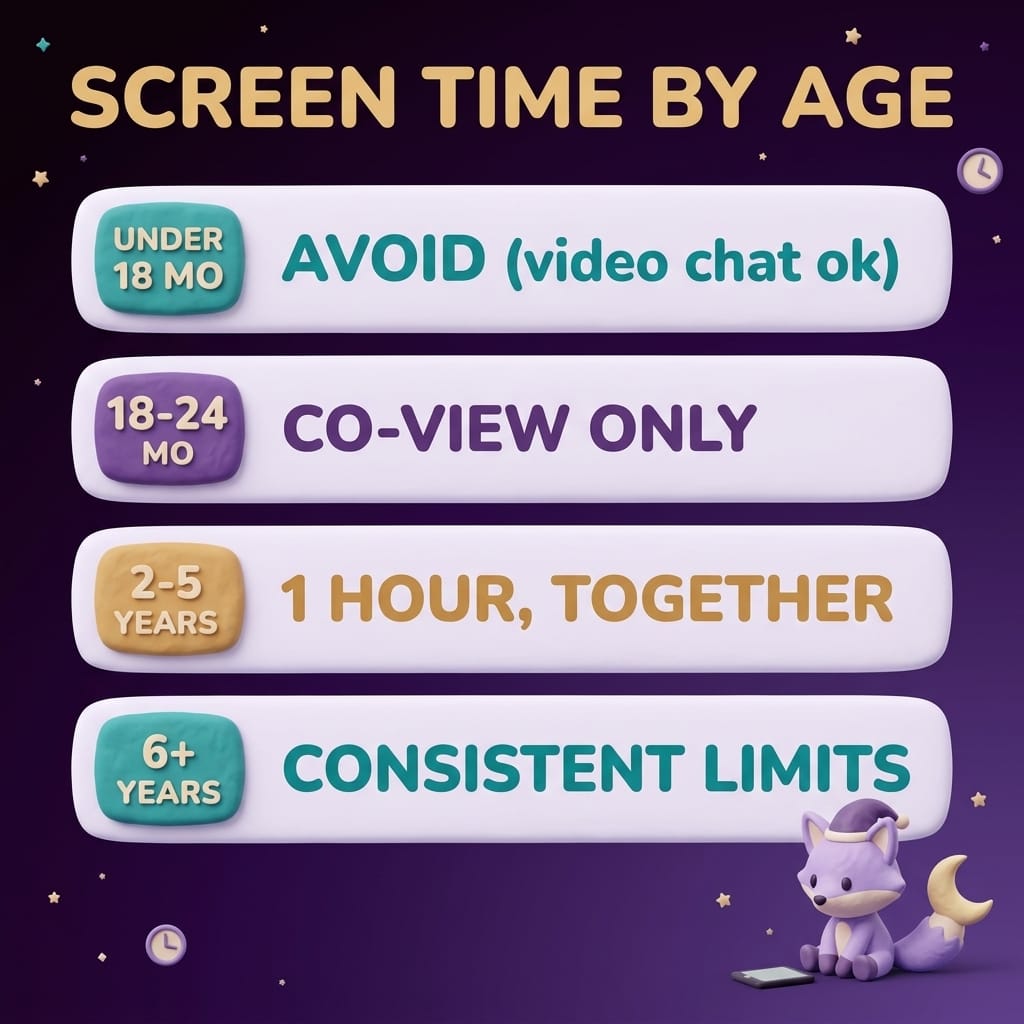
Under 18 months. Avoid screen media other than video chatting. A baby's brain learns from faces, voices, and three-dimensional interaction; a flat screen does not deliver that, and the well-documented "video deficit" means infants learn far less from a screen than from the same content live (Anderson & Pempek, 2005). Video calls with grandparents are the exception — they are genuine social interaction.
18–24 months. If you introduce screens, choose high-quality content and watch it with your child. Solo screen time is not recommended at this age. The co-viewing is the active ingredient.
Ages 2–5. No more than one hour per day of high-quality programming, co-viewed when possible (AAP, 2016). The WHO agrees: one hour or less for ages 2–4, and less is better (WHO, 2019).
Ages 6 and older. Here the AAP deliberately stopped giving a fixed number. Instead: place consistent limits that ensure screens do not displace adequate sleep, physical activity, and other healthy behaviors (AAP, 2016). A family media plan, not a stopwatch.
The shift from "X hours" to "protect sleep, activity, and family time" is the single most important update in modern screen-time guidance — and the most overlooked.
Three things that matter more than minutes
The minute-count is a starting point, not the whole picture. Three factors do more to determine whether screen time helps or hurts.
1. Content: what is on the screen
A slow, age-appropriate educational show and a frenetic, ad-stuffed autoplay feed are not the same "screen time" even at identical minutes. Research consistently finds that fast-paced, overstimulating content is associated with poorer attention and self-regulation immediately afterward, while well-designed educational content can support learning (Lillard & Peterson, 2011). Content quality is the first lever.
2. Context: who is watching, and how
Co-viewing — an adult watching alongside, talking about what is happening, connecting it to real life — transforms screen time. A parent narrating ("Look, the bear is sad — why do you think?") turns passive watching into the same kind of interactive language exchange that builds development. The AAP's emphasis on co-viewing is not a nicety; it is the mechanism that closes the video-deficit gap for young children.
3. Displacement: what the screen replaces
This is the big one, and the most underappreciated. An hour of screen time that replaces an hour of staring out a car window is very different from an hour that replaces sleep, active play, a meal with family, or the bedtime story routine. The harms most strongly linked to heavy screen use — language delay, sleep problems, less physical activity — often trace back to what the screen pushed out, not the screen itself (Madigan et al., 2019). Protect sleep, play, meals, and connection first; fit screens into what's left.
Screen time by age, in practice
Babies (0–18 months). Skip screens beyond video chat. Babies this age learn from your face and voice. The most valuable thing on any "screen" for them is a grandparent on a video call talking back.
Toddlers (18 months–3 years). Introduce slowly, in small co-viewed doses. One short, high-quality show watched together beats a long solo session. Resist using the screen as the default boredom-filler — toddler boredom is the doorway to imaginative play, and a screen at every dull moment quietly closes that door.
Preschoolers (3–5 years). Up to an hour of quality content, co-viewed when you can. This is a great age to start naming the rules out loud ("screens go off before dinner") so the structure becomes ordinary, not a daily negotiation.
School-age (6–10 years). Move from a stopwatch to a family media plan: screens off during meals, off in bedrooms, off in the hour before bed, and not at the expense of sleep, activity, homework, or play. Consistent boundaries, applied calmly, beat a precise minute-count.
The bedtime exception (this one is firm)
If there is one place the research is unambiguous, it is screens before bed. Two mechanisms stack up:
- Light suppresses melatonin. Screen light delays the sleep hormone, pushing back sleep onset (Chang et al., 2015).
- Content keeps the brain alert. Engaging media is the opposite of the wind-down a child's nervous system needs.
The guidance: no screens in the hour before bed, and no screens in the bedroom. This is covered in depth in our dedicated guide, screen time before bed and kids' sleep — but the headline is simple. Whatever you decide about daytime screens, the pre-bed hour should be screen-free.
A screen-free wind-down that still buys you a break. A calm audio bedtime story gives your child the engaging, soothing thing they want before sleep — without the melatonin-suppressing light. Screen off, lights low, a gentle voice carrying the last 15 minutes to sleep. It is the rare "give me ten quiet minutes" tool that actively helps sleep instead of harming it.
Making it work without the guilt
Real households are not research labs. A few honest, sustainable moves:
- Aim for quality and context first, minutes second. A co-viewed, well-chosen hour is a win, not a failure.
- Protect the non-negotiables. Sleep, meals, the pre-bed hour, and some daily active and unstructured play. Defend those, and the leftover screen time mostly takes care of itself.
- Use screens deliberately, not by default. "We're going to watch one show together after bath" beats the tablet appearing automatically at every friction point.
- Make the rules predictable. Children fight arbitrary limits and accept consistent ones. Same rules every day reduce the daily battle.
- Model it. Kids absorb the household's relationship with screens, including yours. Phone-free meals and a phone-free bedtime routine teach more than any lecture.
- Forgive the imperfect days. A sick day, a long flight, a desperate work deadline — a high-screen day does not undo a good pattern. Guidelines describe the average, not every single day.
For screen-light alternatives when you need the kids occupied, see our companion guide on calming activities before bed and the broader screen-free activities ideas.
What the guidelines are not
A few clarifications, because the guidance is routinely overstated:
- They are not a claim that all screens damage children. The associations are with excessive, passive, displacing use — not with a co-viewed educational show.
- They are not a moral scorecard. Going slightly over an hour on a hard day is not harm; it is parenting.
- They are not one-size-fits-all. A child's temperament, the household, and the content all shift what's reasonable.
- They are not static. Recommendations have evolved as research matured — from blanket time limits toward quality, context, and displacement. Expect them to keep evolving.
The honest summary: screens are a tool. Used deliberately, with good content, alongside a parent when kids are young, and kept out of sleep and the pre-bed hour, they fit comfortably into a healthy childhood. The guidelines are a floor and a frame, not a verdict on your parenting.
Common Questions from Parents
My child goes over the limit some days — am I harming them?
Almost certainly not. The guidelines describe a healthy average and a sensible structure, not a hard threshold where harm begins at minute sixty-one. Occasional high-screen days — illness, travel, a brutal work week — are a normal part of real family life and do not undo an otherwise good pattern. The harms in the research are linked to chronic, heavy, displacing use over months and years, not to a single long afternoon. Aim for the pattern, forgive the days.
Is educational content really better, or is that just marketing?
There is a genuine difference, though "educational" labels are not regulated and not all are earned. Well-designed content for young children is slower-paced, builds on real concepts, pauses for the child to respond, and connects to the real world. Research has found that fast-paced entertainment can temporarily impair young children's attention and self-regulation, while genuinely educational, slower content does not show the same effect. The reliable test is not the label but the pace and whether your child can engage rather than just be hypnotized.
How do I cut back without constant battles?
Change the structure, not just the limit. Children fight arbitrary, in-the-moment "turn it off now" demands far more than predictable rules they always know are coming. Set fixed screen-free zones — meals, the car for short trips, the hour before bed, bedrooms — and keep them identical every day so they stop being negotiable. Replace, don't just remove: have the next thing ready (a snack, a book, outside time) so the screen ending is a transition, not a void. Predictability plus replacement beats willpower.
What about screens for my own break — is that allowed?
Yes. Using a screen so you can cook, shower, take a call, or simply breathe is a legitimate, normal parenting tool, not a failure. The research-aligned way to do it: choose quality content, keep it out of the pre-bed hour, and don't let it become the only tool for every hard moment. A parent who occasionally hands over the tablet to get dinner made is doing exactly what the guidelines accommodate. Guilt is not part of the recommendation.