
Bedtime storytelling has not meaningfully changed in a century. The same dozen picture books get read by a tired parent, then re-read, then memorized, then met with "can I pick a different one?" that inevitably leads back to the same book anyway. Meanwhile, the rest of parenting has been reshaped by technology in every other direction.
AI bedtime stories are a new answer to a very old bedtime problem: kids want infinite variety, parents have finite energy, and the story needs to actually help the child fall asleep rather than keep them up. If it is done well, the technology can generate stories that are personalized to your child, calibrated for sleep, and endlessly fresh — without requiring you to be a professional storyteller at 8 PM after a full day.
If it is done badly, it is a screen-based, unfiltered chatbot exposing kids to content that should never reach them. The gap between "done well" and "done badly" is the entire point of this article.
What Are AI Bedtime Stories, Exactly?
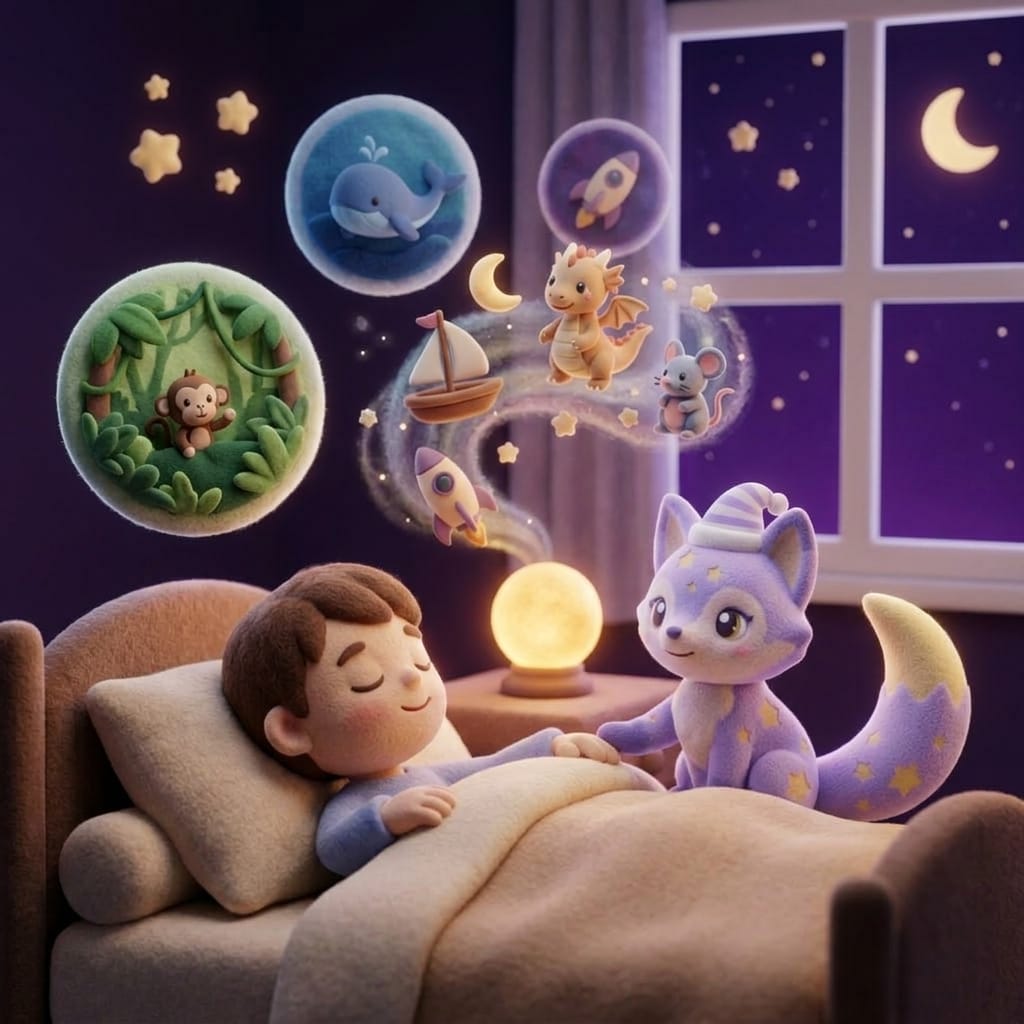
An AI bedtime story is a narrative — typically audio, sometimes text — that is generated by an artificial intelligence model rather than written in advance by a human author. You provide a few inputs (your child's name, age, interests, sometimes a situation they're dealing with), and the app produces a custom story built around those details.
The outputs sit on a spectrum:
- Templated personalization — a human-written story with your child's name and a few details slotted in. Technically AI-assisted, but most of the narrative is pre-written.
- Guided generation — an AI model generates the story, but within carefully designed prompts, safety filters, and narrative structures built by child-development specialists. The child gets novelty; the parent gets predictable quality.
- Open generation — raw AI output with minimal guardrails. This is the category to avoid for kids. Fine for adults testing ChatGPT on a Tuesday afternoon; not fine for a sleepy 4-year-old at 8 PM.
The research-backed value of AI bedtime stories depends almost entirely on which of those three categories you are using. Most quality apps for kids operate in the middle category.
Why AI Stories Can Actually Help Kids Sleep
The question is fair: why would a machine-generated story be better than the picture book you've read eight hundred times? Several reasons, each supported by psychology research.
The self-reference effect
Decades of cognitive science have documented something called the self-reference effect — information processed in relation to the self is remembered more deeply and engaged with more emotionally. A meta-analysis by Symons and Johnson in Psychological Bulletin found this effect is one of the most robust findings in memory research. Children show it strongly from around age 2 (Ray & Bryant, 2022).
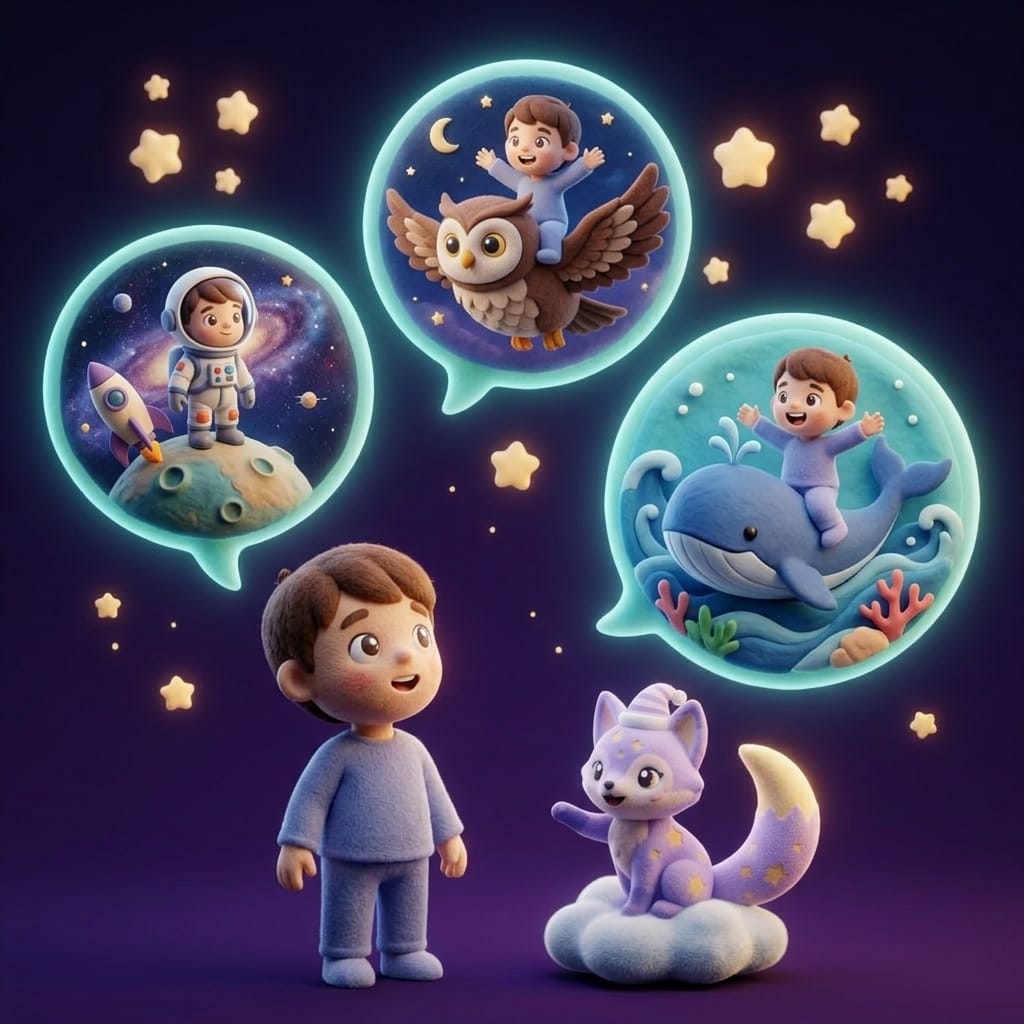
When a story uses your child's name and includes elements from their real life (their cat, their baby sister, their favorite superhero), their brain treats it as about them — which deepens attention, increases emotional engagement, and improves recall. Generic stories cannot do this.
Adaptability for sleep
A traditional picture book ends when the author decided it ends. An AI story can be calibrated for your family's exact bedtime routine — shorter on restless nights, longer on easier ones. More importantly, a good AI story is designed with a slowing narrative arc: the action peaks early, the language softens as the story progresses, and the final minutes are almost a guided wind-down. That narrative shape is what separates a story that helps a child fall asleep from one that wakes them up.
Infinite novelty without overstimulation
Repetition is wonderful — it is how toddlers learn — but many older kids actively resist re-hearing the same story for the twentieth time. AI stories solve this by generating endless variety around the same calming structure. Your child hears something new tonight, but it still follows the same wind-down shape they have learned to fall asleep to. It is the opposite of channel-surfing: same feeling, different surface.
Addressing specific fears or life events
This is where AI stories genuinely outperform books on the shelf. Is your toddler terrified of the dark this week? Starting preschool next Monday? Adjusting to a new baby sibling? A good AI story system can generate a narrative specifically around that challenge, with a character your child resembles facing it and coming through safely. Psychologists call this use of narrative bibliotherapy, and it is well-supported as a gentle way to help children process big feelings (see our guide to personalized bedtime stories for the full research).
Are AI Bedtime Stories Safe for Kids?
This is the right question to ask before using any AI product with your child. The short answer: a purpose-built kids' AI story app is generally safe. A general-purpose chatbot is not. The difference matters.
What makes a kids' AI story app safe
Look for these features before using any AI story tool with your child:
- Explicit "for children" design. The app should state its target age range and have content policies written specifically for kids — not be a general chatbot with a "kids mode" toggle.
- Pre-vetted themes and structures. Stories should be generated within a library of approved themes (adventure, kindness, friendship, curiosity, gentle courage) rather than from arbitrary user input.
- Safety filtering on both input and output. Even the most well-meaning parent can type something into a prompt box that produces a weird or scary result. The app should filter input prompts and model outputs before they reach your child's ears.
- Human-designed narrative structure. The best AI story apps are designed by child-development specialists — the AI fills in variety within a proven sleep-friendly arc, instead of generating from scratch.
- Audio-first, screen-free at bedtime. Once the story is generated and you hit play, there should be no screen for your child to watch. More on this below.
- Transparent privacy practices. Is your child's name stored? For how long? Is voice data retained? A responsible app answers these questions clearly.
What to avoid
- General-purpose chatbots (ChatGPT, Claude, Gemini etc.) used with no guardrails. They are not designed for children and have produced inappropriate content for minors even when prompted carefully.
- Apps that require your child to interact with the chatbot directly (type prompts, answer questions mid-story). Interactivity at bedtime is the opposite of what helps sleep.
- Apps that emit loud, dramatic narration or have built-in ads and upsells that can fire during bedtime.
- Video-based AI story apps that require continuous screen watching — see the next section.
The Screen Question: Why Audio Matters at Bedtime
One of the most important distinctions between a good AI bedtime story app and a bad one is whether it involves a screen during bedtime.
The American Academy of Pediatrics recommends avoiding screens for at least one hour before sleep. The reason is twofold: blue light suppresses melatonin (research shows up to 90% suppression in preschoolers; Hale & Guan, 2015, Sleep Medicine Reviews), and the stimulation of interactive visuals activates a child's brain at exactly the moment it needs to calm down. We cover this in depth in our article on screen time before bed.
This is why the best AI bedtime story apps are audio-only from the moment the story begins. Parents can set up the story through a screen (choose a theme, confirm the child's name), but the actual listening experience is pure audio — no visual stimulation, no tapping, no watching.
Audio has a second advantage beyond sleep science: audio-only storytelling invites kids to build their own mental images, which is active imagination exercise rather than passive watching. That's the same mechanism that makes reading aloud powerful. See our deeper comparison in audio stories vs reading.
How AI Bedtime Stories Actually Get Made (Brief, Honest Version)
Without going too far into the weeds — here is what is happening behind the scenes when an AI bedtime story is generated:
- You (the parent) provide inputs — your child's name, age, and a theme or situation.
- A carefully designed prompt is constructed by the app, combining your inputs with pre-written narrative structure (openings, sleep-calibrated arcs, soothing resolutions, safe themes).
- A language model generates the story text based on that prompt. The model has been trained on vast amounts of text, but the structure and safety constraints keep the output within safe bounds.
- Safety filtering scrubs the output — the story is checked against rules that block age-inappropriate themes, scary content, anything outside what the app allows.
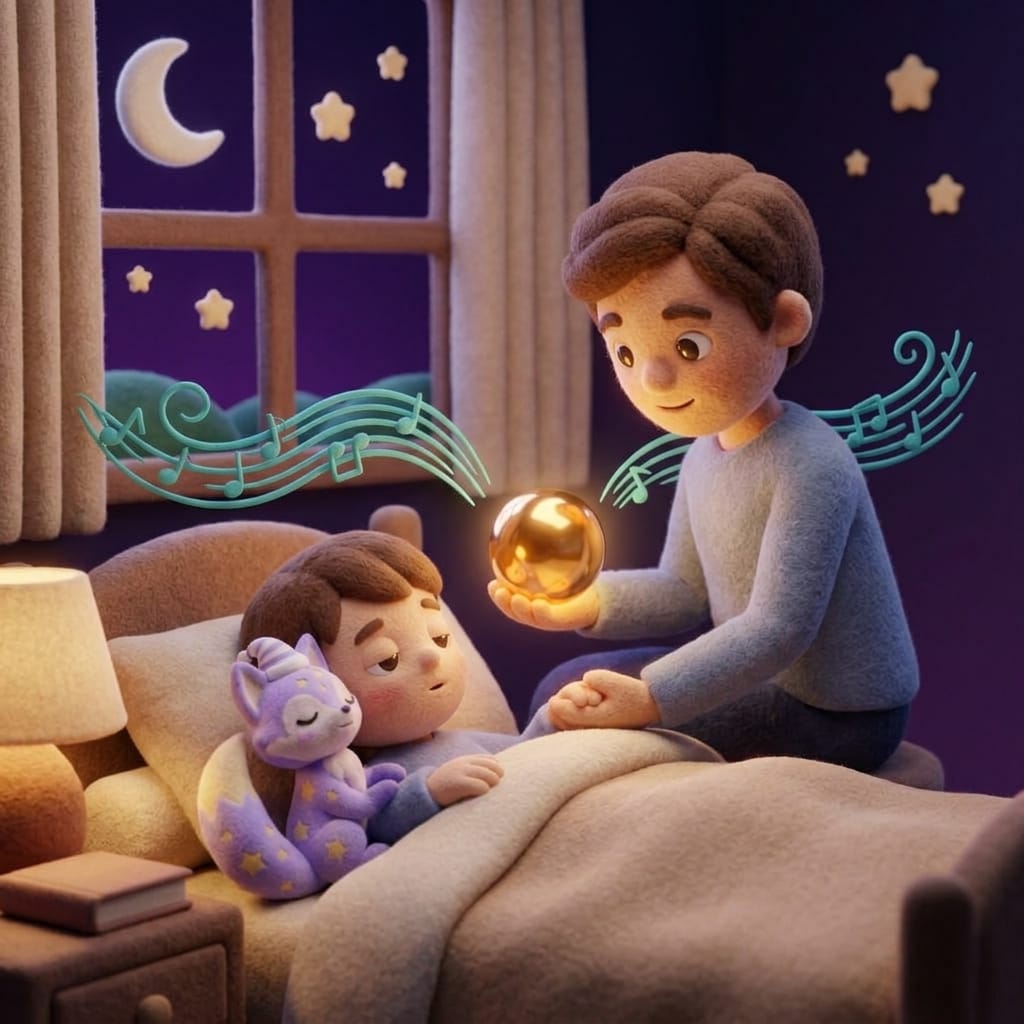
- Text-to-speech (or a pre-recorded voice model) converts the story to audio. Some apps offer multiple voice options; some now allow parent voice cloning (with full consent and technical safeguards).
- You hit play, and your child hears the finished story.
The whole pipeline can run in a few seconds. For most families, it is fire-and-forget — you tap a couple of buttons, hand off to audio, and your child hears a novel story each night that still feels familiar.
How to Actually Use AI Bedtime Stories Well
A tool is only as good as how you use it. Some practical guidance for getting the most out of AI bedtime stories.
Use them in addition to — not instead of — reading aloud
Live reading with a parent is the single most-studied and most-beneficial bedtime activity in child development research. AI stories do not replace it. They add coverage for moments when live reading is not possible or not enough — the 10–20 minutes after lights-out when many kids stall, travel nights, multi-kid households where you cannot sit in every room, or challenging periods when your child needs a specific theme you do not feel up to improvising.
Start the story after the cuddle
Read a book together, give the cuddle, turn out the light, then start the AI story. The AI story bridges the gap from goodbye to sleep — which is the exact moment most bedtime problems surface (calling out, getting out of bed, asking for water, creeping anxiety).
Keep the volume low and consistent
A bedtime story at bedtime volume should be softer than conversational speech — about the level you would use to sing your child a lullaby. If your speaker's quietest setting is still loud, find a different speaker.
Pick themes intentionally
Avoid adventure-themed stories for an already-wired kid. Pick themes like "a gentle forest walk," "a friendly dragon who shares a peaceful meadow," or a story about a character like your child facing a fear they are currently working through. A good app will make this easy.
Use the same voice and cadence across nights
Kids settle faster with predictability. If the app offers voice options, pick one and stick with it for a few weeks. The voice itself becomes a sleep cue.
Do not let your child interact with the story
If the app allows it (some do, unwisely), disable any mid-story interactivity. Once the story starts, the child's job is to listen and drift off, not to tap or answer questions.
Dreamloo's Approach — Briefly
Dreamloo is our take on AI bedtime stories done right. The short version:
- Audio-first. After setup, there is no screen during the story — just your child's voice experience.
- Personalized with research-backed themes. Your child's name, age, and chosen interests shape the story, within themes designed by child-development specialists for sleep.
- Sleep-calibrated arcs. Every story follows a wind-down structure: action peaks early, pace softens, last minutes are almost a guided drift into sleep.
- Safety guardrails at every layer. Input filtering, output filtering, and age-appropriate theme libraries.
- Free to start. Browse our free bedtime stories library to see how it feels.
We built Dreamloo because as parents, we could not find an AI story app that felt right — most were either built for adults and adapted, or built for interactivity and entertainment rather than sleep. Dreamloo is specifically the thing we wanted on our own bedside table.
Common Questions from Parents
Will my child get attached to the AI voice instead of me?
Short answer: no, if you keep reading aloud yourself. Kids bond with the people who show up for them in daily life. A nightly audio story is a supplement — it does not compete for the attachment relationship any more than a lullaby on a CD would have in the 1990s.
Can AI stories have my voice narrate?
Some apps offer parent voice cloning, where a short recording of your voice is used to generate the story's narration. Done well (with strong consent flows, local processing, and strict safeguards against misuse), this can be magical — your child hears your voice even when you are traveling. Done badly, it has privacy implications. Check the app's documentation carefully before using voice cloning features.
Do AI stories ever make mistakes or produce weird content?
Any generative model can occasionally produce unexpected output — which is why the safety filtering layers in a good kids' app matter. A well-designed app catches strange outputs before they reach your child, and the rare miss (a weird phrase, an unusual pacing moment) is not harmful. If you notice repeated strange output, that is a signal the app you are using does not have tight guardrails; pick another one.
Are AI bedtime stories a good idea for kids with sensory sensitivities?
Often yes — the ability to control length, theme, voice, and pace makes AI stories easier to customize for a sensory-sensitive child than a printed book. Start with short (3–5 minute) stories, calm themes, and lower volumes; adjust based on how your child responds.
What about kids who ask for "one more" endlessly?
AI story apps that allow infinite stories can actually make this worse if the child realizes they can always get another one. Set a clear limit ahead of time — "two stories, and then sleep" — and keep it. An infinite supply is only useful if the parent stays in charge of how many play.