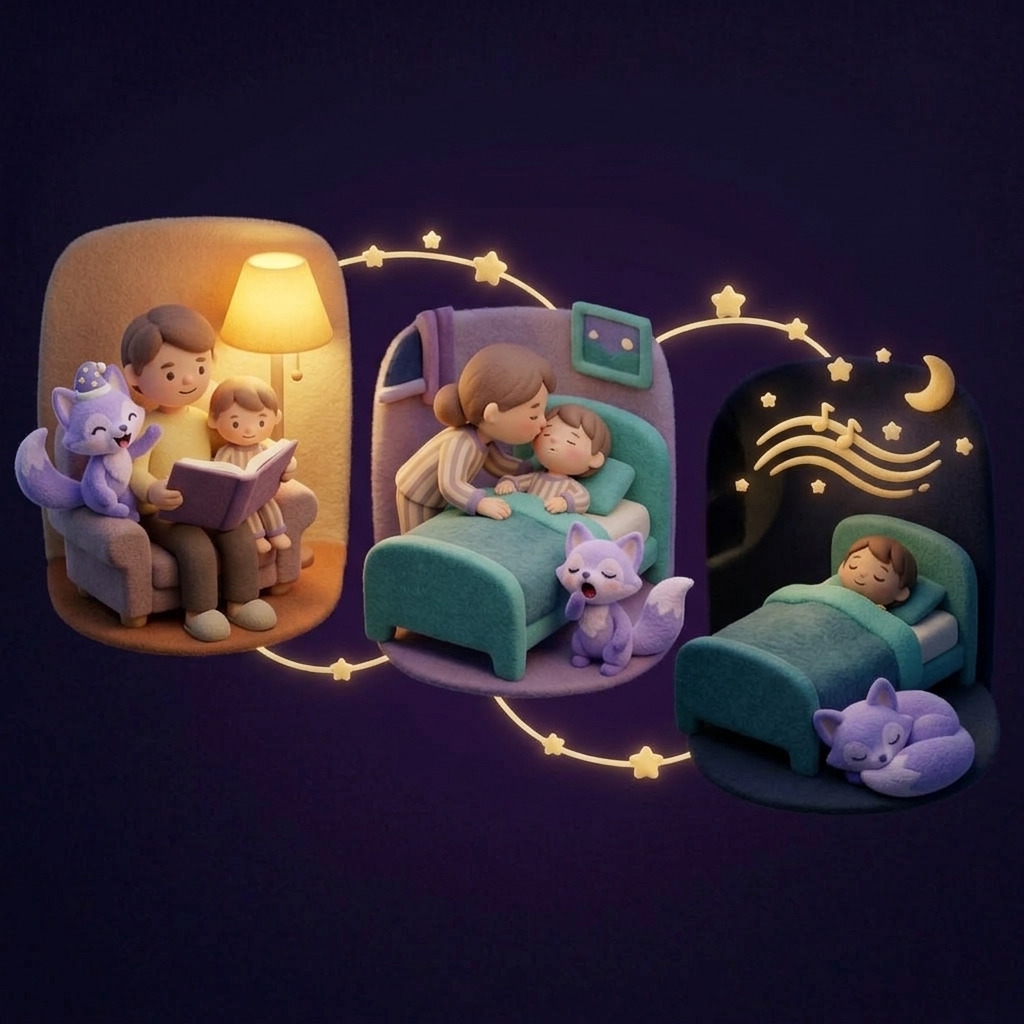

You read to your daughter every night for three years. Then one evening, exhausted after a 12-hour day, you press play on an audio story instead. She listened. She loved it. She fell asleep faster than usual. And you felt guilty about it for a week.
That guilt is common — and, according to the research, largely misplaced. A growing body of evidence suggests that listening to stories and reading stories activate remarkably similar processes in the brain. But "similar" does not mean "identical," and the answer to which is "better" depends on what you are trying to achieve and when.
This guide breaks down what science says about audio stories versus reading aloud, where each one wins, and why the smartest approach — especially at bedtime — might be using both.
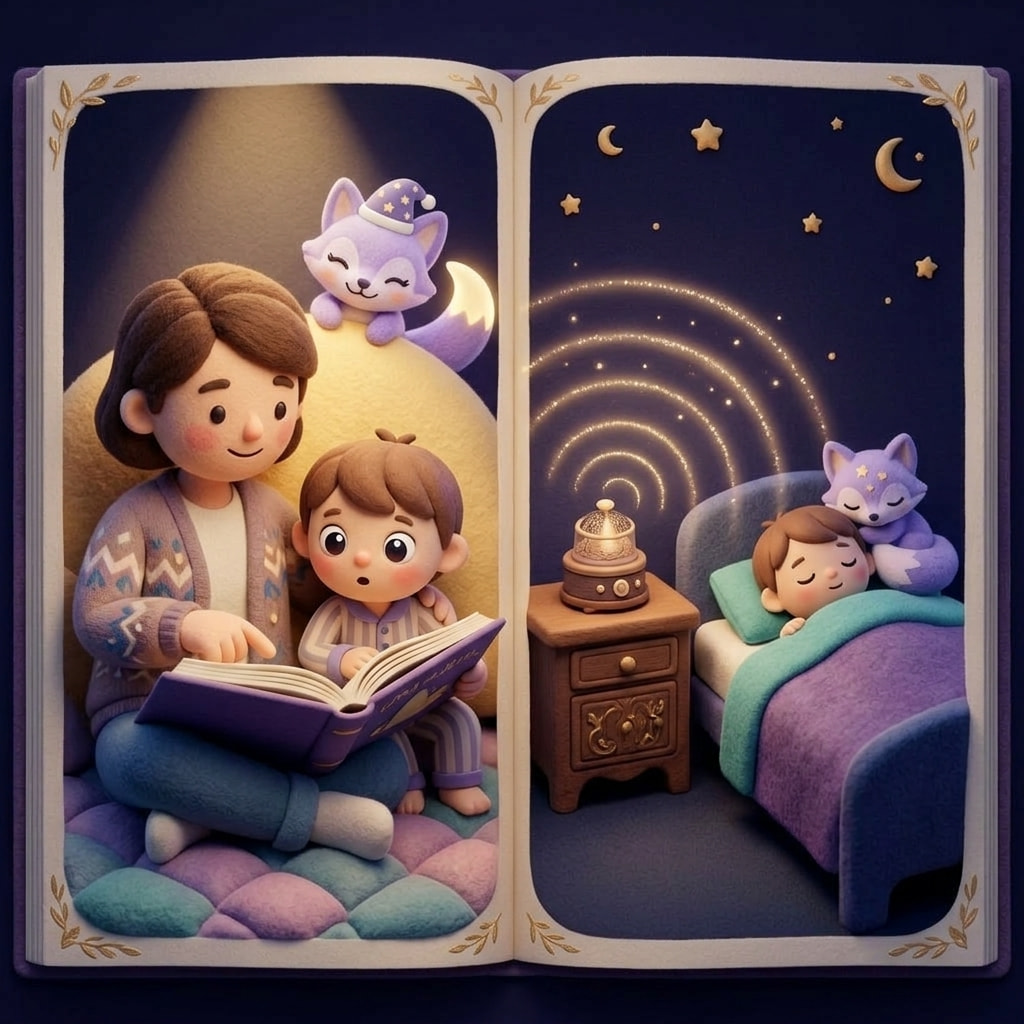
What Happens in the Brain: Reading vs Listening
The most striking finding in this field comes from a 2019 study at UC Berkeley's Gallant Lab, published in the Journal of Neuroscience. Researchers used fMRI brain scans to map how nine participants processed stories delivered in two formats: reading text on a screen and listening to an audiobook.
The result surprised even the lead researcher, Fatma Deniz. The semantic maps — the brain regions activated to process the meaning of words — were nearly identical whether participants read or listened. The same cognitive and emotional areas lit up regardless of format. In simple terms, the brain does not much care whether a story arrives through the eyes or the ears. It processes meaning the same way.
An earlier study by Rogowsky (2016) tested this directly: one group read sections of a book, a second group listened to the audiobook, and a third group did both simultaneously. On a comprehension quiz afterward, there were no significant differences between the three groups.
These are adult studies, and children's brains work differently in important ways. But the core finding holds: listening to a story is a legitimate form of processing narrative, not a shortcut or a cheat.
Where Reading Aloud Wins
None of this means audio stories and reading are interchangeable in every context. Reading aloud — a parent sitting with a child and a physical book — has specific advantages that audio cannot fully replicate.
The parent-child bond
Reading aloud is one of the most intimate interactions a parent and child share. The physical closeness, the eye contact, the back-and-forth conversation about the pictures — these create attachment and emotional security that no speaker or headphone can match.
Research from Cincinnati Children's Hospital, led by Dr. John Hutton, found that children who are read to regularly show stronger activation in brain networks supporting language, imagination, and attention. Critically, the interactive aspect matters: dialogic reading, where parents pause to ask questions and connect the story to the child's life, produces greater language gains than passive read-aloud.
Decoding skills and print awareness
When a child sees words on a page while a parent reads them, they begin to connect spoken language with written symbols. They learn that text flows left to right, that spaces separate words, that letters represent sounds. These are foundational literacy skills that pure audio cannot teach.
For children who are learning to read (roughly ages 4-7), seeing print while hearing words is especially powerful. One study of students with reading difficulties found that those who listened to audiobooks while following along in the text improved their reading speed by 17 words per minute over eight weeks — compared to just 4 words per minute for those reading alone.
Vocabulary in context with visuals
Picture books pair words with images, giving children visual context for new vocabulary. When a child hears "the fox crept through the fern" while looking at an illustration of exactly that, the word "fern" is encoded with both a sound and an image. This dual encoding strengthens retention.

Where Audio Stories Win
Audio stories have their own set of advantages — some of which are especially relevant at bedtime.
Imagination works harder
When there are no pictures, the child's brain has to build the world from scratch. The forest, the castle, the dragon — all of it must be constructed internally. This is not a disadvantage. It is a powerful form of cognitive exercise.
Unlike video (which floods the brain with ready-made images) and unlike picture books (which provide visual scaffolding), audio stories require active mental construction. Research in child development consistently shows that this kind of imaginative engagement strengthens creative thinking and visualization skills.
Listening comprehension exceeds reading comprehension
For children up to middle school age, listening comprehension typically exceeds reading comprehension. A 5-year-old can understand and enjoy a story with vocabulary and plot complexity far above what they could decode from a printed page. Audio stories give children access to richer language, more complex narratives, and more sophisticated ideas than their current reading level allows.
This is not a small point. It means that a child listening to an audio story is often processing harder material than they could handle in a book — and doing so successfully. That exposure to advanced vocabulary and sentence structure feeds directly into later reading ability.
No screen required
This is where audio becomes uniquely powerful at bedtime. The American Academy of Pediatrics recommends turning off all screens at least one hour before bed. Research shows that screen light — even from a tablet showing a picture book — can suppress melatonin production by up to 90% in preschoolers.
An audio story eliminates the screen entirely. The child lies in a dark room, eyes closed, listening. There is no light stimulating the brain. There is no swiping or tapping keeping motor systems active. There is only a voice and a story — which is exactly what a brain transitioning toward sleep needs.
Accessibility and consistency
Some nights you are present, patient, and full of energy for a 20-minute reading session. Some nights you are not. Audio stories provide a consistent, high-quality bedtime experience on the nights when you are running on empty.
This is not about replacing yourself. It is about having a reliable backup that does not involve handing your child a screen. A well-narrated audio story maintains the bedtime ritual even when you cannot be the narrator.
The Bedtime Question: Which Is Better for Sleep?
For daytime learning, the answer is "both, in different ways." But for the specific goal of helping a child fall asleep, audio stories have a clear edge.
The case for audio at bedtime
Darkness is essential for sleep. A child listening to an audio story can do so in a dark room. A child reading a book needs light. Even a dim reading lamp signals "awake" to the brain. After you finish reading and turn off the light, the child's brain has to shift gears from "light mode" to "dark mode." With audio, they are already there.
The voice becomes a sleep cue. When a child hears the same type of calming narration every night as they drift off, their brain begins to associate that voice with sleepiness. Over time, pressing play becomes like flipping a switch that tells the body: time to sleep. This is classical conditioning, and it is one of the most reliable mechanisms in sleep science.
The story fills the silence. The window between "goodnight" and actually falling asleep is when children's minds are most vulnerable to anxiety, fear, and restlessness. An audio story gives them something to focus on — something calming, predictable, and engaging enough to hold attention but not so stimulating that it prevents sleep.
Sleep-optimized pacing. A good bedtime audio story is structurally designed to promote sleep: the narrative pace slows, sentences get longer and more rhythmic, the voice drops in volume, and the story resolves gently. You can do this when reading aloud too — but it requires conscious effort every night. Audio does it automatically.
DreamLoo's bedtime stories are built specifically around this principle. Each story follows a sleep-optimized arc: an engaging beginning that draws the child in, a middle that gradually slows, and an ending that fades into gentle sleep sounds. The child's own name and interests are woven throughout, and the narration can even be in a parent's own cloned voice — combining the intimacy of a parent reading aloud with the consistency and sleep optimization of audio.
The Best Approach: Both (at Different Times)
The research points clearly toward a "both/and" answer, not an "either/or."
During the day: Read physical books together. Use dialogic reading — pause, ask questions, point to pictures, connect the story to your child's life. This builds vocabulary, print awareness, and the parent-child bond.
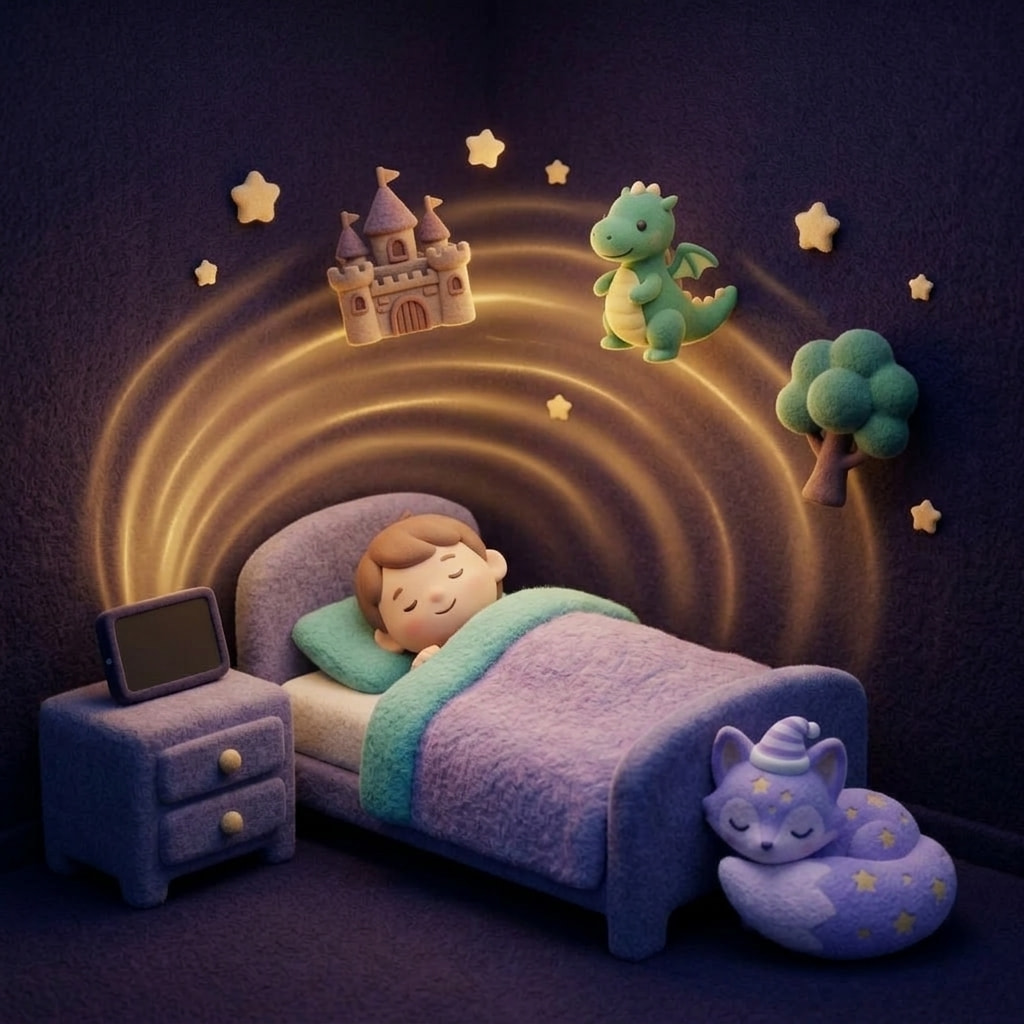
At bedtime: After your reading session (which can be part of the bedtime routine), switch to audio for the final stretch. Read one or two books together, say goodnight, then let a calming audio story play as your child drifts off. The book provides the interaction; the audio provides the bridge to sleep.
In the car, during quiet time, on busy evenings: Audio stories are a screen-free way to keep your child engaged with narrative when reading together is not practical. They are not a substitute for reading — they are a supplement that expands the total amount of story exposure your child gets.
A practical bedtime sequence
- Read one short book together (5-10 minutes). This satisfies the connection, the physical closeness, the dialogic interaction.
- Say your goodnight routine words. Same words, every night.
- Start an audio story. Phone face-down on the nightstand. The room is dark. The child listens.
- The story slows, fades, and transitions to gentle sleep sounds — rain, ocean, white noise.
- The child falls asleep without needing you to come back.
This sequence gives your child the best of both worlds: the warmth of a parent reading, and the sleep-promoting power of audio.