Odysseus and the Cyclops
The Man Who Called Himself Nobody
Odysseus had been at sea for longer than he cared to count. Ten years fighting the war at Troy, and now — months more, trying to get home. The gods were either helping or hindering, depending on their mood, and the sea didn't care about either.
His ship was good. His crew was tired. And the island they found at dawn — green and rocky, with smoke rising from a cave high on the cliff — looked like a place where they might find food, water, and a night's rest.
It was none of these things.
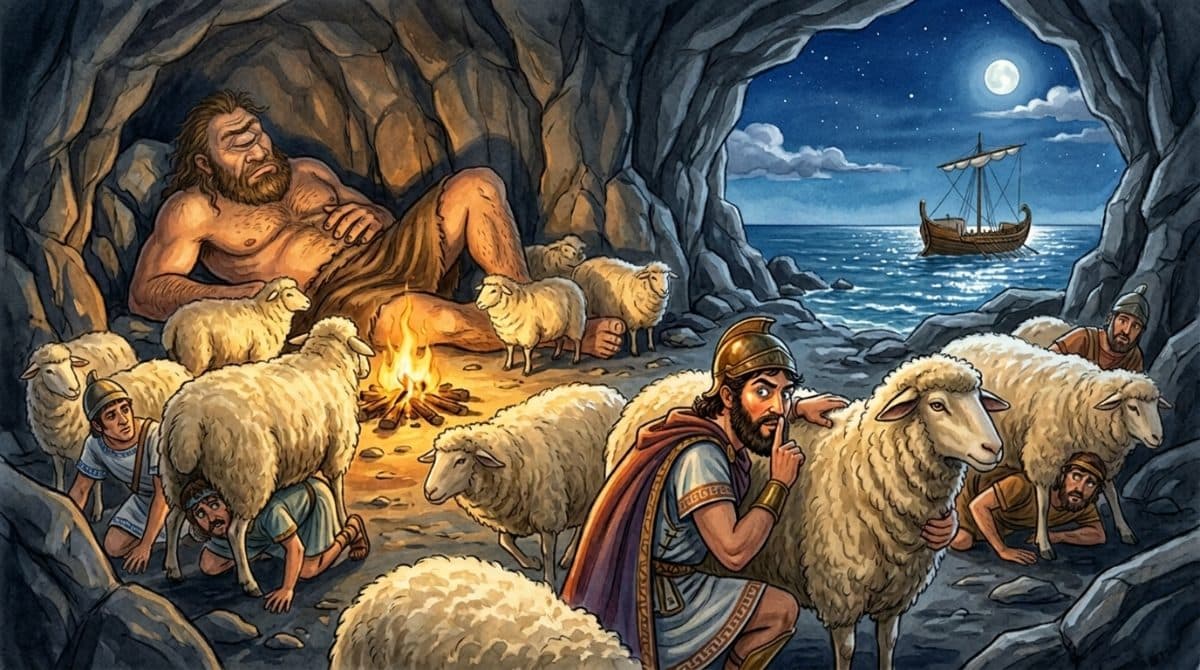
The cave was enormous. Inside: a fire pit, baskets of cheese, pens of sheep so large their backs reached Odysseus's chest. Everything was oversized — the bowls, the jugs, the stone slab that served as a door.
"We should leave," said Eurylochus, who was the most cautious of the crew and therefore the most frequently ignored.
"We should wait," said Odysseus, who was the most curious and therefore the most frequently in danger.
The Cyclops came at sunset. He was as tall as a ship's mast and twice as wide, with one eye in the center of his forehead — a single, lamp-like eye that saw everything in the cave in one sweeping look.
His name was Polyphemus. He was a son of Poseidon, the sea god, which meant he was powerful and also, as Odysseus would soon discover, spectacularly ill-tempered.
Polyphemus herded his sheep into the cave, rolled the stone door shut — a stone that twenty men couldn't move — and lit the fire. Then he saw the sailors.
"WHO are you?" Polyphemus bellowed. His voice shook the walls. Cheese fell from the shelves.
Odysseus stepped forward. His heart hammered, but his voice was steady, because Odysseus had learned long ago that the voice is the last thing you let tremble.
"We are sailors, returning from war. We ask for hospitality — food, shelter, safe passage. The gods honor those who treat guests well."
Polyphemus laughed. It was not a pleasant sound. "I don't CARE about the gods. I am a son of Poseidon. I answer to NO ONE."
He grabbed two sailors. The cave went dark with screaming.
Odysseus didn't sleep that night. He sat against the cave wall, his men pressed around him, and he THOUGHT. The stone door was immovable. The Cyclops was too large to fight. They had swords, but a sword against a giant is a toothpick against a bear.
He needed a different kind of weapon. The kind that fits inside a skull instead of a hand.
By morning, he had a plan.
"Cyclops," Odysseus said, as Polyphemus milked his sheep. "I have wine. Fine wine, from our ship. Would you like some?"
Polyphemus took the wine. He drank. His one eye widened. He drank more. The wine was strong — Odysseus had been saving it, and for good reason.
"This is GOOD," Polyphemus said. "What is your name, little man? I will eat you LAST as a favor."
Odysseus smiled. "My name is Nobody."
"Nobody?"
"Nobody."
Polyphemus drank until the wine was gone. Then he fell asleep — a deep, thunderous, wine-heavy sleep that shook the cave floor with every breath.
Odysseus moved. He and his men took a log from the fire — long, thick, sharpened to a point and hardened in the flames. They lifted it. They aimed.
The Cyclops woke screaming. He clawed at his face. He staggered. He crashed into the walls. His roar shook the entire island.
"WHO DID THIS?" he screamed. "WHO BLINDED ME?"
And from outside, the other Cyclopes on the island called back: "Polyphemus! Who is hurting you?"
"NOBODY!" Polyphemus roared. "Nobody is hurting me! Nobody blinded me!"
The other Cyclopes paused. If nobody was hurting him... then nobody was the problem. They went back to sleep.
Odysseus, crouched in the shadows, permitted himself a very small smile.
But the stone door remained. Polyphemus sat against it, blind and raging, feeling every sheep as it passed — making sure no human rode out on a sheep's back.
The TOP of the sheep's back. He checked the top.
Odysseus tied his men to the UNDERSIDES of the largest sheep — three sheep per man, the sailor strapped beneath the middle one, hidden in the wool. He himself clung to the belly of the biggest ram in the flock, fingers wound into the fleece, holding on with every muscle he had.
One by one, the sheep walked past Polyphemus. The Cyclops ran his hands over each back. He felt wool. He felt nothing else.
"Go, my sheep," Polyphemus muttered. "Go and graze. Only I am left here, blinded by NOBODY."
They made it to the ship. They rowed. The island shrank behind them.
And this is where Odysseus made his mistake.
He stood at the stern. He looked back at the Cyclops, who had stumbled to the cliff edge, blind and howling. And Odysseus — who was brilliant and brave and also, when it mattered most, catastrophically proud — shouted:
"Cyclops! It was NOT Nobody who blinded you! It was ODYSSEUS, king of Ithaca! REMEMBER MY NAME!"
Polyphemus heard the name. He prayed to his father — Poseidon, god of the sea. And Poseidon heard.
The sea, which had been calm, turned. The wind shifted. The journey home, which should have taken weeks, would now take YEARS. Because Odysseus had done the one thing clever men should never do — he traded his secret for his pride.
The ship sailed on. The island disappeared. The sea grew dark and wide and full of things that Odysseus would have to face — storms, and monsters, and islands where the lotus makes you forget, and sirens whose songs could crack a ship in half.
But that is another story. For another night.
On THIS night, the ship rocked gently in the dark water. The crew slept on the oars. The stars turned overhead — the same stars that shone over Ithaca, where Odysseus's wife Penelope waited, and his son Telemachus grew taller with every season.
Odysseus sat at the bow. He didn't sleep. He watched the horizon — dark, endless, impossible to read. Somewhere beyond it, home.
The waves went shhhh against the hull... and the ship creaked like an old house settling... and the wind smelled of salt and distance and the particular loneliness of someone who knows exactly where they want to be... and cannot get there yet.
But the stars held steady... and the ship held course... and Odysseus held on... because that is what heroes do when the sea is dark and home is far... they hold on.
And the night was long... and the sea was wide... and the name "Nobody" dissolved into the spray... and the name "Odysseus" hung in the dark like a star — bright and stubborn and pointed toward home.
And the ship sailed on.
A bedtime retelling of the Cyclops episode from Homer's Odyssey. When Odysseus and his sailors are trapped in the cave of Polyphemus — a one-eyed giant who has no intention of letting them leave — the hero must use his greatest weapon: his mind. With clever wordplay, a daring escape under sheep, and a lesson about the cost of pride, this 8-minute audio story brings Greek mythology alive for children ages 7 and up. Free to listen.
Cleverness can defeat strength — but pride can undo cleverness. The smartest move is knowing when NOT to speak.
Yes. Homer's Odyssey (circa 800 BCE) is in the public domain. This is a bedtime retelling of Book 9.
Ages 7 and up.
Child Development
The benefits of reading to kids every night, in plain science. What 15 minutes of nightly stories actually do for vocabulary, the brain, empathy, sleep, and bond.
Stories & Reading
Should you read to your child or play an audio story? Brain research shows both activate the same regions. Here's when each works best — and how to combine them.
Sleep & Development
A practical 8 month old sleep schedule: naps, wake windows, night sleep, and how to handle the 8-month sleep regression without losing your mind.
Sleep & Development
A practical guide to 6 month old wake windows: the typical range, signs to watch for, and a sample daily schedule you can start using tonight.
Beautifully narrated bedtime stories with soothing sounds to help your little ones drift off to sleep.
Join families who read with Dreamloo. Free stories, sleep tips, and early access to the app.
No spam. Unsubscribe anytime.