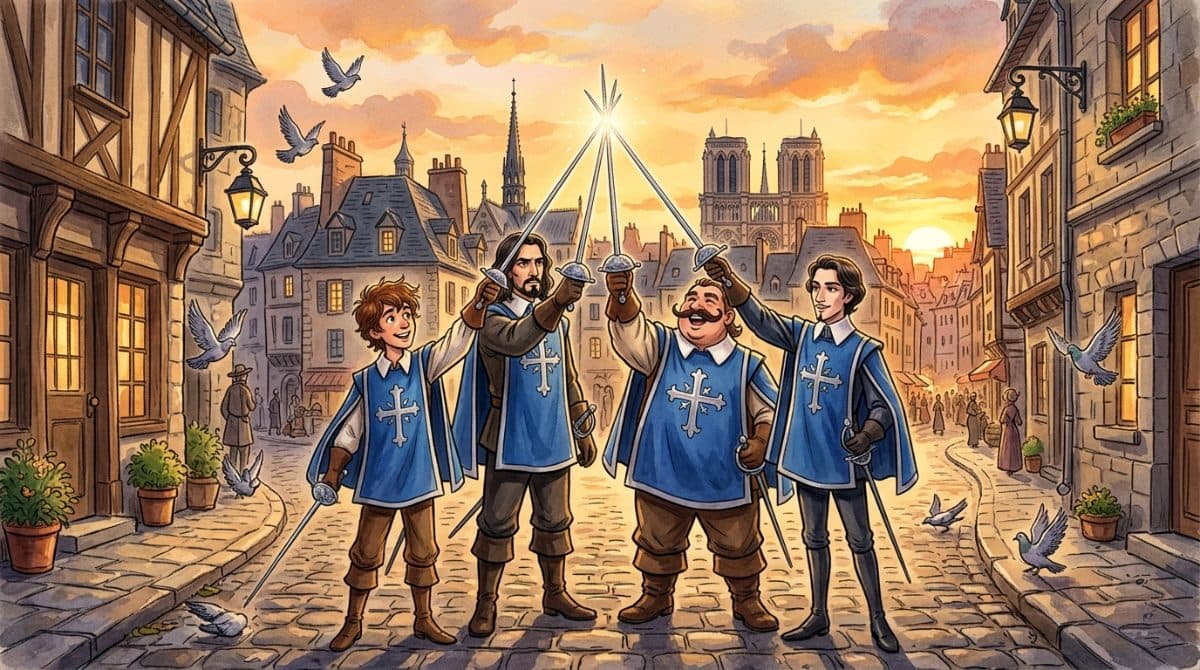
The Three Musketeers
The Boy Who Made Three Enemies and Four Friends
D'Artagnan arrived in Paris on a Tuesday, which was already a bad sign, because nothing good starts on a Tuesday.
He was eighteen. He was from Gascony, a province in the south where people were known for two things: excellent cheese and excessive confidence. D'Artagnan had plenty of the second and none of the first — he'd eaten it on the journey.
He had a horse that was the color of a bad mood — orange with unfortunate spots — and a sword that had been his father's and his father's father's and was now so old the blade wobbled when you swung it, which was not ideal for a weapon but excellent for a conversation starter.
His father's parting words had been: "Go to Paris. Find Captain Tréville of the King's Musketeers. Become a musketeer. And for the love of all things holy, try not to challenge anyone to a duel before Thursday."
D'Artagnan lasted until Tuesday afternoon.
It happened at Tréville's headquarters, a grand house near the Louvre where the musketeers gathered to sharpen their swords and their insults. D'Artagnan was crossing the courtyard when he bumped into a man — a tall, dark-haired man with the saddest eyes d'Artagnan had ever seen and a recently bandaged shoulder.
"Watch WHERE you're going!" the man hissed, gripping his shoulder. "You've aggravated my wound."
"I'm terribly sorry. D'Artagnan, at your service. I—"
"Athos. And you can SERVICE me by meeting me at noon behind the Carmelites. With your sword."
D'Artagnan had accidentally challenged (or been challenged by — the distinction is blurry in French swordsmanship) his first musketeer. He had been in Paris for ninety minutes.
Ten minutes later, rushing through the corridor, he tripped over the outstretched legs of an enormous man who was polishing a belt buckle the size of a dinner plate.
"My BUCKLE!" the man roared, examining it for scratches. "This buckle was a gift from the Duke of — never mind. Porthos. You have offended my buckle. One o'clock. Luxembourg Gardens."
That was musketeer number two.
Five minutes after THAT, rounding a corner, d'Artagnan caught his scabbard in a doorway and swung around into a man who was reading a Bible and walking simultaneously, which is harder than it sounds.
"You've bent my bookmark," the man said mildly. He was slender and elegant and had the face of someone who could quote scripture AND skewer you, in either order. "Aramis. Two o'clock. Behind the convent."
Three duels. Three musketeers. And it wasn't even lunchtime.
D'Artagnan arrived at the Carmelites at noon, prepared to die, which seemed like the likeliest outcome given that his sword wobbled and his opponent was the best swordsman in France.
Athos was waiting. So — to d'Artagnan's surprise — were Porthos and Aramis. They were Athos's seconds. All three musketeers, together, against one eighteen-year-old from the provinces.
"Well," Athos said, drawing his sword with his good arm. "Shall we?"
They never got the chance. Five of the Cardinal's Guards appeared at the end of the alley — red cloaks, polished swords, and the particular arrogance of men who believe their boss is always right.
"Well, well," said the leader. "Three musketeers and a boy. Dueling is ILLEGAL, gentlemen. You're under arrest."
Athos looked at the guards. He looked at d'Artagnan. He looked at his friends.
"Porthos," Athos said calmly. "How many of us are there?"
"Four," said Porthos.
"And how many of them?"
"Five."
"Excellent. Almost fair."
And Athos smiled — the first time d'Artagnan had seen him smile, and it was the kind of smile that made the guards take a step back.
The fight was brief and decisive and involved d'Artagnan's wobbling sword doing exactly the wrong thing at exactly the right moment — it wobbled so unpredictably that no guard could anticipate where it was going, because d'Artagnan himself didn't know.
The guards retreated. Porthos had disarmed two. Aramis had disarmed one while apparently still reading his Bible. Athos had fought left-handed because his right shoulder was bandaged, and still won.
D'Artagnan had wobbled his way to victory.
Porthos clapped him on the back so hard that d'Artagnan's teeth rattled. Aramis closed his Bible and bowed. Athos — quiet, sad-eyed Athos — extended his hand.
"You fight like a windmill in a hurricane," Athos said. "We could use a windmill. Welcome."
That evening, the four of them sat in a tavern near the Seine. Porthos ordered everything on the menu. Aramis ordered wine and bread, because he was either devout or on a budget — nobody was sure which. Athos ordered nothing but drank Porthos's wine when Porthos wasn't looking.
D'Artagnan sat between them and felt, for the first time since leaving Gascony, like he had arrived somewhere. Not a city. Not a headquarters. Somewhere warmer and harder to name.
"The musketeers' oath," Athos said, lifting his glass. His sad eyes were, for a moment, not quite so sad.
Porthos raised his. Aramis raised his. D'Artagnan raised his — a chipped cup, because the tavern had run out of glasses, but it would do.
"All for one," Athos said.
"And one for all," the others answered.
Four cups touched. The sound was small — barely a clink — but it rang in d'Artagnan's chest like a bell, the way certain sounds do when they mark the beginning of something that will last longer than the evening.
The tavern emptied. The candles guttered. Paris settled into its evening fog — the kind of fog that makes the city look like a painting that hasn't quite dried.
Porthos fell asleep at the table. He snored the way he did everything — loudly and without apology. Aramis read by the last candle, his lips moving slightly. Athos sat by the window, watching the river, his sadness settling back around him like a familiar coat.
D'Artagnan sat between them. His wobbling sword leaned against his chair. His orange horse was probably eating something it shouldn't at the stable down the street.
He was eighteen. He was in Paris. He had three friends who had been strangers that morning and were now — somehow, impossibly, as of this afternoon — the most important people in his life.
The river murmured outside... the fog wrapped the city in silver... and four musketeers — three old, one new — sat in a tavern that smelled of candle wax and wine and the particular warmth that comes from being in exactly the right place... at exactly the right time... with exactly the right people.
All for one... and one for all.
And the night was long... and Paris was beautiful... and the swords were quiet... and the oath held... the way some promises do... not because they're written down... but because they're meant.
A bedtime retelling of Alexandre Dumas's The Three Musketeers. When a young man named d'Artagnan rides into Paris with nothing but a rusty sword and too much confidence, he accidentally challenges three of the king's best musketeers to duels — all on the same afternoon. Instead of enemies, he finds the best friends of his life. An 8-minute adventure story about loyalty and brotherhood for children ages 7 and up. Free to listen.
The best friendships sometimes start with a fight — and loyalty, once given, is the strongest weapon of all.
Yes, based on the 1844 novel (public domain). This is a bedtime retelling of the first meeting.
Ages 7 and up.
Sleep & Development
Struggling with the 2 to 1 nap transition? Learn the real signs your toddler is ready, a step-by-step plan, and what to expect during the messy weeks between.
Child Development
The benefits of reading to kids every night, in plain science. What 15 minutes of nightly stories actually do for vocabulary, the brain, empathy, sleep, and bond.
Stories & Reading
5-minute bedtime stories that actually help kids sleep — why short works, how to pick or tell one, plus three full short stories you can read tonight.
Stories & Reading
Should you read to your child or play an audio story? Brain research shows both activate the same regions. Here's when each works best — and how to combine them.
Beautifully narrated bedtime stories with soothing sounds to help your little ones drift off to sleep.
Join families who read with Dreamloo. Free stories, sleep tips, and early access to the app.
No spam. Unsubscribe anytime.