Hansel and Gretel
The Children Who Found Their Way
Hansel was good at planning. Gretel was good at doing. Together, they were very hard to beat.
They lived at the edge of a deep forest with their father, who was a woodcutter, and their stepmother, who was not cruel exactly, but who counted every crumb of bread and sighed when there wasn't enough, which was most of the time.
One evening, Hansel heard the stepmother whisper through the bedroom wall: "There isn't enough food for four. The children will have to fend for themselves."
Hansel's stomach dropped. But his mind started working. Planning was what he did.
He crept outside in the moonlight and filled his pockets with white pebbles — small, round, and bright as tiny moons. The next morning, when the stepmother led them deep into the forest and left them by an old oak ("Wait here, children — we'll come back"), Hansel dropped the pebbles one by one along the path.
That night, when the moon rose, the pebbles glowed like a trail of stars on the ground. Hansel and Gretel followed them home. Their father wept when he saw them. The stepmother said nothing.
But they were taken into the forest again. This time, the stepmother locked the door at night — no pebbles. Hansel used bread crumbs instead. But birds are hungry too, and by morning every crumb was gone.
They were lost. Truly lost. The trees were tall and identical and the path had disappeared as if the forest had swallowed it.
Gretel held Hansel's hand. Hansel held Gretel's. They walked.
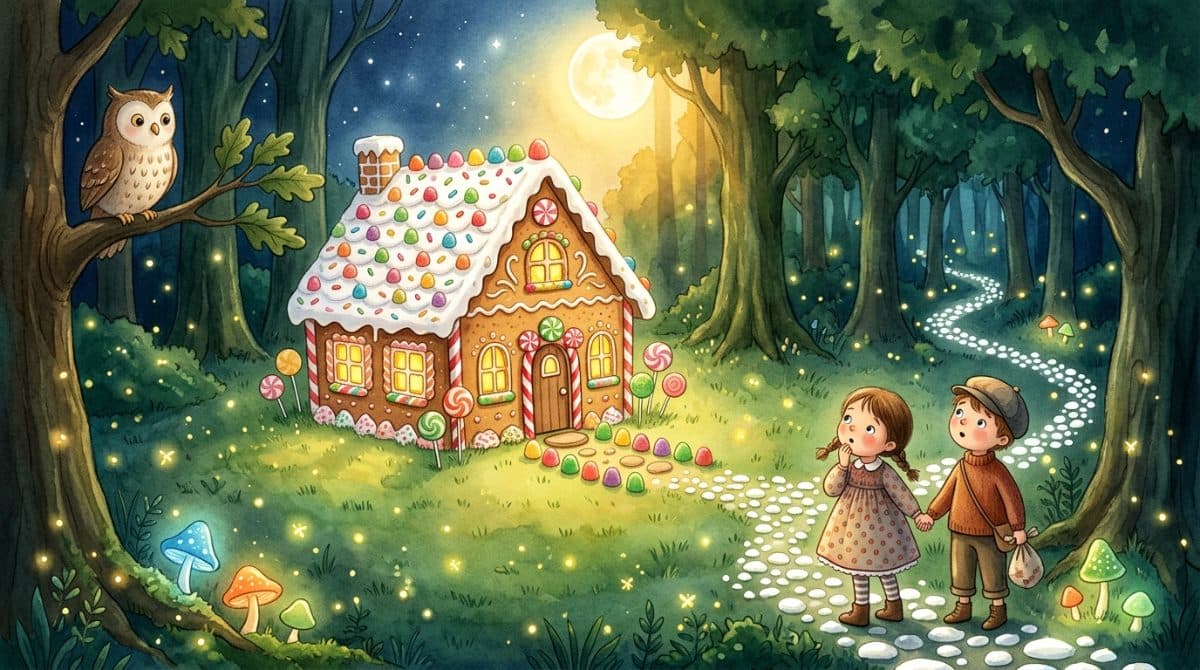
They smelled it before they saw it — sugar and ginger and warm butter, the smell of every good thing you've ever eaten, all at once. And there, in a clearing where the moonlight fell in a perfect circle, stood a cottage.
The walls were gingerbread. The roof was white icing. The windows were clear sugar that caught the light. Gumdrops lined the path. Candy canes framed the door.
Hansel broke off a piece of the windowsill. It tasted like heaven. Gretel ate a gumdrop from the path. It was the best gumdrop she had ever had.
The door opened.
An old woman stood there, smiling. She was small and bent and her eyes were very bright. Too bright, Gretel thought — the way a candle burns right before it goes out.
"Come in, come in, dear children. You must be SO hungry."
She fed them pancakes and cream and honey cakes and milk. She showed them two little beds with soft blankets and feather pillows. Hansel fell asleep in three minutes.
Gretel didn't. Something about the old woman's smile was wrong. It was too wide. It stayed on her face even when nothing was funny. It was the smile of someone who was hungry and looking at food.
In the morning, the old woman locked Hansel in a cage.
"Too thin," she muttered, poking his arm through the bars. "Must fatten him up."
She put Gretel to work — stirring pots, kneading dough, feeding Hansel through the cage bars. The old woman's eyes grew brighter by the day.
But Gretel was watching. Gretel was thinking. Gretel was doing what Gretels do — making a plan that didn't need pebbles.
When the old woman asked Hansel to stick out his finger ("Let me feel if you're fat enough"), Hansel stuck out a chicken bone instead. The old woman's eyesight was terrible. She squeezed the bone and frowned. "Still thin! More porridge!"
This bought them three days. Three days of Gretel watching the old woman's routine. Where she kept the key. When she napped. How the oven worked.
On the fourth morning, the old woman lit the oven. A great brick oven, large enough to — well. Large enough.
"Gretel, dear," the old woman said sweetly, "climb into the oven and tell me if it's hot enough."
Gretel looked at the oven. She looked at the old woman. She was nine years old and she was not stupid.
"I don't know how," Gretel said. "Could you show me?"
The old woman huffed. "Foolish girl." She leaned into the oven to demonstrate.
Gretel pushed. Not hard — she didn't need to. Gravity did the work. She closed the oven door and locked it.
She found the key. She opened Hansel's cage. Hansel stared at her.
"How?" he said.
"She leaned in. I pushed."
"That's IT?"
"Sometimes the best plan is very simple."
They found the old woman's pantry. Not just food — gold coins, hidden in jars and stuffed in socks and tucked into teapots. A lifetime of stolen treasure from a lifetime of stolen children.
They filled their pockets and walked out the candy door.
The forest was the same — tall, identical, pathless. But this time Gretel looked UP. Through the canopy, she could see the North Star — bright and steady and reliable, the way some people are.
"North is home," she said.
They walked north. Through the dark trees. Through the ferns and the fog. All night.
At dawn, they heard it — an axe. Their father's axe, ringing through the forest. They ran.
Their father dropped the axe. He dropped to his knees. He held them so tightly that Hansel's pocket ripped and gold coins spilled across the forest floor.
The stepmother was gone. She had left three days earlier, and nobody missed her, which tells you everything you need to know.
That night, their father cooked the biggest supper of their lives — bread and cheese and sausage and apple cake. Hansel ate until his buttons strained. Gretel ate until she was warm all the way through.
Their father tucked them in. Both of them. In the same bed, because they refused to be separated, which was understandable given the week they'd had.
"Papa?" Gretel said.
"Mm?"
"Don't ever leave us in the forest again."
Their father's eyes filled. "Never," he said. And he meant it — the way you mean something after you've learned what it costs to break your word.
The house was small and warm and smelled of apple cake... and the fire crackled softly... and Hansel was already asleep, one hand on his pocket of gold coins, the other holding Gretel's sleeve...
And Gretel looked at the ceiling... and the ceiling looked back... and the moon came through the window and laid a stripe of silver across the floor — the same moon that had lit the pebbles, the same moon that had shown her the North Star, the same moon that was always there... even when the forest was dark... even when the path was gone...
And Gretel closed her eyes... safe and full and home... with her brother beside her... and her father in the next room... and the forest outside, quiet now, keeping its secrets... the way forests do... until someone brave enough... walks in.
A gentle bedtime retelling of Hansel and Gretel by the Brothers Grimm. When two siblings get lost in a deep forest, they find a house made entirely of sweets — but the old woman inside isn't as kind as she seems. In this version, it's Gretel's quick thinking that saves the day, and the children find their way home using the stars. A 6-minute audio fairy tale for children ages 4-6. Free to listen.
Cleverness and courage — especially Gretel's — can get you through the darkest woods. And sometimes the simplest plan is the best one.
This bedtime version is gentler than the original. The witch is outsmarted without graphic detail, and the ending is warm and safe.
Ages 4 to 6.
Child Development
The benefits of reading to kids every night, in plain science. What 15 minutes of nightly stories actually do for vocabulary, the brain, empathy, sleep, and bond.
Stories & Reading
Should you read to your child or play an audio story? Brain research shows both activate the same regions. Here's when each works best — and how to combine them.
Screens & Tech
Screen-free activities for kids, sorted by age, for tired parents. Simple, low-effort play ideas to keep kids happy off screens, without guilt or boredom.
Sleep & Development
Calming activities before bed for kids, backed by science. A practical menu of wind-down routines that move a wired child from bouncing to drowsy in 20 minutes.
Beautifully narrated bedtime stories with soothing sounds to help your little ones drift off to sleep.
Join families who read with Dreamloo. Free stories, sleep tips, and early access to the app.
No spam. Unsubscribe anytime.