Sherlock Holmes — The Case of the Missing Melody
The Case of the Missing Melody
The girl arrived at 221B Baker Street at quarter past nine on a Thursday evening, which was unusual because clients generally arrived during daylight hours and this one was no older than twelve.
She wore a coat two sizes too large — her grandfather's, Watson noted, from the tobacco stains on the right pocket and the wear pattern of a much taller wearer. She carried a violin case. And she had been crying, though she was trying very hard not to, which Watson found more affecting than if she had simply let the tears fall.
"Mr. Holmes," she said, sitting on the edge of the chair as if she might need to leave quickly. "My name is Ada Chen. My grandfather died three weeks ago. And I've lost his song."
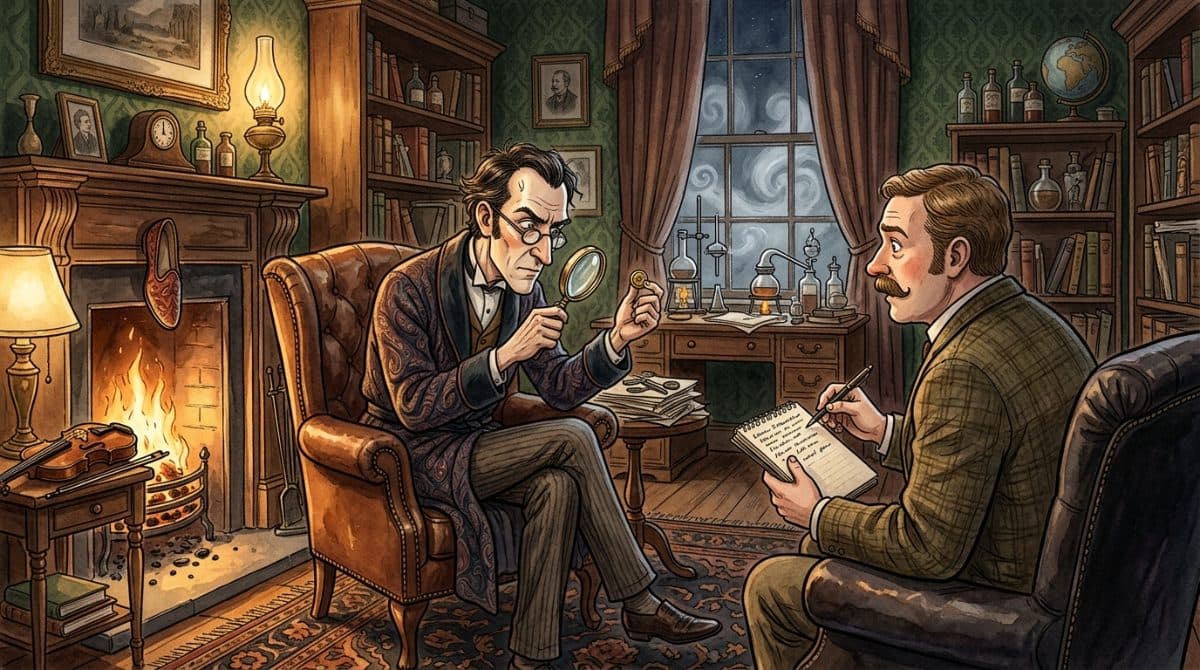
Holmes was in his dressing gown. He had been playing his own violin when the bell rang — a Stradivarius, badly in need of new strings, which he refused to replace because he claimed the imperfection gave it character. He set the instrument down and gave Ada his full attention, which was considerable.
"Explain," Holmes said. Not unkindly. Simply precisely.
"My grandfather composed a melody when he was young. He never wrote it down — he said the best music lives in the fingers, not on paper. He played it for me every Sunday. I know it by heart. I've ALWAYS known it by heart." Her voice cracked. "But since he died, I can't remember it. I sit down to play and my fingers don't know where to go. It's GONE."
Watson leaned forward. "Grief can do that. Memory is —"
"I don't want a medical explanation," Ada said. There was iron in her voice. Twelve years old and already formidable. "I want the melody BACK."
Holmes studied her for eleven seconds. Watson knew it was exactly eleven because Holmes counted silently and Watson had learned to count with him.
"Your grandfather was left-handed," Holmes said.
Ada blinked. "Yes."
"He played the violin restrung for a left-handed player — the strings reversed. You, however, play right-handed. You learned the melody by watching his fingers in a MIRROR arrangement. Your muscle memory learned it reversed."
Watson stared. Ada stared.
"Play the melody," Holmes said, "facing a mirror."
"I told you — I can't REMEMBER it."
"You can't remember it facing forward. Your fingers learned it watching his. His left hand was your right hand's mirror. The memory isn't gone, Miss Chen. It's reflected. Your body remembers what your mind forgot — but only when the image is correct."
Holmes stood. He walked to the mantelpiece and turned the mirror above the fireplace to face the room. "Stand here. Watch your own hands in the mirror. And play."
Ada opened the violin case. The instrument inside was old and well-kept — rosewood, with a small crack on the body that had been repaired with care. She lifted it to her chin.
She looked at her hands in the mirror. Left became right. Right became left. Her grandfather's hands, reflected.
She drew the bow across the strings.
The first note was wrong. The second was uncertain. But the third — the third was RIGHT. And her fingers remembered.
The melody spilled out — not all at once, but in pieces, like a puzzle assembling itself. A phrase here. A run there. A strange, beautiful turn that Watson couldn't identify but that made the hair on his arms stand up.
Ada played with her eyes closed. The mirror didn't matter anymore — the memory had unlocked, the way a door opens once you find the right key, and the music flowed as if it had never stopped.
It was a simple melody. Not grand, not complex. The kind of song someone hums while making tea, or walking through a garden, or rocking a child to sleep. It sounded like Sunday mornings. It sounded like a grandfather.
When she finished, the room was very quiet. The fire crackled. The fog pressed against the windows.
"Write it down," Holmes said. His voice was softer than Watson had heard in a long time. "Tonight. Before you sleep. Your grandfather was wrong about one thing — the best music lives in the fingers AND on paper. Paper doesn't grieve. Paper doesn't forget."
Ada looked at Holmes. Her eyes were bright but no longer red. "How did you KNOW? About the mirror? About the left hand?"
Holmes picked up his violin. He turned it over. On the back, scratched into the wood in tiny letters, were the words: "For Sherlock — play when you cannot think. Your fingers know more than your mind. — M.H."
"My mother," Holmes said. "She was also left-handed."
Watson looked at his friend. In all their years together, Holmes had never mentioned this. The firelight caught the scratch-marks on the violin, and Watson understood, in that quiet moment, something about Holmes that no case file or newspaper article had ever captured — that the great detective had his own missing melodies, and his own ways of finding them.
Ada left at half past ten, the melody written on the back of Watson's grocery list because it was the only paper available. She would copy it properly at home. She shook Holmes's hand — a firm shake, the kind adults give, which Holmes respected — and then she hugged Watson, which surprised them both.
The door closed. Baker Street was quiet. The fog was thicker now, turning the gaslight into soft golden spheres that floated outside the window like notes on a stave.
Holmes picked up his violin. He didn't play the Stradivarius — he played something else. Something quiet and simple and unfinished, with a strange, beautiful turn that Watson almost recognized.
"Holmes?" Watson said.
"Mm."
"Was that your mother's song?"
Holmes didn't answer. He played the phrase again — slower this time, letting each note hang in the warm air of the room before placing the next.
Watson picked up his pen. He opened his notebook. And while Holmes played, Watson wrote — not the notes, which he couldn't read, but the way the music made the room feel: like Sunday mornings, like tea cooling on a windowsill, like the particular silence that follows a question you already know the answer to.
The fire burned low... the fog wrapped 221B Baker Street in grey cotton... and the violin sang its quiet, unfinished song to the empty street below...
And Watson wrote... and Holmes played... and the gaslight dimmed... and the city went to sleep, street by street, lamp by lamp...
And somewhere in the fog, a girl walked home with a melody in her pocket and a grandfather in her fingers... and the night was long and quiet and full of songs that had been lost... and found... and written down... so they could never be lost again.
An original bedtime mystery featuring Arthur Conan Doyle's Sherlock Holmes and Dr. Watson. When a young violinist arrives at 221B Baker Street, distraught because her grandfather's melody has vanished from her memory after his death, Holmes takes the case — not to find a criminal, but to find a song. A gentle 8-minute audio detective story for children ages 7 and up. Free to listen. Uses only Conan Doyle's original public domain characters.
It's an original bedtime story using Arthur Conan Doyle's public domain characters (Holmes, Watson, 221B Baker Street). The case is new.
Ages 7 and up. It has more complex vocabulary and themes than the younger stories.
The original stories (1887-1923) are in the public domain. Later stories entered PD in 2023.
Child Development
The benefits of reading to kids every night, in plain science. What 15 minutes of nightly stories actually do for vocabulary, the brain, empathy, sleep, and bond.
Stories & Reading
Should you read to your child or play an audio story? Brain research shows both activate the same regions. Here's when each works best — and how to combine them.
Sleep & Development
A practical 8 month old sleep schedule: naps, wake windows, night sleep, and how to handle the 8-month sleep regression without losing your mind.
Sleep & Development
A practical guide to 6 month old wake windows: the typical range, signs to watch for, and a sample daily schedule you can start using tonight.
Beautifully narrated bedtime stories with soothing sounds to help your little ones drift off to sleep.
Join families who read with Dreamloo. Free stories, sleep tips, and early access to the app.
No spam. Unsubscribe anytime.