

You have been reading to your child every night for four years. Some nights it feels like a small miracle. Other nights — the exhausted ones — it feels like one more task between you and the couch. The question that surfaces on those nights is fair: is this actually doing anything, or is it just a tradition?
The answer, from the research, is yes. A 2015 study at Cincinnati Children's Hospital scanned the brains of preschoolers while they listened to stories and found that children from homes where parents read regularly showed measurably greater activation in language and imagination regions of the brain (Hutton et al., 2015). A meta-analysis covering thousands of children found that the amount of print a child is exposed to predicts vocabulary, reading skill, and academic outcomes — across infancy, childhood, and into adulthood (Mol & Bus, 2011). The American Academy of Pediatrics now formally recommends reading aloud to children daily, starting at birth (AAP, 2014).
The benefits of reading to kids every night are real, measurable, and cumulative. This article covers what those benefits actually are, what the brain does during a bedtime story, how much reading "counts," and what to do on the nights you cannot face one more page.
What "reading every night" really means
It is not a curriculum. It is not a test of stamina. Reading to a child every night — what researchers call shared reading or reading aloud — means sitting close, opening a story, and reading it together. For a toddler, that is a board book and a lot of pointing. For a preschooler, picture books and questions. For an older child, a chapter at a time of something with a plot. The shape changes; the practice is the same.
Two things make nightly reading specifically powerful. First, it is spaced — small daily doses, which the developing brain consolidates better than occasional long sessions. Second, it pairs language with relationship — your voice, your face, your closeness — which makes the language stick.
The brain on bedtime stories
In the Hutton fMRI study, preschoolers listened to stories inside a scanner. Children whose parents reported a richer home reading environment showed significantly more activation in the left-sided brain network responsible for understanding language and constructing mental images from words (Hutton et al., 2015). A later study by the same group found that the quality of shared reading — engaged, interactive, dialogic — also tracked with this activation (Hutton et al., 2017).
In plain terms: reading aloud lights up the brain in exactly the way needed to do well at language, comprehension, and imagining what is described — and the children who get more of it light up more.
The Mendelsohn group ran a randomized controlled trial of a reading-aloud intervention for low-income families. Children whose parents received support to read aloud regularly showed improvements not just in language outcomes but in behavior and emotional regulation by age four and a half (Mendelsohn et al., 2018). Stories do not only teach words. They help build the brain that handles feelings, attention, and other people.
The five benefits, in plain language
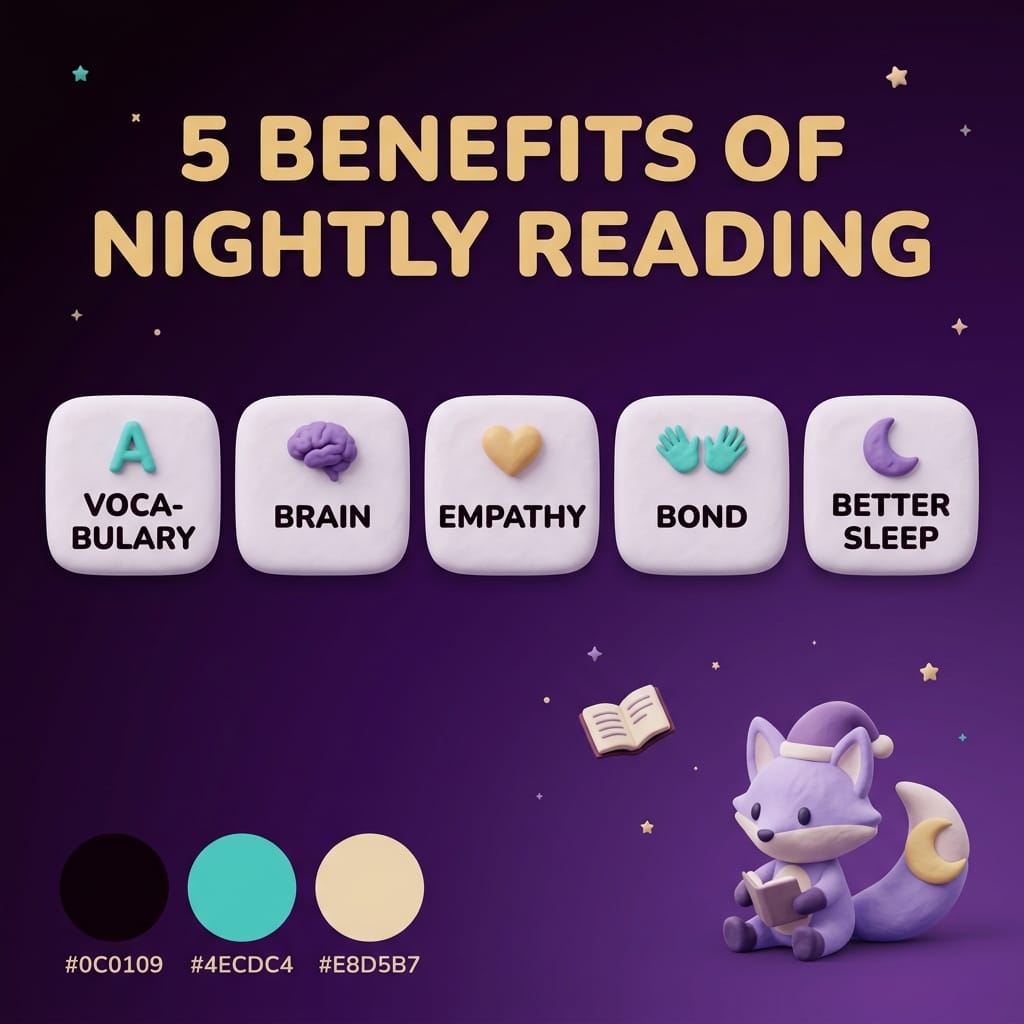
1. Vocabulary and literacy. Books contain words a child rarely hears in conversation. The classic meta-analysis by Bus, van IJzendoorn, and Pellegrini (1995) found that shared book reading is one of the strongest single predictors of later reading skill. Mol and Bus (2011) confirmed this scales: more print exposure across childhood predicts stronger vocabulary, comprehension, and reading achievement, all the way to early adulthood.
2. Brain development. Hutton's fMRI work shows the neural mechanism — activation in language and mental-imagery networks (Hutton et al., 2015, 2017). The brain that is read to regularly literally develops different patterns of engagement when processing language.
3. Empathy and social understanding. Stories ask a child to step into another mind. That practice — repeated nightly — is exactly what builds theory of mind, the ability to understand that other people have feelings, thoughts, and reasons different from one's own. The reading-aloud RCT (Mendelsohn et al., 2018) found measurable improvements in social-emotional behavior in children whose parents read more.
4. Parent-child bond. The body of evidence on early literacy promotion treats the parent-child interaction during reading — eye contact, warm voice, closeness, back-and-forth — as part of the benefit, not just a setting (Duursma et al., 2008). For many families, the nightly story is the most reliably calm, unhurried, present time of the whole day.
5. Easier sleep. A consistent bedtime routine improves sleep onset and reduces night wakings in young children (Mindell et al., 2009). A nightly read-aloud is one of the easiest, most-recommended anchors of that routine — covered in more depth in why bedtime stories help kids sleep.
How much actually counts?
You do not need an hour. Across the research, the consistent finding is that consistency beats duration. Reading every night for 10 to 20 minutes produces stronger effects than reading once a week for an hour.
A working rule of thumb by age:
- 0–2 years: 5–10 minutes, one or two short board books. Babies do not need a plot — they need your voice, your face, and rhythmic language.
- 3–5 years: 10–20 minutes, one or two picture books, with lots of pointing, questions, and rereading favorites.
- 6–10 years: 15–25 minutes, a chapter or two of an early reader or chapter book. Yes, even once they can read themselves.
The dose-response question matters here. Mol and Bus (2011) found a clear cumulative effect: every additional hour of print exposure across the years adds up. There is no threshold below which reading is pointless and no ceiling above which more does nothing. Daily is the lever.
Want the reading hour to do double duty? Pair your nightly book with a calm audio bedtime story when you need the wind-down to extend gently into sleep — Dreamloo's stories are designed for the 10–20 minutes between book and lights-out, so the language exposure keeps going while you can step out of the room.
Reading at every age
The shape of "every night" changes as a child grows.
Babies (0–12 months). This is the age that surprises new parents most. Babies cannot follow a plot, but they hear melody, rhythm, and the specific cadence of your voice. Books with high-contrast images, rhymes, and a few words per page are perfect. Five minutes counts. Repetition counts even more.
Toddlers (1–3 years). Toddlers want to point, name, lift flaps, and turn pages. Let them. Dialogic reading — asking questions, pausing for them to fill in a word, following their interest — is consistently linked to bigger vocabulary gains than straight read-throughs (Duursma et al., 2008). The book becomes a conversation.
Preschoolers (3–5 years). Now imagination opens up. Stories with plots, character feelings, and gentle problems give a preschooler safe ground to think about big things. This is also the prime age for repetition — the fortieth reading of the same book is doing real work, not boring you for nothing.
School-age (6–10 years). Many families stop reading aloud once a child can read independently. Don't, if you can help it. Reading to a child who is past the decoding stage exposes them to longer, more complex stories than they could yet read alone, and keeps the bedtime ritual intact. A chapter a night is enough.
What "good" reading time looks like
The mechanics, again from the research:
- Slow down. A few words per beat. The race-through read-aloud captures less than half the benefit.
- Make it interactive. "What do you think happens next?" "Have you ever felt like that?" Even one or two questions per page.
- Match your voice to the story. Quiet for the calm parts, lift slightly for the big moments. Children remember stories told this way.
- Reread favorites. Repetition lets new layers land — words, then patterns, then meaning. Toddlers especially learn vocabulary faster from repeated readings than from one-shot variety.
- Sit close. Reading is also a touch ritual. Lap, shoulder, head on chest — that proximity is part of why the language sticks.
- Phones down. A divided-attention read-aloud lands far weaker than a present one.
What if you can't read every single night?
Some nights you are wrecked. Some nights one parent is traveling. Some nights the child is feverish, or the day was a wreck. Two honest moves:
One: call in audio. A calm narrated bedtime story delivers the language exposure, the vocabulary, the imagination — most of the brain side of the benefits — without requiring a depleted parent to perform. It does not replicate the cuddle, but it preserves the language stream. See our deeper comparison: audio stories vs reading for kids.
Two: be honest about "every." "Every night" is the aim, not a perfection test. Five nights a week, every week, for ten years, is far more than enough to produce all the documented effects. Miss a night without guilt; come back the next.
A small note on what reading is not
Reading aloud is not a substitute for medical or developmental support, and it is not a fix-all. It supports development; it does not treat language delays, attention difficulties, or learning differences. If a child is consistently uninterested in being read to past the toddler stage, struggles to focus on simple stories well into preschool, or shows other signs of a language or developmental concern, talk to your pediatrician. Reading every night is one of the best things you can do alongside whatever else is needed — not instead of it.
Common Questions from Parents
My child squirms and won't sit still — does it still count?
Yes. Listening is happening even when the body is not. Toddlers and many preschoolers absorb stories perfectly well while crawling around, fiddling with a toy, or hanging upside-down off the bed. Forcing stillness usually backfires; the child associates reading with restraint. Let the body move, keep the voice steady, and ask a question now and then to check in. Children who appear not to be listening are often the ones who can repeat the story word for word a week later.
Is e-book reading as good as a paper book?
Mostly yes, with one caveat. The language exposure and shared time are similar on paper or screen if a parent is reading. The caveat is interactive e-books with games, sounds, and pop-ups: those tend to pull attention to the device features and away from the story, and research suggests they produce weaker comprehension and weaker parent-child interaction than a plain text. A simple digital book read aloud is fine. A noisy "interactive" one is not what we mean by reading aloud.
Should I read to my older child if they can already read alone?
Yes, if they will let you. Independent reading and shared reading do different jobs. Independent reading builds fluency at the child's own level. Reading aloud lets you take them somewhere a few years ahead — vocabulary, sentence structure, narrative complexity — that they could not yet decode on their own. Many parents who keep reading to school-age children find it becomes one of the most reliable conversation spaces of late childhood.
What if I'm not a great reader-aloud — does it still help?
Yes. Children do not grade your performance. They respond to your voice and your attention. Slow down, sit close, do one funny voice if it makes you both laugh, and let the rest go. The benefits of reading to kids every night come from showing up, not from theater.