
It sounds almost too simple. Read your child a story before bed, and they will sleep better. But behind this ancient parenting instinct lies a surprisingly deep body of scientific evidence — and it goes far beyond just "calming them down."
Bedtime stories change how your child's brain develops. They change how long and how deeply your child sleeps. They change how your child processes emotions, builds vocabulary, and bonds with you. And they work not because of some vague notion of "quality time," but because of specific, measurable biological and psychological mechanisms that researchers have been documenting for decades.
If you have ever wondered whether storytime really matters — or whether you could just skip it on those exhausting nights — here is what the science actually says.
The Pavlov Effect: How Stories Become a Sleep Switch
Dr. Janet Kennedy is a clinical psychologist who spent eight years developing the Sleep Disorders Treatment Program at the Manhattan Veterans Affairs Medical Center. She has studied sleep in both adults and children, and she describes the mechanism behind bedtime stories in a way that most parents immediately recognize.
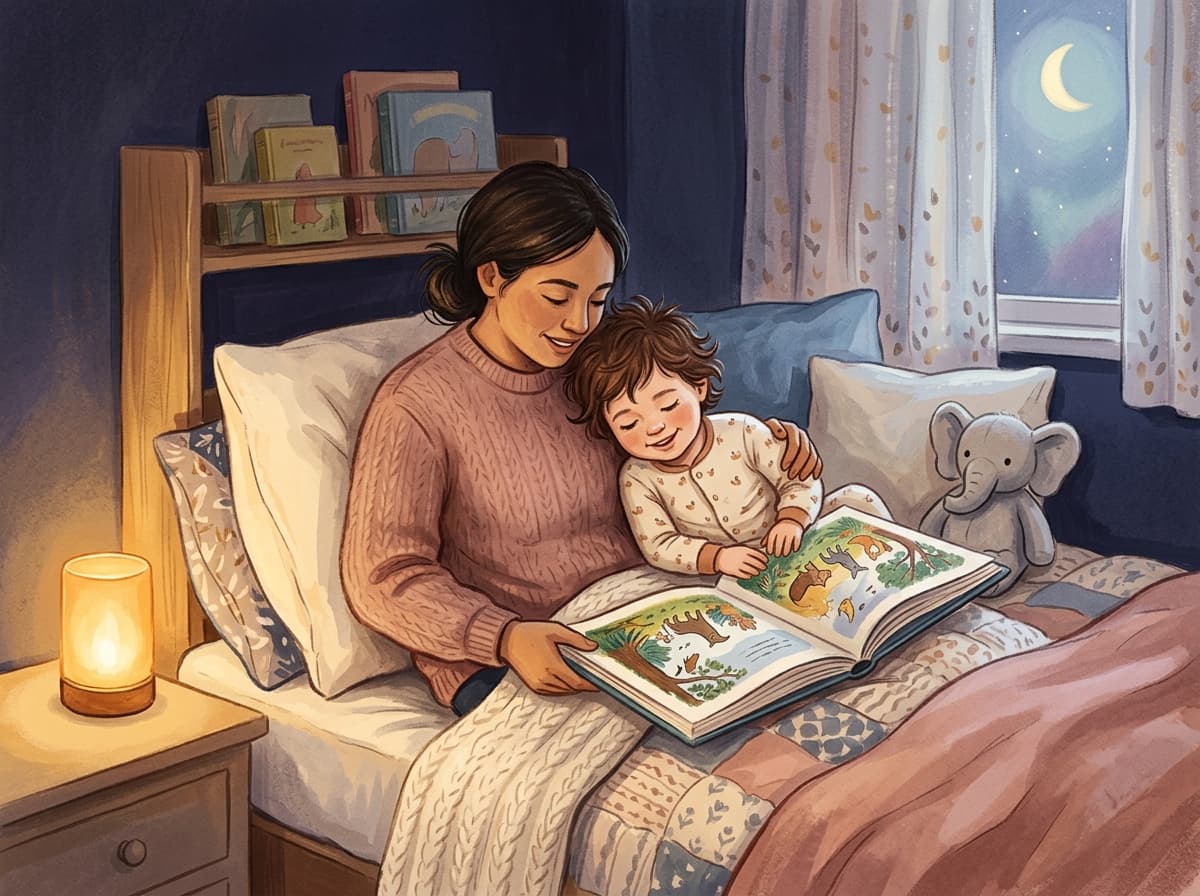
Bedtime reading happens when your child is already tired and physically relaxed. The warm bed, the dim light, your calm voice — all of this unfolds in a state of natural drowsiness. Over time, your child's brain begins to associate the act of hearing a story with the feeling of sleepiness. This is classical conditioning — the same principle behind Pavlov's famous experiment, but working entirely in your child's favor.
With enough repetition, the story itself begins to trigger drowsiness. Your voice reading those familiar words becomes a cue that tells the nervous system: everything is safe, you can let go now.
This is why consistency is so important. A story read once in a while is a nice moment. A story read every single night, in the same place, at the same time, in the same soft voice, becomes a powerful biological signal. You are literally training your child's brain to fall asleep.
And this conditioning lasts. Kennedy notes that many adults who were read to as children still feel a wave of sleepiness when they open a book in bed — decades later. The neural pathway, once established, is remarkably durable.
Five Ways Bedtime Stories Help Your Child (Backed by Research)
The sleep benefit alone would be enough reason to read every night. But the research shows the effects reach much further.
1. Better, Longer Sleep
A landmark study of over 10,000 families from 14 countries, published in the journal SLEEP (Mindell et al., 2015), found that children with a consistent bedtime routine — with storytime as a core element — slept over an hour longer per night than children without one. They also fell asleep faster, woke up less during the night, and had fewer parent-reported sleep problems.
The effect was dose-dependent: the more nights the routine happened, the better the child slept. And the results were universal — they held across the United States, India, China, and every other country in the study.
A follow-up study (Mindell et al., 2017) tested how quickly this effect kicks in. The answer: families who started a simple nightly routine saw measurable improvements in sleep onset, night waking frequency, and sleep continuity within the first three nights.
For a detailed plan on how to build a complete bedtime routine with storytime at its center, see our step-by-step bedtime routine guide.
2. Stronger Brain Development
This is where the science gets truly remarkable.
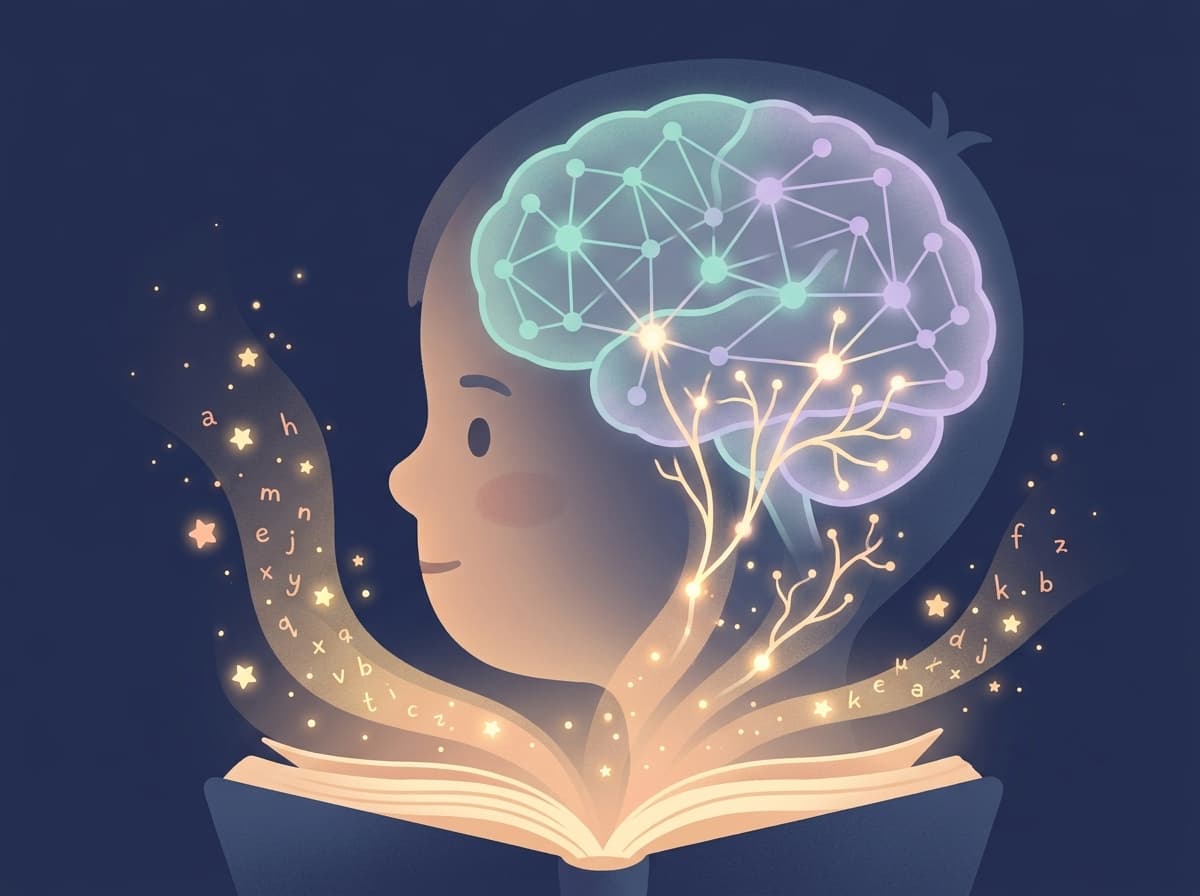
A team at Cincinnati Children's Hospital used functional MRI to observe preschoolers' brains while they listened to stories through headphones. Children who were regularly read to at home showed significantly greater activation in brain regions responsible for mental imagery and narrative comprehension — the parts of the brain that allow a child to "see" a story in their mind and extract meaning from language.
The more reading happened at home, the stronger the neural response — even after controlling for household income, which is a common confounding factor in developmental studies.
A 2023 study from the University of Cambridge went even further. Analyzing data from over 10,000 American children tracked through adolescence, the researchers found that children who began reading for pleasure early in life had moderately larger total brain volumes during their teen years — including regions critical for cognition and mental health. These children also scored higher on cognitive tests, showed fewer signs of depression, and had fewer behavioral problems. The optimal amount of reading was around 12 hours per week.
Here is the number that should get every parent's attention: ninety percent of brain development occurs between birth and age five. Every story you read to your child during those years is contributing to the physical architecture of their brain.
3. Bigger Vocabulary and Stronger Literacy
Research presented at the 2017 Pediatric Academic Societies Meeting found that reading to children during infancy had measurable effects on vocabulary and reading skills four years later — when the children entered school. Babies who were read to performed better, regardless of their family's income or education level.
Why? Spoken language at home tends to be simple and repetitive. Books introduce children to words and sentence structures they rarely hear in everyday conversation. A bedtime story about a rabbit who "scurried through the meadow" teaches a child the words "scurried" and "meadow" in a context they can feel and picture. That is how vocabulary sticks.
Speech-language therapists also point out that storytime builds print knowledge — the understanding that text has meaning, that pages turn left to right, that letters represent sounds. These pre-reading skills lay the foundation for everything that comes later in school.
4. Emotional Regulation and Empathy
A recent neuroscience study published in Developmental Science used brain imaging to observe preschoolers during two conditions: listening to a story read aloud by a human, and watching a similar story on a screen. The results were striking.
When a human read the story, a brain region called the right temporoparietal junction was activated. This is the area responsible for understanding other people's emotions, taking someone else's perspective, and processing social cues. When the children watched the same story on a screen, this region was not activated.
Stories give children a safe space to practice emotions they have not yet encountered in real life — fear, loss, jealousy, courage, kindness. When a character in a story feels scared and then finds safety again, the child's brain rehearses that emotional journey. Over time, this builds real emotional resilience and empathy.
The bedtime context makes this especially powerful. At night, with defenses down and the body relaxed, the brain is more open to emotional processing. Many parents notice that their children ask deeper, more reflective questions during bedtime reading than at any other time of day. That is not a coincidence — it is the brain's natural receptive state at that hour.
5. Stronger Parent-Child Bond
A 2008 study found that mothers who regularly read to their children reported more positive interactions throughout the day — not just at bedtime. A follow-up found that consistent shared reading was associated with less harsh parenting and greater warmth overall.
The American Academy of Pediatrics updated its policy in 2024, emphasizing that shared reading from birth is not merely a literacy tool — it is a relational one. Pediatrician Dr. Perri Klass, lead author of the new AAP policy statement, wrote that children who first encounter books in the arms of their parents arrive at school associating reading with a sense of security and the voices of the people they love most.
Bedtime is often the only moment in a hectic day when a parent and child are physically close, unhurried, and focused entirely on each other. That closeness — your warmth, your voice, your undivided attention — is itself a form of nourishment that no app or video can replicate.
Reading Aloud vs. Screens: Why the Delivery Method Matters
In a world where tablets are as common as teddy bears, it is fair to ask: does it matter whether a child hears a story from a person or watches it on a device?
The research says yes — significantly.
The Developmental Science brain imaging study showed that live storytelling activates empathy-related brain regions that screen-based stories do not. The AAP's 2024 technical report concluded that digital books do not produce equivalent parent-child interactions compared to physical books.
And the sleep impact is especially stark. Screen use before bed suppresses melatonin, delays sleep onset, and reduces sleep quality in children. Storytime — whether read aloud or listened to — does the opposite: it promotes relaxation and primes the brain for sleep.
This does not mean screens are always the enemy. But for the specific purpose of a bedtime wind-down, stories delivered through a human voice — whether live or recorded audio — are biologically superior to stories on a glowing screen.
What About Audio Stories?
Not every parent has the energy to read aloud every single night. Some nights you are running on empty. Some nights you are not physically there. Some nights your voice is hoarse from a day of talking, negotiating, and explaining.
That is completely okay. Audio stories are not a lesser alternative — they are a legitimate and research-supported tool.
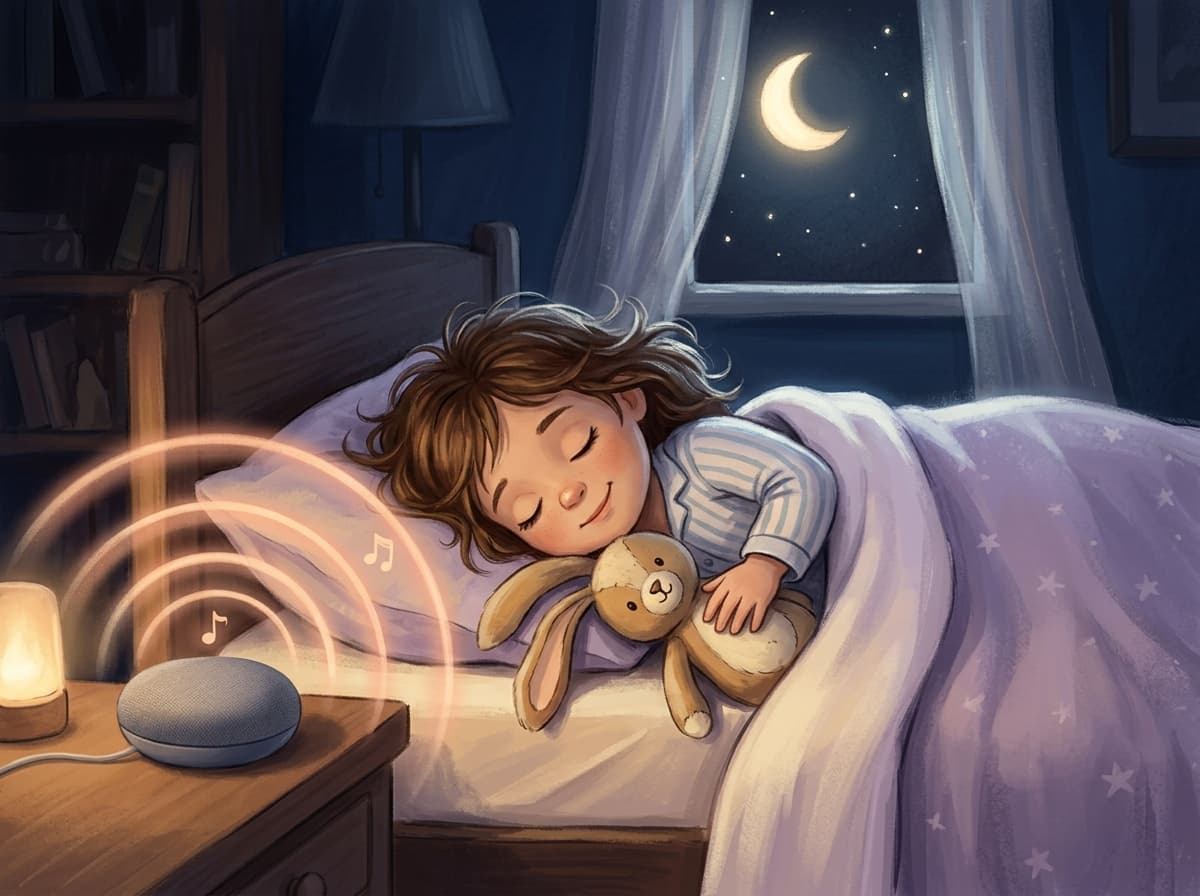
A study published in the Journal of Sleep Research found that listening to relaxing narrated content before and during the early stages of sleep increases the duration of deep sleep. The mechanism is straightforward: gentle narration slows the heart rate and breathing, helping the brain disengage from the day's stimulation and enter the restorative phases of sleep more quickly.
For children, audio stories offer several unique advantages:
They help children learn to fall asleep independently. One of the hardest transitions in early childhood is learning to fall asleep without a parent in the room. An audio story gives a child something comforting to focus on — a gentle voice, a narrative arc, soft background music — that is not a screen and not a parent who will eventually leave. It bridges the gap between needing someone beside them and being able to drift off alone.
They are endlessly patient. A tired parent might rush through a story or skip pages. An audio story delivers the same calm, consistent narration every time — with no impatience, no yawning, no checking the phone.
They are screen-free. Unlike a tablet or TV show, an audio story does not emit light, does not require visual attention, and does not stimulate the brain in ways that interfere with melatonin production. Your child can close their eyes and listen — which is exactly what you want at bedtime.
They work for siblings with different bedtimes. If you have two children who go to bed at different times, audio stories let the older child have their own wind-down time while you handle bedtime with the younger one.
DreamLoo was built around this principle. Every story in our library is narrated in a calm, soothing voice with gentle music — designed not to entertain your child into staying awake, but to guide them gently into sleep. Try our free bedtime stories and see the difference.
How to Make Storytime Work Best for Sleep
Not all storytime is created equal. Here are a few practical tips to maximize the sleep benefit:
Choose calm content. A story about a daring rescue or a surprise twist is great for daytime. At bedtime, you want gentle narratives, repetitive language, and peaceful resolutions. Stories about nature, animals going to sleep, or characters on quiet adventures tend to work best. For age-specific recommendations, see our guide to the best bedtime stories by age.
Keep your voice low and slow. The rhythm of your voice is part of the sleep cue. Let it get gradually quieter and slower as the story progresses. Think of it as a vocal lullaby — you are using tone, pace, and volume to signal the nervous system to wind down.
Set a clear limit. "We are reading two books tonight" or "We are listening to one story." State it before you begin, and hold the boundary gently. This prevents the "one more!" spiral that can push bedtime later and later.
Embrace repetition. If your child asks for the same story every night, that is actually ideal. Familiar stories reduce cognitive stimulation — the brain does not need to work hard to follow the plot. The predictability is soothing, and the familiarity strengthens the conditioned sleep association.
Dim the lights first. Start dimming lights 30-60 minutes before storytime begins. Research shows that even standard room lighting can suppress melatonin in preschoolers. Read by the glow of a warm nightlight or a low-wattage lamp — not overhead lights.
Let the story be the last active thing. After the story ends, keep the transition to sleep simple: a brief cuddle, a consistent goodnight phrase, and lights out. The story should be the final "active" step before your child closes their eyes.