

It's 2 a.m. and you hear a soft thump, followed by the patter of small feet crossing the hallway. Your toddler has just climbed out of the crib for the third night in a row, and you're standing in the dark wondering if it's finally time to make the crib to toddler bed transition. You're not imagining the risk. The U.S. Consumer Product Safety Commission has repeatedly identified falls, most often from a toddler climbing over the crib rail, as one of the leading causes of nursery-product injuries treated in emergency departments each year (U.S. Consumer Product Safety Commission, 2022). This guide walks through the real signs it's time, how to set up the new bed safely, and a practical plan for the first hard week.

When Is It Time for the Crib to Toddler Bed Transition?
There's no single correct age for the crib to toddler bed transition. Most families make the switch somewhere between 18 months and 3.5 years, but pediatric guidance points to behavior, not the calendar, as the real signal (American Academy of Pediatrics, HealthyChildren.org). A toddler who is calm and content in the crib at 2 years old doesn't need to move just because a peer already has.
Signs Your Toddler Might Be Ready
- Climbing over the rail. This is the clearest safety signal. Once a toddler can get over the top rail, the crib itself becomes the fall risk it was designed to prevent.
- Reaching the height guideline. Pediatric guidance generally suggests moving a toddler out of the crib once they're tall enough that the rail no longer sits well above their chest, since that's when climbing attempts get easier and more frequent.
- Genuine curiosity about a "big kid" bed. Some toddlers ask for one, point at a sibling's bed, or get excited about picking out new sheets.
- A sibling on the way. This can be a practical reason to move the timeline up, but only if the transition starts well before the new baby arrives, not the same week.
- Potty training at night. A bed makes it easier for a toddler to get up and use the bathroom independently, though this alone isn't a strong enough reason to switch early if climbing isn't yet a concern.
Sleep patterns shift gradually through toddlerhood, and total sleep need doesn't change overnight just because the sleeping surface does. Research tracking sleep duration from infancy through adolescence shows a steady, gradual decline in total sleep as children grow, not a sudden reset tied to any single milestone (Iglowstein, Jenni, Molinari, & Largo, 2003). That's a useful reminder that a bed change doesn't need to come with a whole new sleep schedule attached.
Rushing the switch, whether from pressure, a due date, or a milestone chart, tends to backfire more than waiting a few extra weeks. A toddler who isn't climbing and isn't asking for a bed usually does better staying in the crib a little longer, since the crib itself is doing its job of keeping bedtime simple and contained. Pediatric sleep research consistently finds that outcomes depend far more on how consistently a new routine gets applied than on which exact week it starts (Owens & Mindell, 2011).
Preparing the Room Before You Make the Switch
A few changes to the room before the first night in the new bed make the whole process smoother.
- Keep the bed in the same spot as the crib, if you can. Familiar orientation to the door, window, and nightlight reduces one more variable your toddler has to adjust to.
- Childproof at toddler height, not crib height. A toddler who can now get out of bed can also reach outlets, cords, and unsecured furniture they couldn't touch before. Anchor dressers and bookshelves, and move blind cords well out of reach.
- Bring over familiar bedding and a comfort object. The same sheet pattern, the same stuffed animal, or a blanket that already smells like their room helps carry over a sense of "this is still my space."
- Tighten the bedtime routine first if it's been loose. A change like this lands more smoothly on top of a routine your toddler can already predict. If bedtime has been inconsistent lately, our bedtime routine for toddlers guide is a good place to start before you touch the bed itself.
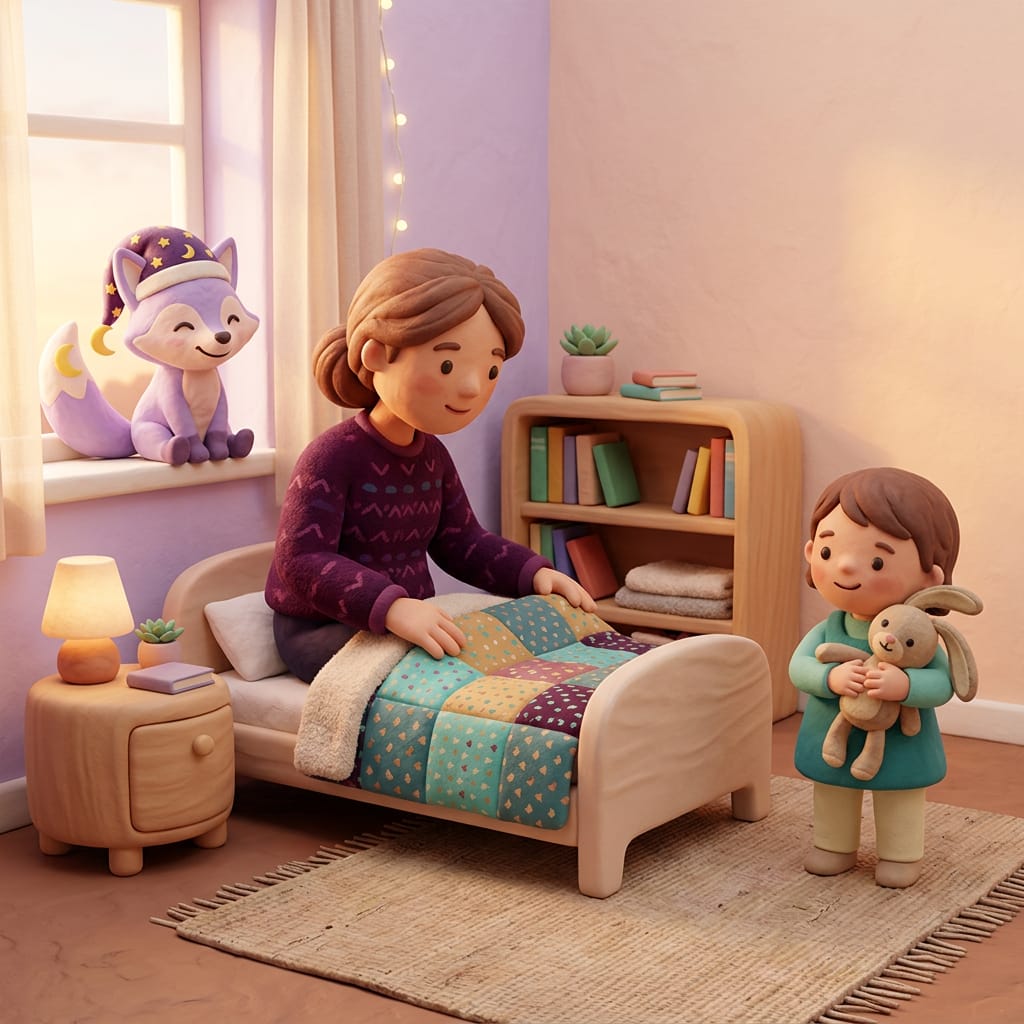
How to Make the Crib to Toddler Bed Transition: A Step-by-Step Plan
- Talk about it during the day, simply. A short, matter-of-fact heads-up works better than a big buildup: "Tonight you're going to sleep in your new bed."
- Let your toddler help set it up. Picking out sheets or placing a favorite toy on the new bed gives them a small sense of ownership over the change.
- Try the new bed at naptime first. A daytime nap in the new bed, with less riding on the outcome, gives your toddler a low-stakes first experience before the first full night.
- Keep the wind-down routine identical. Same bath, same book or story, same lights-down sequence. The bed is the only thing that's new. Everything else should feel exactly like last week.
- Use a bed rail for the first few weeks if the bed sits low but open on one side. It reduces the chance of a rolled-out-of-bed fall while your toddler learns the new edges.
- Respond to nighttime wake-ups the same calm way, every time. A brief, quiet walk back to bed, minimal conversation, works better than negotiating or adding extra minutes together. This kind of steady consistency is one of the most reliable predictors of success in behavioral sleep research with young children (Mindell, Kuhn, Lewin, Meltzer, & Sadeh, 2006). If your toddler has never fully settled to sleep without help, our guide on how to get your toddler to sleep alone covers the groundwork in more depth.
Keep the wind-down familiar. A calm, screen-free Dreamloo audio story can carry over from the crib routine unchanged, so the only thing shifting at bedtime is the bed itself, not the whole experience your toddler counts on.
What to Expect During the First Week
Almost every family hits a bumpy few nights, and that doesn't mean the transition is failing. Expect more calling out, more requests to come find you, and possibly a toddler who gets out of bed just to test whether the new rules actually hold. This kind of boundary-testing is a completely normal part of any routine change at this age, not a sign something has gone wrong.
Parenting consistency matters more here than almost anywhere else in the sleep process. Studies on parenting behavior and toddler sleep patterns across cultures consistently find that how predictably a parent responds to nighttime wake-ups shapes how quickly a child settles into a new arrangement (Sadeh, Tikotzky, & Scher, 2010). A response that's calm on Monday and frustrated by Thursday tends to stretch the adjustment period out, since your toddler is left guessing which version of bedtime they'll get.
A short regression is also common if your toddler gets sick, travels, or has a big week at daycare during the transition. That's a normal dip, not a reason to abandon the plan. Hold steady, and pick back up once things settle.

Common Mistakes That Make the Transition Harder
- Switching for the wrong reason at the wrong time. Moving a toddler out of the crib only because a new baby needs it, and doing so the week before the baby arrives, tends to cause more resistance than starting a month or two earlier.
- Changing more than one thing at once. A new bed, a new room, and a new daycare in the same week is a lot for a toddler to process together.
- Long negotiations at bedtime. Extra minutes spent talking through a protest can, from a toddler's perspective, feel like a reward for getting up in the first place.
- Removing the crib immediately. Keeping it nearby, or at least not making a dramatic show of taking it apart, keeps the change feeling less final and scary.
- Expecting zero pushback. Some resistance is a normal response to any change in a long-standing routine. It doesn't mean the plan isn't working.
Safety Essentials Once the Crib Is Gone
Once a toddler can get out of bed on their own, the safety picture in the room changes completely. A few essentials are worth setting up before the first night, not after a scare.
- Install a gate at the top of stairs if your toddler's room is upstairs, since a toddler who can now leave the bed can also leave the room.
- Consider a floor bed for very active sleepers. A low mattress placed directly on the floor removes fall height almost entirely, which matters given how often nursery-product falls show up in emergency room injury data (U.S. Consumer Product Safety Commission, 2022).
- Secure furniture and cover outlets at the new, lower reach height your toddler now has access to.
- Keep a dim, warm nightlight on so a toddler who does get up isn't navigating a pitch-dark room.
- Check window cords and blinds one more time, now that your toddler can reach areas of the room they couldn't from inside the crib.

When to Get Extra Support
Most families get through the crib to toddler bed transition with a steady plan and a couple of rough weeks. It's worth a conversation with your pediatrician if the resistance is extreme and doesn't ease after about a month, if your toddler seems fearful rather than simply testing limits, or if nighttime wandering becomes a real safety concern despite gates and childproofing. If fear of the dark or of being alone seems to be driving the pushback more than habit, our guide on a child afraid of the dark covers ways to ease that worry without undoing the progress you've already made.
Common Questions from Parents
Should I get rid of the crib completely, or keep it for a future sibling?
You can keep it. Many families store the crib rather than sell or donate it right away, especially if another baby might use it later. Keeping it out of the toddler's room, even if it's just in a closet or garage, avoids any confusion about which bed is "theirs" now while still saving you a future purchase.
What if my toddler refuses to sleep in the new bed at all?
Give it more time before switching strategies. A few nights of resistance is common and doesn't mean the transition has failed. If refusal continues past two or three weeks with a consistent routine, try shortening the gap between the wind-down routine and lights-out, or reintroduce the bed at naptime again to rebuild familiarity in a lower-pressure setting.
Is it normal for a toddler to fall out of a toddler bed?
Yes, occasional falls in the first few weeks are common, and a toddler bed's low height keeps the risk minimal. A bed rail cuts this down further while your toddler learns where the new edges are. If falls continue well past the adjustment period, a floor bed removes the height risk almost entirely.