Pinocchio
The Puppet Who Wanted to Be Honest
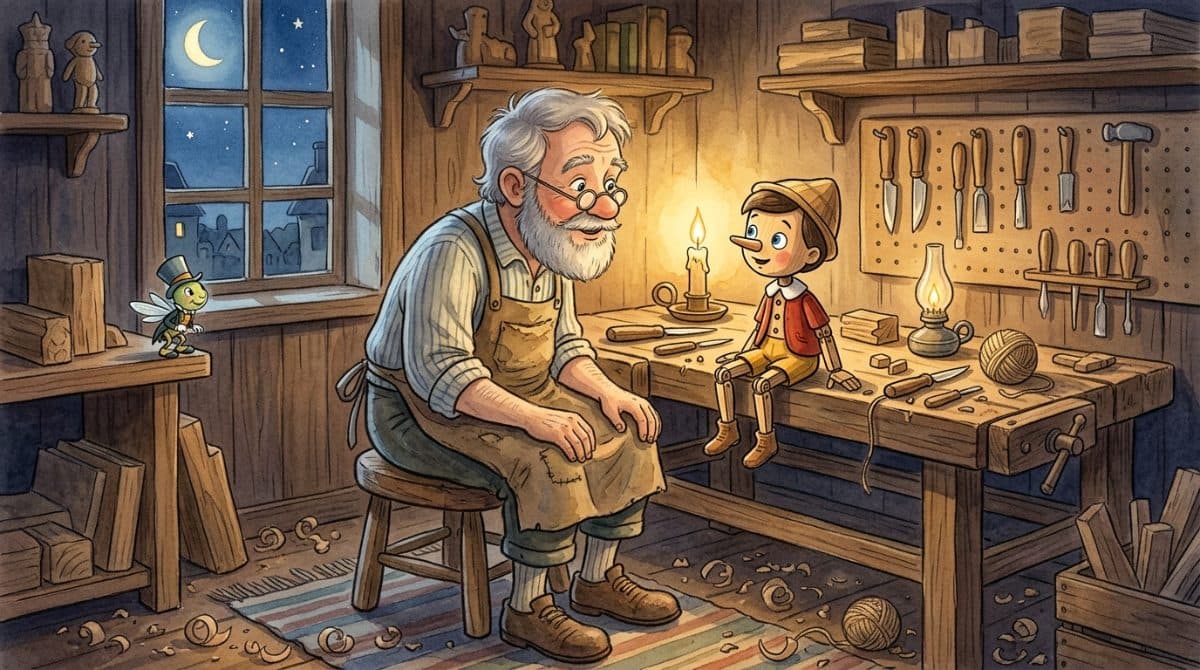
The wood was already singing when Geppetto found it.
It was a piece of cherry wood, left over from a broken chair, sitting in the corner of his workshop. Most wood is quiet. This piece hummed — a low, warm note, like a cat purring inside a log.
Geppetto was old and kind and lived alone. He made puppets — puppets with painted smiles and jointed arms that danced on strings. Children loved them. But when the puppet show ended and the children went home, the workshop was very quiet.
"I'll make one more," Geppetto said to the humming wood. "One that stays."
He carved all night. He shaped a round head with careful hands. He whittled arms and legs and fingers — ten tiny fingers, each one perfect. He painted two wide brown eyes that looked, even on wood, like they were about to blink.
He gave the puppet a nose. A small, straight, wooden nose.
And at midnight, when the candle had burned to a stub and wood shavings covered the floor like snow — the puppet opened his eyes.
"Papa?" he said.
Geppetto dropped his chisel. His hands shook. His eyes filled.
"Yes," he whispered. "Yes, I'm your papa."
Pinocchio — because that's what Geppetto named him, after the pine nuts he kept in a jar on the shelf — was alive. Wooden, but alive. His joints clicked when he walked. His painted eyes blinked. And when he spoke, his voice sounded like two sticks rubbing together, but softer — like a wooden wind chime in a gentle breeze.
He was wonderful. He was also TERRIBLE at being real.
On his first day, he knocked over the paint jars, broke a shelf, and told a bird outside the window that he could fly — then jumped off the table to prove it. He couldn't fly. He could, however, dent the floor.
"You need to be more careful," Geppetto said, gluing Pinocchio's left arm back on.
"I WAS careful. The floor attacked me."
Geppetto looked at the dent. He looked at Pinocchio. He said nothing, but his eyebrows said quite a lot.
The problem with Pinocchio was not that he lied. It was that he didn't know how to tell the truth when the truth was uncomfortable.
When he accidentally broke Geppetto's favorite cup — the blue one, the one Geppetto's wife had painted before she passed — he hid the pieces under the workbench.
"Have you seen my blue cup?" Geppetto asked.
Pinocchio's nose tingled. Not longer — not yet. Just... heavier. Like the unsaid words were collecting inside it, pressing down.
"No," Pinocchio said.
His nose didn't grow. But it felt like it wanted to. Like something inside was waiting.
A cricket lived on the shelf above the paint jars. His name was Grillo. He had been watching since the beginning.
"You should tell him," Grillo said that night, when Geppetto was asleep.
"Tell him what?"
"About the cup. About the floor. About the bird you told you could fly."
"The bird doesn't MATTER."
"The cup does."
Pinocchio looked at his wooden hands. They couldn't feel warmth or cold. But they could feel something — a tightness, like holding a fist too long.
"If I tell him, he'll be sad," Pinocchio said.
"He'll be sadder if he finds out you hid it," Grillo said. "Trust is what makes you real, Pinocchio. Not magic. Not wishing. Trust."
Pinocchio thought about this all night. He sat on the workbench while the moon moved across the window and the wood shavings glittered on the floor and the only sound was the tick of the clock and Geppetto's gentle snoring from the bedroom.
His nose felt heavy. Not with lies — with everything he hadn't said. The words were piling up inside it like splinters, pressing outward.
In the morning, Pinocchio climbed down from the bench. He walked to Geppetto's room. His wooden feet went click-click-click on the floorboards.
"Papa?"
Geppetto opened his eyes. "Good morning, little pine nut."
"I broke your blue cup. The one with the flowers. I hid the pieces under the workbench because I was scared you'd be sad and I didn't want you to look at me the way the baker looks at bread that didn't rise."
The words tumbled out — wooden and clicking and real.
Geppetto was quiet for a moment. Then he sat up and opened his arms.
Pinocchio climbed onto the bed. Geppetto held him — carefully, because he was still wood and Geppetto knew which joints were fragile.
"Thank you for telling me," Geppetto said.
"Are you sad?"
"About the cup? A little. About you telling me?" He smiled. "Not even slightly."
And Pinocchio's nose — his small, straight, wooden nose — felt lighter. Not shorter. Not different. Just lighter. Like something that had been pressing from the inside had finally found its way out.
Grillo watched from the shelf. He didn't say "I told you so," because crickets have better manners than that.
That evening, Geppetto glued the blue cup back together. It had a crack down the middle — visible, permanent — but it held tea just fine. He set it on the table between them. Pinocchio held it with both wooden hands, feeling the warmth through the ceramic.
"Papa?"
"Mm?"
"I can't really fly."
"I know."
"And the floor didn't attack me."
"I know that too."
The candle flickered. Geppetto yawned. Pinocchio's joints settled — click, click — as the warmth of the room worked its way into his grain, the way warmth does with wood, slowly, from the outside in.
Geppetto carried him to the shelf where he slept — the wide one, with a folded cloth for a mattress and a thimble for a water cup. He laid him down gently.
"Goodnight, Pinocchio."
"Goodnight, Papa."
Grillo chirped once from his corner... the workshop was dark and warm and smelled of cherry wood and candle wax... and Pinocchio lay still on his shelf, his painted eyes closing slowly, his wooden chest rising and falling — not with breath, exactly, but with something that felt very much like it...
And his nose was light... and his hands were still... and somewhere, deep in the grain of the wood he was made from, something hummed — the same low, warm note Geppetto had heard the night he found the singing piece of cherry wood in the corner of his shop...
A note that sounded, if you listened very carefully... like a heartbeat.
A warm bedtime retelling of Pinocchio by Carlo Collodi. When a lonely woodcarver named Geppetto carves a puppet from a piece of enchanted wood, the puppet comes alive — but being alive turns out to be harder than it looks. In this version, Pinocchio's nose doesn't grow from lies but from the weight of words he hasn't said yet. A calming 6-minute audio fairy tale with original illustrations for children ages 4-6. Free to listen.
This version shows that honesty isn't about avoiding punishment — it's about the relief of not carrying hidden words, and the trust that makes love real.
This bedtime version is for children ages 4 to 6.
Yes. Carlo Collodi's original (1883) is in the public domain. This retelling uses only original story elements, not Disney's version.
Child Development
The benefits of reading to kids every night, in plain science. What 15 minutes of nightly stories actually do for vocabulary, the brain, empathy, sleep, and bond.
Stories & Reading
Should you read to your child or play an audio story? Brain research shows both activate the same regions. Here's when each works best — and how to combine them.
Screens & Tech
Screen-free activities for kids, sorted by age, for tired parents. Simple, low-effort play ideas to keep kids happy off screens, without guilt or boredom.
Bedtime Stories
Bedtime stories with moral lessons can shape a child — but only the right ones. The surprising science of what makes a moral story land and what to skip.
Beautifully narrated bedtime stories with soothing sounds to help your little ones drift off to sleep.
Join families who read with Dreamloo. Free stories, sleep tips, and early access to the app.
No spam. Unsubscribe anytime.