

It is the Sunday night before kindergarten. Your usually chatty five-year-old has been quiet all afternoon. At dinner she pushes the food around her plate. At bedtime she says her tummy hurts and asks if she can stay home tomorrow, just this once.
This is one of the most common scenes in childhood, and one of the easiest to handle badly. Most parents have the same impulses: cheer her up, promise it will be great, brush off the tummy ache, deliver a confidence speech. None of those work very well. What does work is a small set of evidence-based moves — recognising what anxiety actually looks like in a child, doing the right preparation in the days before, and using a short, calm goodbye script on the morning itself.
Childhood anxiety around school transitions is well studied. Anxiety disorders are among the most common mental health concerns in children, and school transition is one of the most reliable triggers (Ginsburg, 2009). The good news is that almost all first-day anxiety is normal, time-limited, and responsive to a few specific parental behaviors. This article covers the signs, the two-week preparation, the night-before and morning-of plan, what not to do, and the red flags that warrant calling the pediatrician.

What first day of school anxiety actually is
In plain terms, school anxiety is an anticipatory fear response to a new, unknown, and high-stakes situation — and it is genuinely uncomfortable, not performance. A child anticipating a hard thing experiences real physiological arousal: faster heart rate, tense muscles, stomach upset, sleep disruption (Compas et al., 2001). The body does not know that the threat is "first day of kindergarten" rather than "actual danger." It reacts the same way.
Three flavors show up most:
Separation anxiety. Worry about being away from caregivers. Peaks developmentally between 10 and 18 months, then again around school transitions. Strong in many otherwise resilient kids.
Anticipatory anxiety. Worry about what might happen — getting lost, missing the bus, not finding the bathroom, not knowing anyone. The unknown is the engine, not any one specific fear.
Performance anxiety. Worry about not being able to do something — read, write their name, follow instructions. More common in older children and gifted kids.
All three are normal. All three usually settle within the first one to two weeks once the unknown becomes known. The pediatric literature on school refusal — a more severe pattern — only kicks in when anxiety persists for weeks or causes complete school avoidance (Kearney, 2008).
Why the first day hits so hard
A child entering school faces, in one morning, almost every category of stress at once: a new environment, new people, separation from caregivers, novel expectations, sensory overload, and an entire day during which they cannot ask their parent anything. From a child's nervous system perspective, this is a serious load.
Three amplifiers make it worse:
- Sleep loss in the days before. Anxiety disrupts sleep, and lost sleep amplifies anxiety. The night before is often the worst slept of the season.
- Adult anxiety, mirrored. Children are precise emotional mirrors. A parent radiating barely concealed nerves transmits exactly that to the child, who absorbs the cue without knowing why. This is not blame — it is biology.
- Pep-talk pressure. Big enthusiastic "you'll have the BEST day!" messaging can paradoxically increase pressure. The child hears "I am required to be happy about this," which is harder than honest acknowledgement.
Reducing all three — protecting sleep, regulating your own nerves first, swapping pep talks for calm acknowledgement — is itself half the work.
Signs to watch
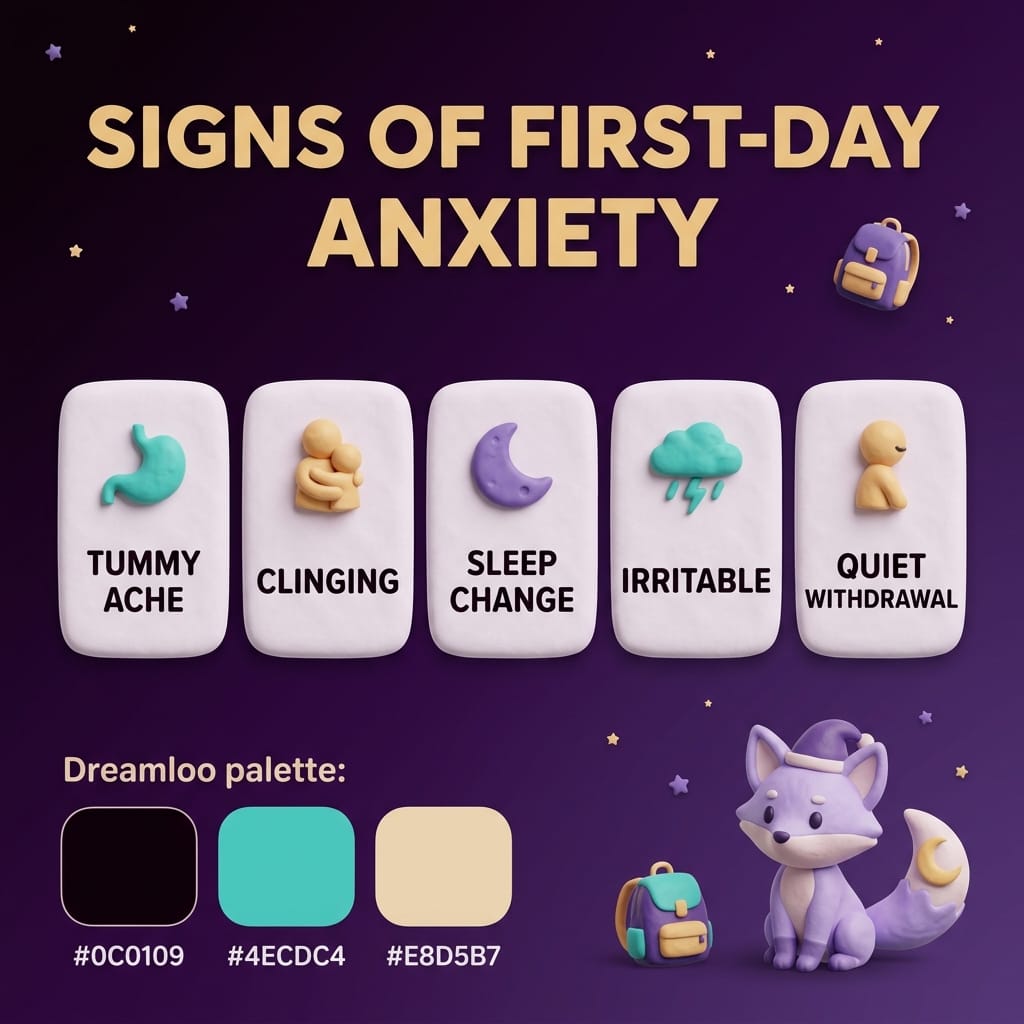
Young children often feel anxiety in the body before they can name it. The most common signs:
- Stomach aches, headaches, nausea. Real physical symptoms, not invented. Hallmark sign: they appear on school mornings and disappear by mid-morning or on weekends.
- Sleep changes. Trouble falling asleep, night wakings, early waking, or bad dreams the week before. For sleep that fragments during a transition, bedtime stories for anxious kids is the practical companion to this article.
- Clinging. Extra wanting to be held, not wanting you out of sight, needing to sleep in your bed. Often most intense in the 48 hours before.
- Irritability or sudden tears. Anxiety masquerades as anger in many kids, especially boys. A child who is suddenly "in a mood" all weekend may be holding worry.
- Quiet withdrawal. The kid who normally narrates everything goes silent. Less obvious than tears but a meaningful signal.
- Skill regression. Some young children temporarily lose recent gains — wetting the bed again, talking less, asking to be fed. Normal under transition stress, fades on its own.
- Repeated "what if" questions. What if I can't find my classroom? What if no one plays with me? What if I miss you? Each one is anxiety asking for reassurance.
If you see two or more in the week before school, your child is processing anxiety and benefits from the steps below.
What to do in the two weeks before
Predictability dissolves anticipatory anxiety. Two weeks of preparation does more than any single confidence speech.
- Make the unknown known. Visit the school if you can — playground, building, parking lot. If not, look at photos of the school and the classroom together. Drive or walk the route.
- Practice the morning routine. Three times in the week before, do a "rehearsal morning": wake up at the school-day time, get dressed, eat breakfast, get the backpack on, walk to the door. Familiarity removes friction on the real morning.
- Read about it and tell stories. Books about a small child starting school give a model. So do short bedtime stories where a brave character handles a first day — the positive-hero framing we covered in moral lessons in bedtime stories is exactly what works here.
- Talk in small, honest doses. Not a single big sit-down. Mention school briefly across the days — "On Tuesday you'll meet your teacher" — so the topic becomes ordinary, not loaded.
- Acknowledge feelings, do not argue with them. "It is okay to feel nervous about something new. A lot of kids feel that way. I'll be right here at pickup." Skip "you'll love it!" — you do not know that, and the child knows you do not know.
- Strengthen sleep the week before. Lock the bedtime routine, dim screens early, protect wake times. A rested child handles anxiety far better than a depleted one.
- Plan a small comfort object. A photo in a pocket, a small token from home, a favorite plush at home for after-school. Transitional objects are well-documented anxiety helpers for school transitions.
The night before and the morning of
The night before, do almost nothing different from a normal night. Lay out clothes and the backpack so morning has no surprises. Keep the bedtime routine identical. Resist any "big talk" or final pep speech. The strongest signal you can send is calm normality.
The morning of:
- Wake calmly, slightly early. Hurry triggers stress; even ten extra minutes makes the morning gentler.
- Eat something, even small. An anxious child often does not want food. A bite of toast or a banana is enough to keep blood sugar from sharpening the anxiety further.
- Skip the pep speech. Match the energy you want — slow, steady, warm.
- Use the calm-goodbye script. At drop-off: kneel to eye level, one specific reassurance, one quick affection, leave confidently. Three lines is enough.
A goodbye script that works for most children:
"I love you. I always come back at pickup. Have a good morning."
Hug, smile, leave. Do not look back from the door. The hardest part of the calm goodbye is yours, not theirs — most children recover within minutes of separation, even when the goodbye is hard. The school staff sees this every single day; trust their feedback if they tell you your child settled.
Plant a brave story the night before. Dreamloo's personalized audio bedtime stories can put your child by name into a gentle story about a brave kid handling a first day — the positive-hero framing the research connects with actual behavior change. A calm story at lights-out beats a pep talk at the door.
What not to do
A few common moves quietly make things worse.
- Don't sneak out. The relief is yours; the cost is your child's trust. The next separation will be worse.
- Don't linger. Extending the goodbye stretches the most painful moment. Short and warm beats long and emotional.
- Don't dismiss feelings. "You're fine, there's nothing to worry about." The child's body says otherwise. Dismissal teaches them not to share next time.
- Don't over-question after. How was it? Did you make friends? Were you scared? Did you eat your snack? A barrage of questions on a tired, dysregulated child often gets a flat "fine" or tears. Open-ended, low-pressure works better — "Tell me one thing about today, whenever you want."
- Don't make the deal. Avoid promising rewards for going to school. It frames school as a thing to be endured for the prize at the end, and once the rewards stop, the anxiety often comes back stronger.
When to call the pediatrician
Most first-week anxiety resolves on its own. Call your pediatrician — or your child's school counselor — if you see:
- Persistent refusal to attend school after the first two to three weeks.
- Panic-level distress at drop-off that does not settle within the morning, every day for more than a few days.
- Severe somatic symptoms — sustained stomach pain, vomiting, headaches — that do not have a clear medical cause and that persist beyond the transition window.
- Major regression in toileting, talking, eating, or sleeping that does not resolve in one to two weeks.
- Strong, specific fears (a bully, a teacher, a single situation) that escalate rather than settle.
- Family history of anxiety disorders combined with marked, persistent symptoms — early support is well evidenced to help (Ginsburg, 2009).
These can point to school refusal, separation anxiety disorder, or other treatable concerns. Cognitive-behavioral approaches have strong evidence in school anxiety and refusal in children (Last, Hansen, & Franco, 1998). Early support is far more effective than waiting it out.
Common Questions from Parents
My child was fine and is now suddenly anxious mid-year — is that normal?
It can be. Anxiety can flare during the year for many reasons: a friendship change, a new teacher, a hard subject, a frightening event at school, or sometimes nothing identifiable. Treat a mid-year flare the same way as a first-day one — listen, acknowledge, look at sleep and routine, and use a calm goodbye script if separation has resurfaced. If the flare lasts more than a couple of weeks or includes serious distress, contact the school counselor and your pediatrician. Mid-year anxiety often points to a specific cause that can be addressed once identified.
Should I let my child stay home if they say they don't feel well?
Generally, no — unless there are clear medical signs (fever, vomiting unrelated to mornings, real illness symptoms). Staying home reliably reinforces the avoidance loop: brain learns that anxiety + protest = escape, and the next morning gets harder. The exception is genuine illness. For ambiguous "tummy aches" that consistently disappear by mid-morning, the gentle but firm answer is school, with extra warmth at drop-off. Talk to your pediatrician if you are unsure whether physical symptoms are anxiety or illness.
My child cries at drop-off every day for weeks — is something wrong?
It is on the line worth checking. Many children cry at drop-off for the first week or two and settle quickly after you leave; that is normal. Daily crying that continues past 2–3 weeks, especially if the school reports they do not settle for the morning, warrants a conversation with both the teacher and the pediatrician. The first step is usually data from the school: what happens in the ten minutes after drop-off? Often it is much better than the parent sees. If it is not, that is useful information for next steps.
Should younger siblings be at drop-off?
If logistics allow, drop-off is easier without an audience. A younger sibling adds noise, hurry, and an additional emotional cue your anxious child is processing on the doorstep. Either a quick efficient drop with the sibling in the car or having the other parent handle the sibling separately gives the anxious child the small, focused goodbye they need. This is a temporary, transition-period adjustment, not a permanent rearrangement.