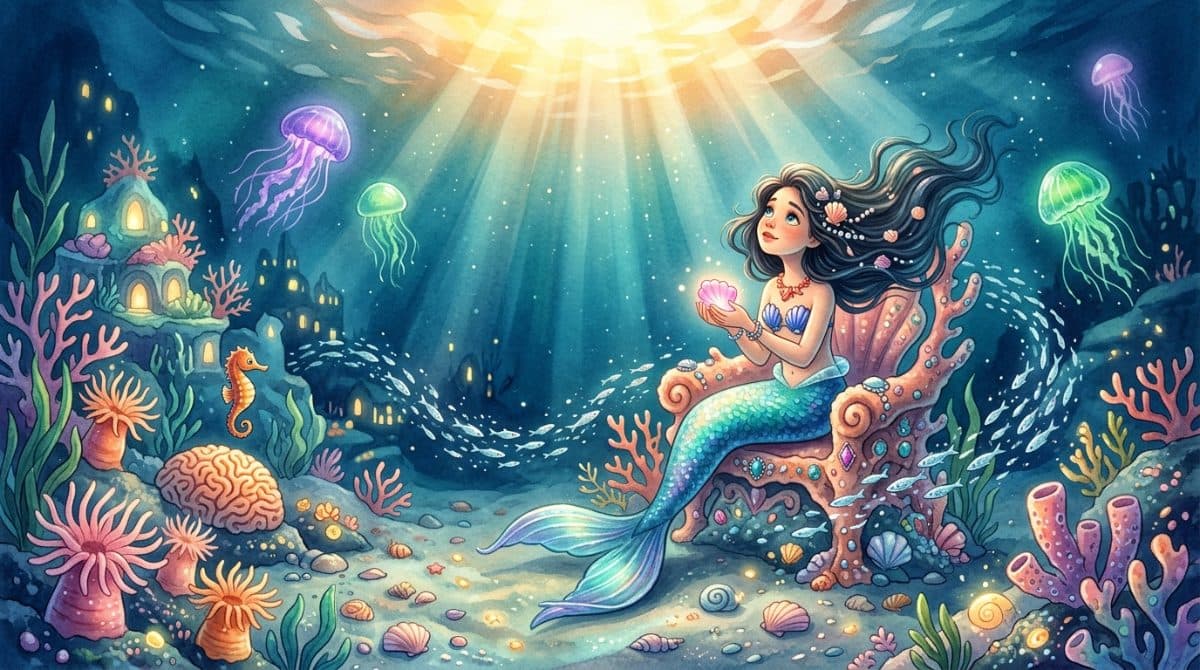
The Little Mermaid
The Mermaid Who Listened to the Surface
Deep beneath the waves, where the sunlight turns green and then blue and then disappears altogether, there was a kingdom made of coral and pearl. The palace had walls of living shell that opened and closed with the tide. The gardens grew sea-flowers that glowed in the dark — purple and silver and a blue so deep it had no name.
Coral lived there. She was the youngest of six sisters, and the quietest — not because she had nothing to say, but because she preferred to listen. She listened to the whale songs that vibrated through the water like slow thunder. She listened to the shrimp clicking in the reef. She listened to the tide pulling and pushing, pulling and pushing, like the ocean breathing.
But the sound she loved most came from above. From the surface.
It was muffled and strange — splashing, and laughter, and sometimes music carried down by the current. The sound of a world she had never seen.
Her sisters had all visited the surface. Each one, on her fifteenth birthday, was allowed to swim up and look. Each one came back with stories — of ships and stars and a thing called "fire" that danced on sticks and was apparently very exciting.
Coral waited. She waited five long years while her sisters swam up one by one and came back with wider eyes.
On the morning of her fifteenth birthday, she swam straight up. Past the twilight zone. Past the schools of silver fish. Past the place where the water goes from blue to green to gold.
She broke the surface.
The sky was ENORMOUS. She had known it would be big — her sisters had warned her — but knowing and seeing are different countries. The sky stretched in every direction, pink and orange at the edges where it met the sea. And above — stars. Not the bioluminescent glow of jellyfish, but sharp, white, burning points of light that went on forever.
And there, floating on the water, was a ship. Lanterns hung from its masts. Music drifted down. People danced on the deck — laughing, spinning, their feet making sounds she had never heard. Thump-thump-thump. Like a heartbeat made of wood.
A boy stood at the railing, looking out at the sea. He was about her age. His hair blew in the wind. He was smiling at nothing — at the water, at the sky, at the bigness of it all. Coral understood that smile. She made it too, sometimes, when the whale songs were particularly beautiful.
She watched the ship until it sailed away. Then she floated alone in the dark water, staring at the stars, feeling something new and uncomfortable in her chest — a pulling, like the tide, but inward. Toward the surface. Toward the sky. Toward a world that didn't belong to her.
"I want to go up there," she told her grandmother, who was very old and very wise and had barnacles on her tail.
"You can visit," her grandmother said. "But you cannot stay. The surface is not made for us."
"What if I could BECOME like them?"
Her grandmother's eyes went soft. "There is a sea witch who can give you legs. But the price is your voice. And if the boy does not love you within three days, you turn to sea foam."
Coral stared at the water around her. Her voice — the voice that listened to whale songs and tide patterns and the clicking of shrimp. The voice that was quiet, but HERS.
She swam to the edge of the kingdom, where the water grew cold and the coral turned black. The sea witch's cave glowed with a sickly green light.
But she didn't go in.
She sat at the edge of the cave and listened. Not to the witch. To herself.
The surface was beautiful. The stars were sharp. The boy's smile was real.
But the whale songs were real too. And the glowing gardens. And the shrimp clicking in the reef, and her sisters' laughter, and the palace walls breathing with the tide.
She had spent her whole life listening. And now, sitting in the cold dark at the edge of a witch's cave, she heard something she had never heard before — her own voice, saying clearly and quietly: "I don't want to give up what I am to become something I'm not."
She swam home.
Her grandmother said nothing. Her sisters said nothing. They didn't need to — they held her, all six of them, in a tangle of tails and arms and hair, and the water was warm and the palace glowed.
But Coral didn't stop visiting the surface. On clear nights, when the stars pressed close to the water, she would float just below and listen — to the ships, to the music, to the laughter. She collected surface sounds the way some people collect shells.
And one night — a night when the sea was perfectly still and the sky was perfectly clear — she sang.
Not loudly. Not for anyone to hear. Just... the sounds she had collected, woven together — the thump of feet on wood, the splash of oars, the wind through sails — all hummed in her own voice, her underwater voice, the one she had almost given away.
A whale passing in the deep heard her and changed course. He surfaced nearby, his great eye level with hers.
"That's a new song," the whale said.
"I made it from the surface," Coral said.
The whale considered this. "It's good," he said. "It sounds like two worlds at once."
Coral smiled. Two worlds at once. Yes. That was exactly what it sounded like.
She dove back down, singing, and the song followed her — down through the green and the blue and the dark, all the way to her bed of soft sand and sea-glass, where her sisters were already sleeping and the palace walls breathed slowly in and out...
And the song settled around her like a blanket... made of starlight and whale song and the sound of the tide... pulling and pushing... pulling and pushing...
And Coral closed her eyes... in the deep, warm dark... where she belonged... and where the surface, if she listened very carefully, was never quite as far away as it seemed.
A bedtime retelling of Hans Christian Andersen's The Little Mermaid. A young mermaid named Coral dreams of the world above the ocean — but when she finally visits the surface, she discovers something unexpected: the world she already has is more extraordinary than the one she wished for. A gentle 7-minute audio fairy tale with a hopeful ending, perfect for children ages 5-7. Free to listen.
This version shows that wanting to explore is natural, but you don't have to give up who you are to experience the world — you can carry both worlds inside you.
No. This is based on Hans Christian Andersen's original 1837 fairy tale. It uses only public domain elements — no Disney characters, songs, or plot points.
For children ages 5 to 7.
Child Development
The benefits of reading to kids every night, in plain science. What 15 minutes of nightly stories actually do for vocabulary, the brain, empathy, sleep, and bond.
Stories & Reading
Should you read to your child or play an audio story? Brain research shows both activate the same regions. Here's when each works best — and how to combine them.
Screens & Tech
Screen-free activities for kids, sorted by age, for tired parents. Simple, low-effort play ideas to keep kids happy off screens, without guilt or boredom.
Sleep & Development
Calming activities before bed for kids, backed by science. A practical menu of wind-down routines that move a wired child from bouncing to drowsy in 20 minutes.
Beautifully narrated bedtime stories with soothing sounds to help your little ones drift off to sleep.
Join families who read with Dreamloo. Free stories, sleep tips, and early access to the app.
No spam. Unsubscribe anytime.