Rapunzel
The Girl Who Sang Her Way Down
The tower had no door. That was the point.
Dame Gothel had built it that way — smooth stone, no handholds, no stairs, no way in and no way out except the single window at the very top. She had put Rapunzel there when the girl was three, and Rapunzel had not left since.
Rapunzel didn't remember her parents. She remembered Gothel's voice — sharp, certain, always right. And she remembered the tower, which was all she knew.
The tower was round. It had one room with a bed, a table, a comb, and a window. The window showed the world — meadows and mountains and a forest that turned orange in autumn and white in winter and green in spring. Rapunzel watched it change and change and change, and sometimes she forgot she was watching and felt like she was IN it, running through the meadow, touching the trees, feeling the wind.
But she was not in it. She was in the tower.
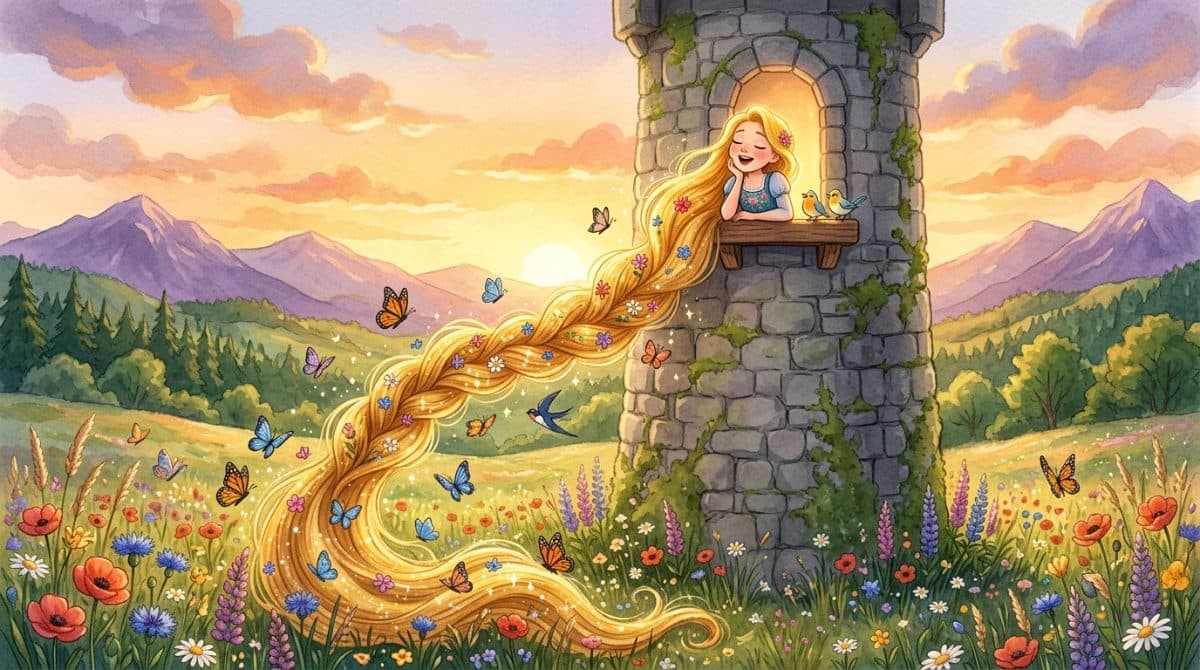
Her hair grew. And grew. And grew. Not normal growing — enchanted growing. By the time she was twelve, it reached the ground from the window. By fifteen, it pooled in the meadow below like a golden river. Gothel used it as a rope — she would stand at the base and call "Rapunzel, Rapunzel, let down your hair!" and Rapunzel would lower her braid and Gothel would climb.
It hurt. Rapunzel never said so, because Gothel didn't like complaints, and because pain you've had since childhood starts to feel normal.
The one thing Gothel hadn't counted on was the singing.
Rapunzel sang to fill the silence. She sang because the tower was quiet and her voice bounced off the round walls and came back to her changed — fuller, richer, like the tower itself was harmonizing. She sang songs she'd heard Gothel hum. She sang songs the birds brought from the forest. She sang songs she made up herself — about the meadow she could see but not touch, the rain she could hear but not feel.
Her voice carried. Over the meadow. Into the forest. Down to the village where people would stop what they were doing and listen, not quite sure where the sound was coming from, only that it made them feel something they couldn't name.
A boy from the village followed the sound. His name was Finn, and he was a beekeeper's son who had no business climbing through enchanted meadows except that the singing pulled him the way honey pulls bees — without asking.
He found the tower. He heard Rapunzel's voice pouring from the window like liquid gold. He sat at the base and listened until sunset. Then he came back the next day. And the next.
"Who's there?" Rapunzel called one evening, because she could hear breathing below.
"Someone who likes your singing," Finn called back. "My name is Finn. I keep bees."
"What are bees?"
This was such a surprising question that Finn spent the next hour explaining bees, and honey, and flowers, and the way a hive hums — which, Rapunzel thought, sounded a lot like her tower when she sang.
They talked every evening. Finn sat at the base. Rapunzel leaned from the window. He told her about the village — the baker, the blacksmith, the market on Thursdays. She told him about the tower — the way the light moved across the wall in the morning, the birds that nested on the windowsill, the exact number of stones she could see from her bed (four hundred and twelve).
"Why don't you leave?" Finn asked.
"There's no door."
"Your hair reaches the ground."
Rapunzel looked at her braid, coiled on the floor of the tower like a sleeping golden snake. She had never thought of it as a way DOWN. Only ever as a way for Gothel to come UP.
It took her three days to work up the courage. Not because climbing was hard — because leaving was. The tower was all she knew. The stones, the window, the four hundred and twelve visible from her bed. Leaving meant choosing the unknown over the known, which is the hardest kind of bravery.
On the fourth morning, before Gothel's daily visit, Rapunzel tied her braid to the bedpost. She tugged it. It held. She climbed onto the windowsill.
The world was enormous. She had seen it from above for fifteen years, but seeing it from INSIDE was different — the way hearing a song is different from singing it.
She climbed down. Hand under hand, feet bracing against the stone, her hair rough against her palms. The wind hit her face — real wind, not window wind — and it smelled of grass and earth and something sweet that Finn later told her was clover.
Her feet touched the ground. Real ground. She stood in the meadow with her golden hair piled around her like a nest, barefoot, shaking, free.
Finn was there. He had brought a jar of honey, which seemed like a strange welcome gift but turned out to be exactly right, because Rapunzel had never tasted honey and her face when she did was the kind of face that Finn would remember for the rest of his life.
"It tastes like your singing sounds," Finn said, then immediately turned red, because that was the most embarrassing thing he had ever said.
Rapunzel laughed. She had never laughed outside before. The sound didn't bounce off walls — it went UP, into the sky, and didn't come back.
Gothel returned that afternoon. She stood at the base of the tower and called the words she had called every day for twelve years. "Rapunzel, Rapunzel, let down your hair!"
The braid hung from the window, tied to the bedpost, swaying in the breeze. But nobody was holding it. Nobody was at the top.
Gothel understood. She stood very still for a long time. Then she turned and walked into the forest. Nobody saw her again.
Some people said she went looking for another tower. Others said she simply got lost, which is easy to do in a forest when you are the kind of person who locks girls in towers — the world tends to stop helping you find your way.
Rapunzel cut her hair. Finn gave her his kitchen scissors, which were not ideal for the task, and the result was uneven and slightly ridiculous and absolutely perfect.
"It's so LIGHT," Rapunzel said, shaking her head and feeling the short ends bounce around her face. She had been carrying that weight for fifteen years. Her neck ached. Her scalp ached. She hadn't known, because you don't notice a weight you've carried your whole life until someone shows you what it feels like to put it down.
She stayed in the village. She sang — not from a tower, but from the ground, in the market on Thursdays, next to the baker and the blacksmith and Finn's beehives. People came from far away to listen. Not because the singing was better — it was the same voice, the same songs — but because singing in the open, with the wind taking your voice wherever it wanted, sounds different from singing in a tower.
It sounds free.
That night — her first night outside — Rapunzel lay in the grass and looked up. No ceiling. No stones. Just the sky, so wide it made her dizzy, and more stars than she had ever seen through her single window.
Finn sat nearby, not talking, because some moments don't need words. A bee buzzed past. The meadow hummed the way meadows do when the day is ending and the earth is warm and everything is settling down for the night.
And Rapunzel closed her eyes... not in a tower... not behind stone... but in the open air, with the grass against her back and the stars above and the wind touching her short, uneven, wonderfully light hair...
And she didn't sing. For the first time in years, she didn't need to fill the silence. Because the silence was full already... full of crickets and wind and the low hum of sleeping bees...
And it was enough... more than enough... it was everything.
A bedtime retelling of Rapunzel by the Brothers Grimm. A girl locked in a doorless tower by an enchantress has only her voice and her hair. In this version, no prince rescues her — Rapunzel rescues herself, using the one thing the enchantress never thought to take away: her singing. A 7-minute audio fairy tale for children ages 5-7. Free to listen.
Freedom starts with choosing to climb down — and the weight you've carried your whole life is the hardest to notice and the best to put down.
No. Rapunzel rescues herself. Finn (a beekeeper's son, not a prince) is a friend who shows her the world exists — but she makes the choice to leave on her own.
Ages 5 to 7.
Child Development
The benefits of reading to kids every night, in plain science. What 15 minutes of nightly stories actually do for vocabulary, the brain, empathy, sleep, and bond.
Sleep & Development
Calming activities before bed for kids, backed by science. A practical menu of wind-down routines that move a wired child from bouncing to drowsy in 20 minutes.
Sleep & Development
Sleep regression ages explained — the 4-month, 8–10-month, 12-month, 18-month, and 2-year stages, why they happen, how long they last, and what to do.
Stories & Reading
Should you read to your child or play an audio story? Brain research shows both activate the same regions. Here's when each works best — and how to combine them.
Beautifully narrated bedtime stories with soothing sounds to help your little ones drift off to sleep.
Join families who read with Dreamloo. Free stories, sleep tips, and early access to the app.
No spam. Unsubscribe anytime.