Robin Hood
The Outlaw Who Shared Everything
Robin was good at three things: shooting arrows, climbing trees, and getting into trouble. The first two were useful. The third was unavoidable, because Robin had a problem — he could not watch unfair things happen without doing something about them.
This is an excellent quality in a hero and a terrible quality in someone who would like a quiet life.
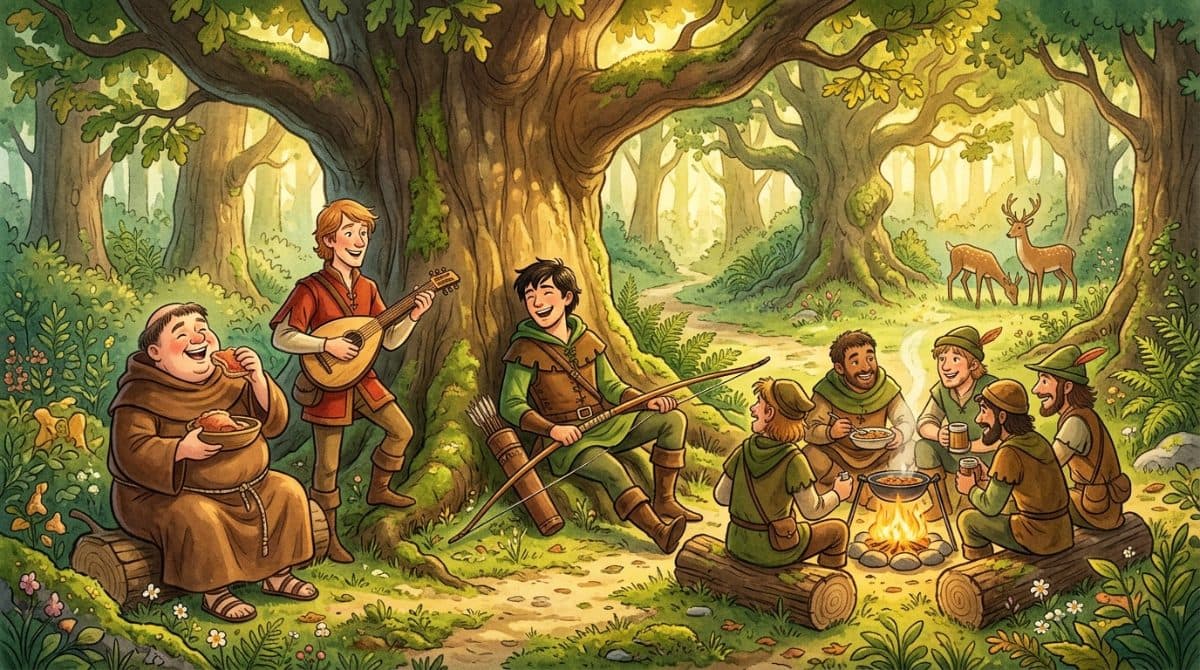
He lived in Sherwood Forest with a band of friends who called themselves the Merry Men, even though not all of them were men and not all of them were merry all the time. There was Little John, who was enormous and gentle and could carry a full-grown deer across a river without getting his hat wet. There was Friar Tuck, who loved three things: God, food, and arguments — in that order, unless it was lunchtime. And there was Marian, who was a better archer than Robin and reminded him of this whenever he got too pleased with himself, which was often.
They lived under the trees, slept on beds of ferns, and cooked over open fires that smelled of wood smoke and roasting venison and the particular kind of happiness that comes from eating outside.
The problem was the Sheriff.
The Sheriff of Nottingham was not evil. He was worse — he was GREEDY. He taxed the farmers until their pockets were empty. He taxed the bakers until the bread was thin. He taxed the millers and the cobblers and the candlemakers, and when there was nothing left to tax, he taxed the NOTHING and charged them for the air.
Robin decided this was not acceptable.
"We can't fight the Sheriff," Little John said. "He has soldiers."
"We can't reason with the Sheriff," Friar Tuck said. "He has lawyers."
"We can outsmart the Sheriff," Marian said. "He doesn't have brains."
The plan was Marian's. Because the best plans always were.
The Sheriff was holding an archery contest in Nottingham — first prize: a golden arrow. Every archer in the county would be there. Including the Sheriff's guards. Which meant the Sheriff's castle would be nearly EMPTY.
"I'll enter the contest," Robin said. "As a disguise. While the guards watch me, you and Little John sneak into the castle and take back what the Sheriff stole."
"The taxes?"
"The FLOUR. The grain. The food. Everything he took from people who needed it."
"And what do we do with it?"
Robin grinned. The kind of grin that made Little John nervous. "We give it back."
Robin disguised himself. He dirtied his face, borrowed a ratty cloak from Friar Tuck, and wrapped his bow in rags. He entered the contest as "Tom the Tinker," a name he made up on the spot and immediately wished he'd thought harder about.
The contest had forty archers. By the third round, there were ten. By the fifth, three. And in the final round — one shot, at a target so far away it was barely a dot — it came down to Robin and the Sheriff's best man.
The Sheriff's man shot first. The arrow struck the edge of the target. The crowd cheered.
Robin raised his bow. He breathed. He thought of the family whose flour had been taken. He thought of the baker whose bread was thin. He thought of the candlemaker who couldn't afford her own candles.
The arrow sang. It split the Sheriff's man's arrow clean in half and buried itself in the dead center of the target.
The crowd went silent. Then they ERUPTED.
The Sheriff squinted at "Tom the Tinker." Something about the shot was familiar. Something about the grin was VERY familiar.
But by the time the Sheriff put it together, Marian and Little John were already three miles into Sherwood Forest with four carts of flour, six sacks of grain, and a wheel of cheese that Friar Tuck had "accidentally" liberated from the pantry.
Robin collected the golden arrow, bowed deeply to the furious Sheriff, and disappeared into the crowd like smoke into sky.
That night, Sherwood Forest glowed. Robin and the Merry Men drove the carts to every village, every farm, every door. They left sacks of flour on doorsteps. They poured grain into empty bins. They gave the cheese to the baker's wife, who cried, because she hadn't been able to bake proper bread in weeks.
Nobody saw them. That was the point. The giving was the thing, not the credit.
By midnight, the carts were empty and the forest was quiet. The Merry Men sat around the fire — tired, dirty, grinning. Friar Tuck said a blessing. Little John roasted something that smelled incredible. Marian sat next to Robin and poked the fire with a stick.
"The Sheriff will come for us," she said.
"Probably."
"We'll need a better plan next time."
"Probably."
"I'll make it."
"Definitely."
The fire crackled. The stars pressed through the canopy — a thousand tiny lights, like the windows of a city that only existed overhead.
Robin leaned back against the great oak. His bow rested across his knees. Little John was already snoring. Friar Tuck was singing something very quietly that might have been a hymn or might have been a song about cheese — it was hard to tell.
Marian leaned against the other side of the oak. "Robin?"
"Mm."
"The golden arrow. Where is it?"
Robin smiled. "I left it on the baker's doorstep. With the flour."
"You gave away the PRIZE?"
"It was just an arrow. The flour was more useful."
The forest breathed... the fire dimmed to embers... and the Merry Men slept under the great oaks of Sherwood, wrapped in cloaks and starlight...
And the villages below were quiet... and the doorsteps had flour... and the baker's wife was already mixing dough for tomorrow's bread...
And somewhere in the dark, an owl called... and the wind moved through Sherwood like a whisper... like a secret shared between trees... like the sound of someone doing the right thing... when nobody was watching...
And Robin slept... his bow across his knees... the forest holding him... the way forests do... gently... and without asking for anything... in return.
A bedtime retelling of Robin Hood, the legendary outlaw of Sherwood Forest. When a young archer named Robin sees the Sheriff's men take a family's last sack of flour, he decides to do something about it — not with arrows, but with cleverness, a disguise, and a pie. A 7-minute adventure story about fairness and sharing for children ages 5-7. Free to listen. Based on traditional English folklore (public domain).
True heroism is sharing what you have with those who need it — and the best kind of giving is the kind nobody sees.
Yes. Robin Hood legends are English folklore dating back to the 13th century.
Ages 5 to 7.
Child Development
The benefits of reading to kids every night, in plain science. What 15 minutes of nightly stories actually do for vocabulary, the brain, empathy, sleep, and bond.
Stories & Reading
Should you read to your child or play an audio story? Brain research shows both activate the same regions. Here's when each works best — and how to combine them.
Screens & Tech
Screen-free activities for kids, sorted by age, for tired parents. Simple, low-effort play ideas to keep kids happy off screens, without guilt or boredom.
Sleep & Development
Calming activities before bed for kids, backed by science. A practical menu of wind-down routines that move a wired child from bouncing to drowsy in 20 minutes.
Beautifully narrated bedtime stories with soothing sounds to help your little ones drift off to sleep.
Join families who read with Dreamloo. Free stories, sleep tips, and early access to the app.
No spam. Unsubscribe anytime.